Alabama Social Studies SS24.5.6a
The Standard
- SS24.5.6
- Identify the contributions of Alabamians to sports, film, and the arts during the early twentieth century, the Harlem Renaissance, and the Jazz Age.
Explain how overcropping, the boll weevil, and low cotton prices affected farmers in Alabama.
2024 Alabama Course of Study: Social Studies
Teacher's field guide
What This Standard Means
What Students Need to Do
- Students explain how growing cotton on the same land year after year wore out the soil and cut harvests. They describe how boll weevils damaged cotton. They explain why low cotton prices meant less money for farmers.
What Mastery Looks Like
- Given a short account of an Alabama cotton farm, a student can identify each problem and explain its effect. They can explain why a farmer might struggle to buy seed or repay a loan.
Common Misconceptions
- Some students think planting more cotton on the same field always means a bigger harvest. Others confuse insect damage with worn-out soil. They may assume a good harvest always brings good earnings, even when cotton sells for little.
How to Assess It
- Exit ticket: A farmer grows cotton on the same field for years, weevils destroy some bolls, and cotton sells for less per pound. Explain how each problem changes the farmer's harvest or income.
Lesson moves
Ways to Teach It
Give pairs 12 cotton tokens; remove four for depleted soil and three for weevils, then compare earnings at $2 and $5 per token.
Write a two-sentence letter from a cotton farmer to a lender explaining why a smaller harvest and low prices make a loan hard to repay.
Sort six cards into cause-effect pairs: repeated planting, thin soil, weevils, damaged bolls, low prices, and lower earnings.
Using farmers market prices, calculate what a grower earns from ten baskets at $5 each versus $2 each.
Free download
Printable SS24.5.6a Worksheet
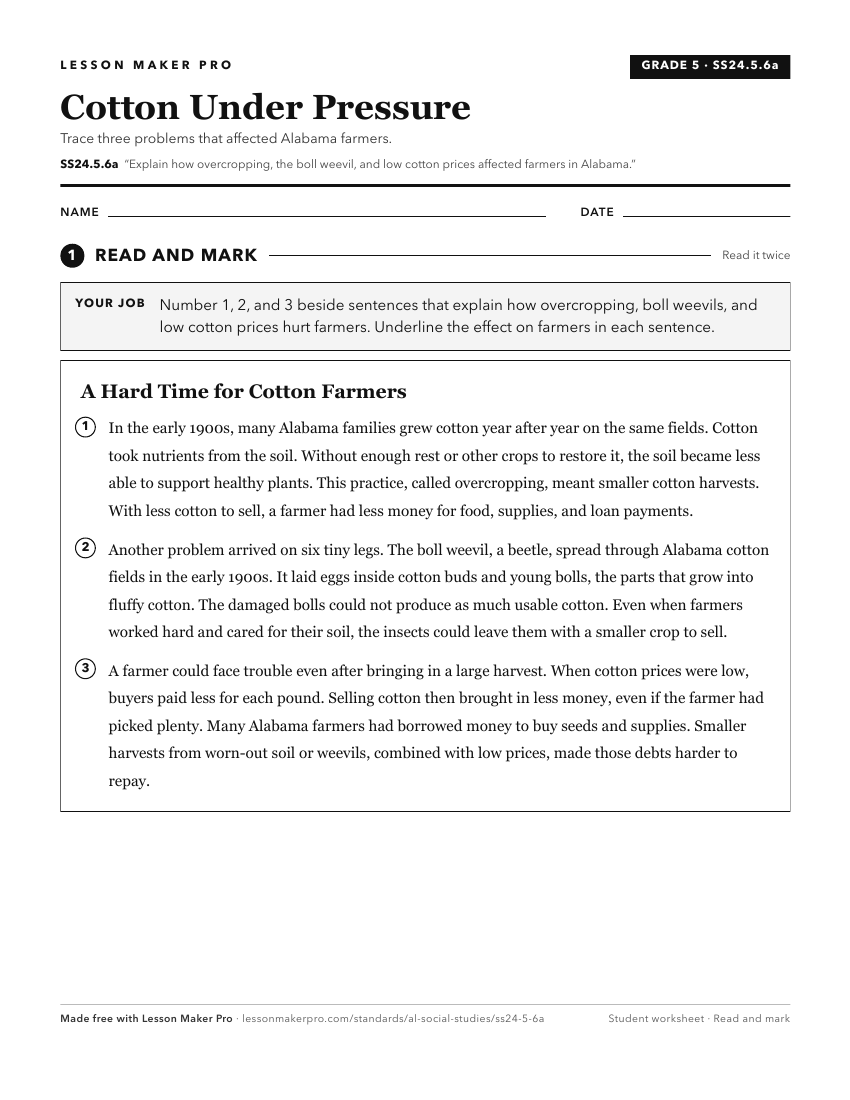
A ready-to-print activity worksheet aligned to SS24.5.6a, with an answer key for the teacher on its own page. No account needed.
PDF, US Letter, prints cleanly in black and white.
Download the worksheetKeep exploring
Related Standards
- SS24.US1.11c
Describe how Alabamians were impacted by growing sectionalism from 1832 to 1861, including the reliance on cotton and slave labor, the Second Creek War, and sec...
- SS24.4.16a
Describe how industry, trade, farming, and the rise of Populism changed Alabama after the Civil War and shaped its economy and communities in the late 1800s.
- SS24.5.7a
Explain how the Great Depression impacted Alabamians and the nation, including increased labor tensions.
- SS24.5.11b
Describe the decline of farming and the growth of urban areas in Alabama after World War II.
Turn this exact standard into a lesson
Grade, subject, topic, and the complete standard are prefilled. Create one free, no account needed.
Also for this standard:Make a WorksheetMake a QuizMake a Sub Lesson