Alabama Social Studies SS24.5.11a
The Standard
- SS24.5.11
- Describe how the United States’ economy grew and American culture changed after World War II.
Identify Alabamians who contributed to the growth of American culture post-World War II into the 1970s.
2024 Alabama Course of Study: Social Studies
Teacher's field guide
What This Standard Means
What Students Need to Do
- Students name Alabamians who shaped American music, books, sports, and civil rights after World War II. They connect each person to a specific contribution and explain its reach beyond Alabama.
What Mastery Looks Like
- A student can identify Nat King Cole's television show, Harper Lee's novel, and Rosa Parks's role in the Montgomery bus boycott. They can explain how each influenced Americans in a different way.
Common Misconceptions
- Students may think culture means music alone and miss books, sports, and civil rights. Some place the Montgomery bus boycott during World War II or say Rosa Parks organized it alone.
How to Assess It
- Exit ticket: Name two Alabamians who made contributions between 1945 and the 1970s. For each, write what they did and how it reached people beyond Alabama.
Lesson moves
Ways to Teach It
Have pairs match Harper Lee, Nat King Cole, Rosa Parks, and Willie Mays to photos of a book, TV show, boycott, or baseball game.
Ask, 'How did Harper Lee's novel and Rosa Parks's role in the Montgomery bus boycott influence Americans in different ways?'
Play four-corners with signs for books, music, sports, and civil rights; read clues about the four Alabamians and have students move.
Search a public library catalog for Harper Lee's novel; ask how readers today still find an Alabama author's 1960 book.
Free download
Printable SS24.5.11a Worksheet
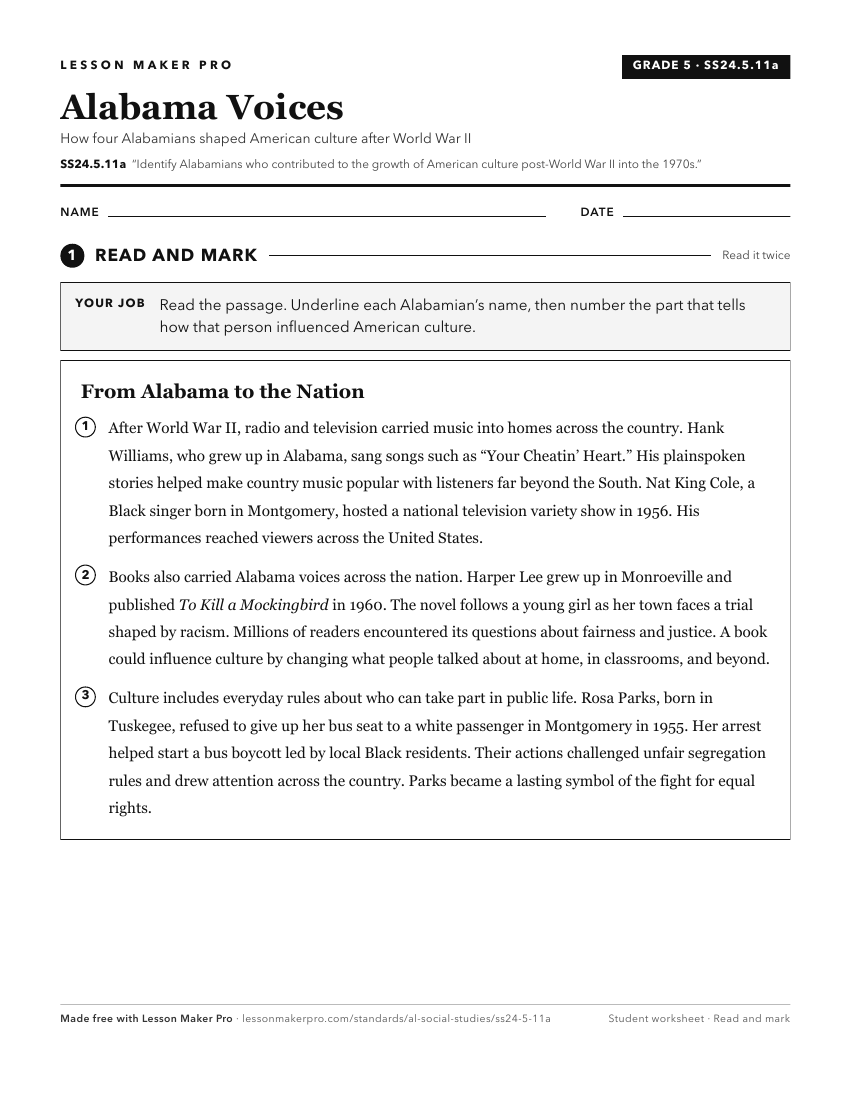
A ready-to-print activity worksheet aligned to SS24.5.11a, with an answer key for the teacher on its own page. No account needed.
PDF, US Letter, prints cleanly in black and white.
Download the worksheetKeep exploring
Related Standards
- SS24.5.12e
Identify Alabamians who contributed to concurrent civil rights movements in the United States during the decades following World War II.
- SS24.5.6
Identify the contributions of Alabamians to sports, film, and the arts during the early twentieth century, the Harlem Renaissance, and the Jazz Age.
- SS24.US2.10e
Describe how key Alabamians provided leadership, generated change, or demonstrated resistance to the Civil Rights Movement.
- SS24.4.15d
Recount the contributions of Alabamians who helped shape their state during Reconstruction.
Turn this exact standard into a lesson
Grade, subject, topic, and the complete standard are prefilled. Create one free, no account needed.
Also for this standard:Make a WorksheetMake a QuizMake a Sub Lesson