Alabama Social Studies SS24.US2.10e
The Standard
- SS24.US2.10
- Evaluate the influence of events, organizations, and individual actions on the expansion of the Civil Rights Movement nationally.
Describe how key Alabamians provided leadership, generated change, or demonstrated resistance to the Civil Rights Movement.
2024 Alabama Course of Study: Social Studies
Teacher's field guide
What This Standard Means
What Students Need to Do
- Students identify Alabamians who worked for civil rights and others who opposed them. They explain what each person did and what happened as a result.
What Mastery Looks Like
- A student can describe how Rosa Parks's arrest helped start the Montgomery bus boycott and how Fred Shuttlesworth organized protests in Birmingham. They can explain that George Wallace tried to block Black students from enrolling at the University of Alabama, but did not stop them.
Common Misconceptions
- Students may say Parks acted only because she was tired, missing her years of organizing. They may think Wallace's schoolhouse door blockade kept Black students out permanently, though federal intervention let them enroll.
How to Assess It
- On an exit ticket, list Rosa Parks, Fred Shuttlesworth, and George Wallace. Ask students for one action and one result for each, plus whether the action advanced or opposed desegregation.
Lesson moves
Ways to Teach It
Give pairs cards for Parks's bus arrest, Shuttlesworth's Birmingham campaign, and Wallace's schoolhouse door blockade; tape them to a dated timeline.
Ask: What changed after Parks's arrest, and what did Wallace try to prevent at the university? Use one event to support each answer.
Play a matching game: pair Parks, Shuttlesworth, and Wallace with action and result cards, then have students explain their matches.
Use the Rosa Parks Museum website to draft a two-sentence visitor sign explaining how her arrest helped start the Montgomery bus boycott.
Free download
Printable SS24.US2.10e Worksheet
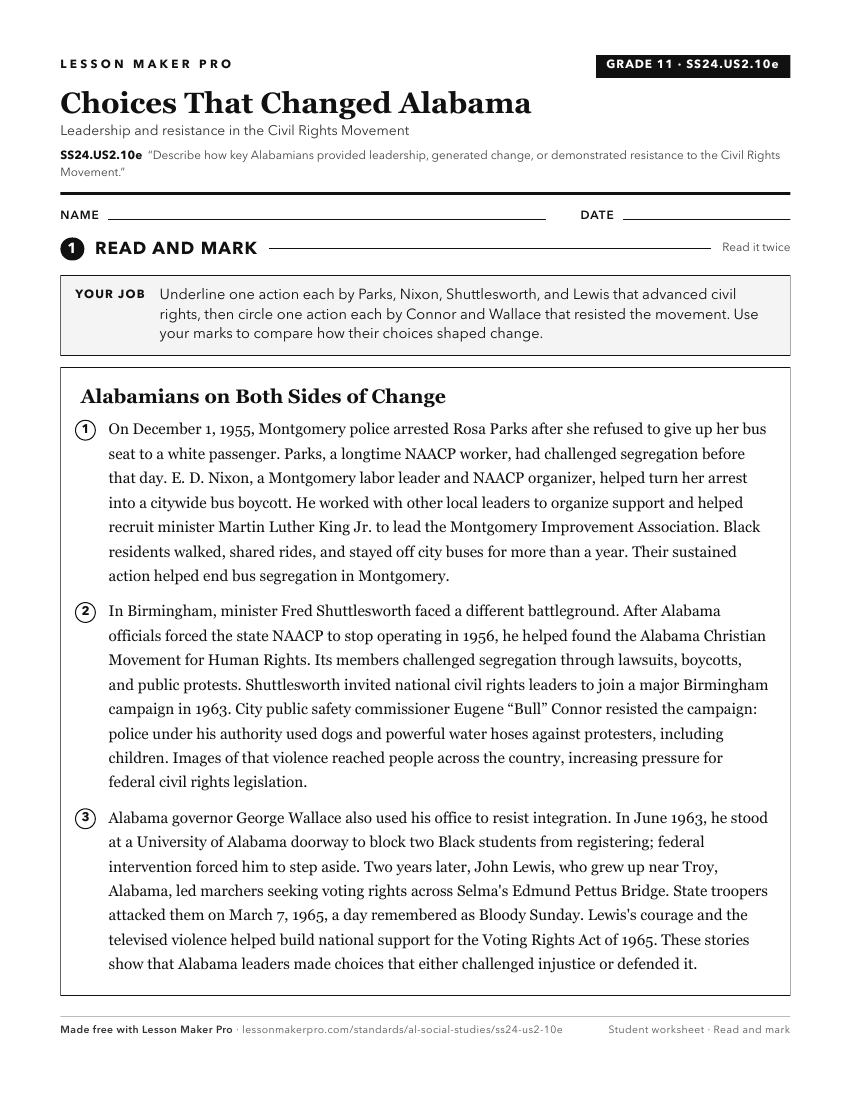
A ready-to-print activity worksheet aligned to SS24.US2.10e, with an answer key for the teacher on its own page. No account needed.
PDF, US Letter, prints cleanly in black and white.
Download the worksheetKeep exploring
Related Standards
- SS24.AS.16c
Identify civil rights leaders and foot soldiers in Alabama, and explain their contributions to fostering change in the state.
- SS24.5.12e
Identify Alabamians who contributed to concurrent civil rights movements in the United States during the decades following World War II.
- SS24.5.12c
Describe the contributions of Alabama leaders and foot soldiers of the Civil Rights Movement as well as other Alabamian supporters who aided their efforts.
- SS24.AS.16a
Describe how civil rights campaigns in Alabama were led by a coalition of local, grassroots organizations and national civil rights leaders and organizations.
Turn this exact standard into a lesson
Grade, subject, topic, and the complete standard are prefilled. Create one free, no account needed.
Also for this standard:Make a WorksheetMake a QuizMake a Sub Lesson