Alabama Social Studies SS24.WH.8a
The Standard
- SS24.WH.8
- Analyze the global cultural, economic, and political developments immediately following World War I.
Compare and contrast political ideologies that emerged in Europe following World War I, including communism, fascism, and social democracy.
2024 Alabama Course of Study: Social Studies
Teacher's field guide
What This Standard Means
What Students Need to Do
- Students compare how communism, fascism, and social democracy addressed problems after World War I. They look at who held power, who owned businesses, and whether people could oppose the government.
What Mastery Looks Like
- A student can explain that communism called for collective ownership, while fascism put the nation and its leader first. They can describe how social democrats sought reforms through elections and distinguish communist goals from Soviet rule.
Common Misconceptions
- Students may assume communism and fascism were the same because both produced one-party states. They may also mistake social democracy for Soviet communism, or assume fascists abolished private businesses.
How to Assess It
- On an exit ticket, ask: Which ideology best fits each policy, state ownership of factories, rule by a nationalist leader, or worker protections passed by an elected legislature? Have students name one difference between two of their answers.
Lesson moves
Ways to Teach It
Give pairs policy slips about factories, elections, and opposition; have them sort the slips into three ideology columns.
Ask students to write: Why might a worker after World War I support social democracy instead of communism?
Play a matching round with policy cards, then ask students to defend each match with one clue from the card.
Show a current news headline about public health care and ask why one policy cannot identify a government's whole ideology.
Free download
Printable SS24.WH.8a Worksheet
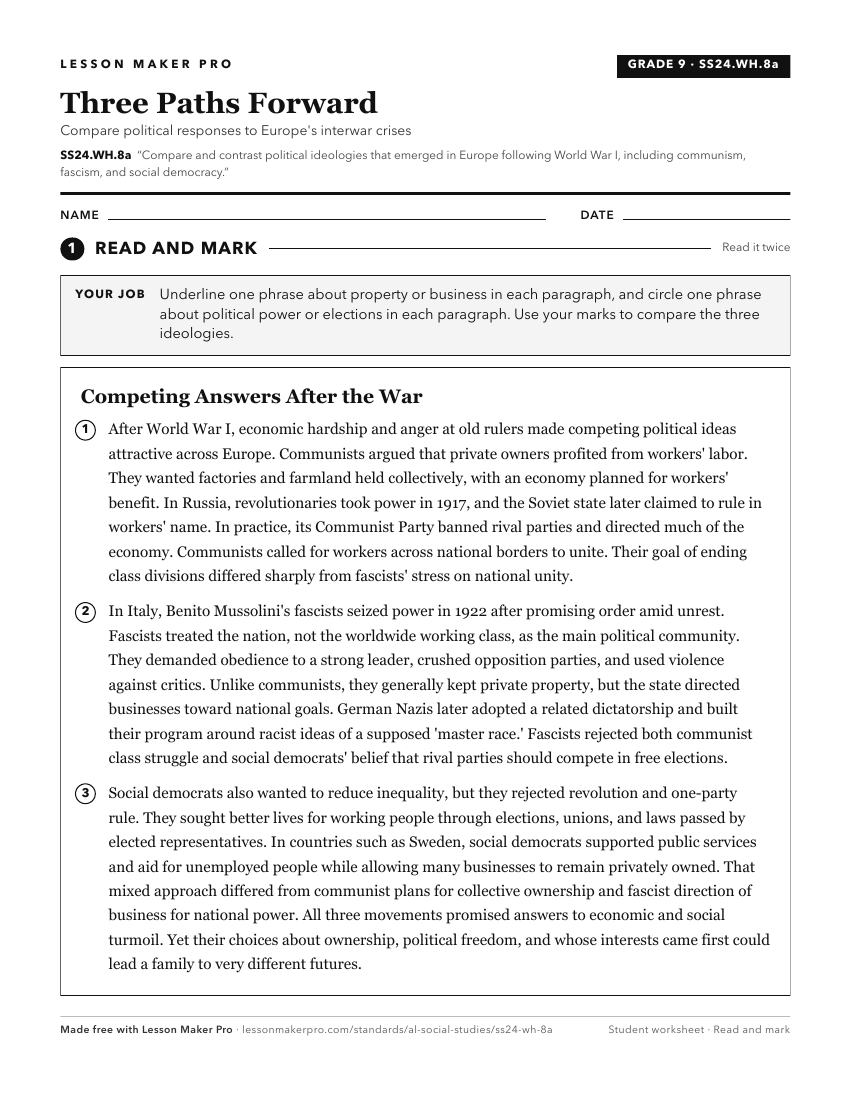
A ready-to-print activity worksheet aligned to SS24.WH.8a, with an answer key for the teacher on its own page. No account needed.
PDF, US Letter, prints cleanly in black and white.
Download the worksheetKeep exploring
Related Standards
- SS24.5.9a
Compare totalitarianism and democracy as represented in the Axis and Allied powers prior to war in Europe.
- SS24.WH.8
Analyze the global cultural, economic, and political developments immediately following World War I.
- SS24.WH.13b
Compare political ideologies that existed within the United States, the Soviet Union, and People’s Republic of China after World War II.
- SS24.WH.4b
Compare the theories of capitalism, utilitarianism, socialism, and Marxism, including the philosophies of John Stuart Mill, Karl Marx, and Robert Owen.
Turn this exact standard into a lesson
Grade, subject, topic, and the complete standard are prefilled. Create one free, no account needed.
Also for this standard:Make a WorksheetMake a QuizMake a Sub Lesson