Alabama Social Studies SS24.WH.4b
The Standard
- SS24.WH.4
- Explain how changes associated with the Industrial Revolution affected the economies, societies, and politics of Europe.
Compare the theories of capitalism, utilitarianism, socialism, and Marxism, including the philosophies of John Stuart Mill, Karl Marx, and Robert Owen.
2024 Alabama Course of Study: Social Studies
Teacher's field guide
What This Standard Means
What Students Need to Do
- Students compare how private ownership, cooperative reform, and class revolution address factory work and wages. They explain how Mill judged choices by their effects on people's happiness, while Owen and Marx proposed different changes to society.
What Mastery Looks Like
- Given a low-wage factory case, students can explain how a capitalist owner, Mill, Owen, and Marx might respond. They use details such as private profit, overall happiness, cooperative ownership, and class conflict to support their answers.
Common Misconceptions
- Students may treat utilitarianism as a plan for owning factories, rather than a way to judge actions by their results. They may lump Owen and Marx together, missing Owen's cooperative experiments and Marx's call for class revolution. Some assume capitalism means factories cannot have rules.
How to Assess It
- Exit ticket: A factory owner cuts wages to raise profits. Explain how Mill, Owen, and Marx might respond, and state who owns the factory under capitalism.
Lesson moves
Ways to Teach It
Sort four factory-plan cards: private ownership, a cooperative mill, worker revolution, and rules chosen for overall happiness; match each to an idea or thinker.
Ask: Would Owen and Marx support the same fix for a factory paying low wages? Write two sentences explaining your answer.
Match three paraphrase slips, 'greatest happiness,' 'class struggle,' and 'cooperative mills,' to Mill, Marx, or Owen.
Compare a worker-owned grocery store with a privately owned one; list who makes decisions, sets pay, and receives profits at each.
Free download
Printable SS24.WH.4b Worksheet
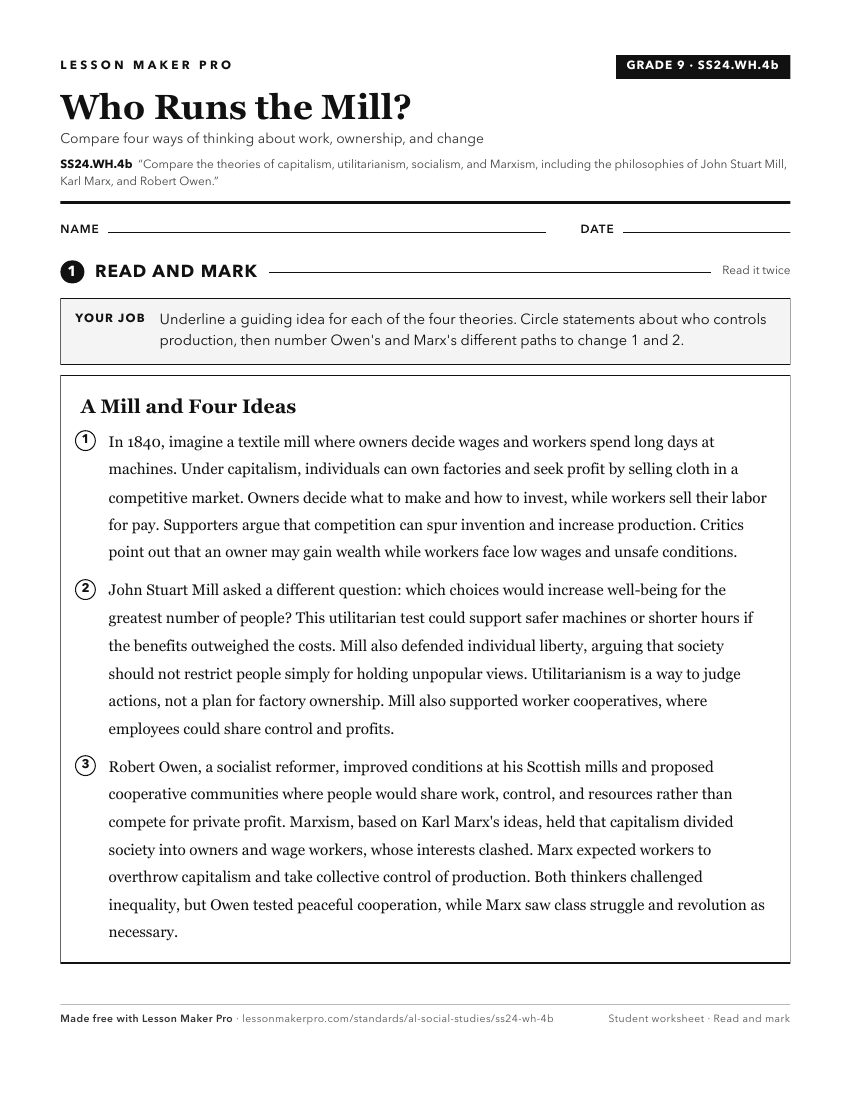
A ready-to-print activity worksheet aligned to SS24.WH.4b, with an answer key for the teacher on its own page. No account needed.
PDF, US Letter, prints cleanly in black and white.
Download the worksheetKeep exploring
Related Standards
- SS24.E.3c
Compare the ways that different economic systems address competition, consumer sovereignty, government regulation, private ownership, and profit motive.
- SS24.WH.1a
Compare and contrast the emerging ideas of Adam Smith, Jean-Jacques Rousseau, John Locke, Mary Wollstonecraft, Montesquieu, and Voltaire.
- SS24.E.3
Compare the methods that various economic systems use to allocate goods and services.
- SS24.S.3
Compare and contrast the three major sociological theories: functionalism, conflict theory, and symbolic interaction.*
Turn this exact standard into a lesson
Grade, subject, topic, and the complete standard are prefilled. Create one free, no account needed.
Also for this standard:Make a WorksheetMake a QuizMake a Sub Lesson