Alabama Social Studies SS24.E.3
Standard Cluster
Compare the methods that various economic systems use to allocate goods and services. 3a Describe the key elements of command, market, and mixed economic systems. 3b Research and share information illustrating how different economic systems answer the basic economic questions of what to produce, how to produce, and for whom to produce. 3c Compare the ways that different economic systems address competition, consumer sovereignty, government regulation, private ownership, and profit motive.
2024 Alabama Course of Study: Social Studies
Cluster contents
Standards in This Cluster
SS24.E.3 is a cluster heading. These are the individual standards under it.
- SS24.E.3a
Describe the key elements of command, market, and mixed economic systems.
- SS24.E.3b
Research and share information illustrating how different economic systems answer the basic economic questions of what to produce, how to produce, and for whom ...
- SS24.E.3c
Compare the ways that different economic systems address competition, consumer sovereignty, government regulation, private ownership, and profit motive.
Teacher's field guide
What This Cluster Means
What Students Need to Do
- Students identify who makes production and distribution decisions in command, market, and mixed economies. They find and share a country example, then explain what gets made, how it is made, and who gets it. They compare ownership, competition, consumer choice, government rules, and profit.
What Mastery Looks Like
- Given a short case, students identify the economic system and point to evidence, such as production quotas or private firms setting prices. They use a sourced example to explain who makes decisions and how those decisions affect access to a good.
Common Misconceptions
- Students may think a market economy has no government rules or that a command economy has no private trade. They may confuse consumer choice with being able to afford anything they want. They may assume every mixed economy uses the same balance of public and private decisions.
How to Assess It
- Give students two brief profiles: one with state-set production quotas and one with private firms setting prices under safety rules. Ask them to identify each system and compare who decides what to produce, how to produce it, and who gets it.
Lesson moves
Ways to Teach It
Give groups 20 paper snack coupons; use state quotas, buyer bids, or bids with price caps to allocate them.
Ask: “Who should get scarce concert tickets: highest bidders, lottery winners, or priority groups?” Have students defend one rule in writing.
Run a card sort with price controls, private shops, and production quotas; students place each card and explain their choice.
Have pairs find a news article on food prices in one country, then report who sets prices and which government rules apply.
Free download
Printable SS24.E.3 Worksheet
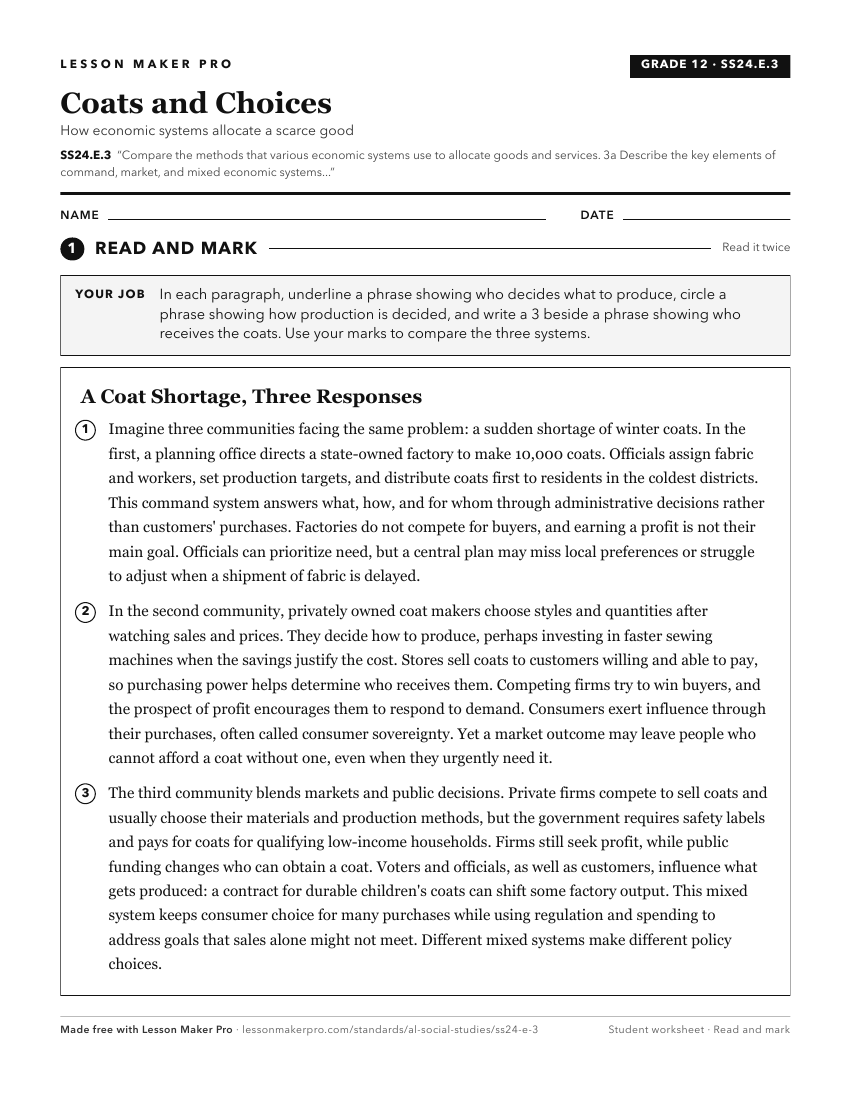
A ready-to-print activity worksheet aligned to SS24.E.3, with an answer key for the teacher on its own page. No account needed.
PDF, US Letter, prints cleanly in black and white.
Download the worksheetKeep exploring
Related Standards
Turn this cluster into a lesson
Grade, subject, topic, and the complete cluster are prefilled. Create one free, no account needed.
Also for this cluster:Make a WorksheetMake a QuizMake a Sub Lesson