Alabama Social Studies SS24.WH.13b
The Standard
- SS24.WH.13
- Explain the origins of the Cold War as they relate to the economic, global, political, and social consequences of World War II.
Compare political ideologies that existed within the United States, the Soviet Union, and People’s Republic of China after World War II.
2024 Alabama Course of Study: Social Studies
Teacher's field guide
What This Standard Means
What Students Need to Do
- Students compare how the United States, Soviet Union, and China chose leaders and made economic decisions after World War II. They connect multiparty elections and mostly private business to U.S. democracy and capitalism. They connect one-party rule and state-directed economies to Soviet and Chinese communism.
What Mastery Looks Like
- Students can compare the three countries using elections, business ownership, and government planning, with an accurate example for each. They can explain that Soviet and Chinese leaders shared communist ideas but took different approaches, including China's focus on rural peasants.
Common Misconceptions
- Students may assume Soviet and Chinese communism worked the same way. They may think holding elections always meant voters could choose between competing parties. Some think capitalism meant the U.S. government never regulated business.
How to Assess It
- Exit ticket: For each country, name who held political power and who made major economic decisions. Add one difference between Soviet and Chinese approaches.
Lesson moves
Ways to Teach It
Have pairs sort nine policy cards, including multiparty ballots, Soviet factory targets, and Chinese rural communes, into country columns.
Ask students to write: Who decided what factories produced in each country, and how did that reflect its political ideas?
Play rapid-fire clue match: read “competing parties,” “state quotas,” and “rural communes”; students hold up country cards and explain their choices.
Show a 1950s U.S. refrigerator ad, a Soviet factory poster, and a 1958 Chinese commune photo; ask who controlled production.
Free download
Printable SS24.WH.13b Worksheet
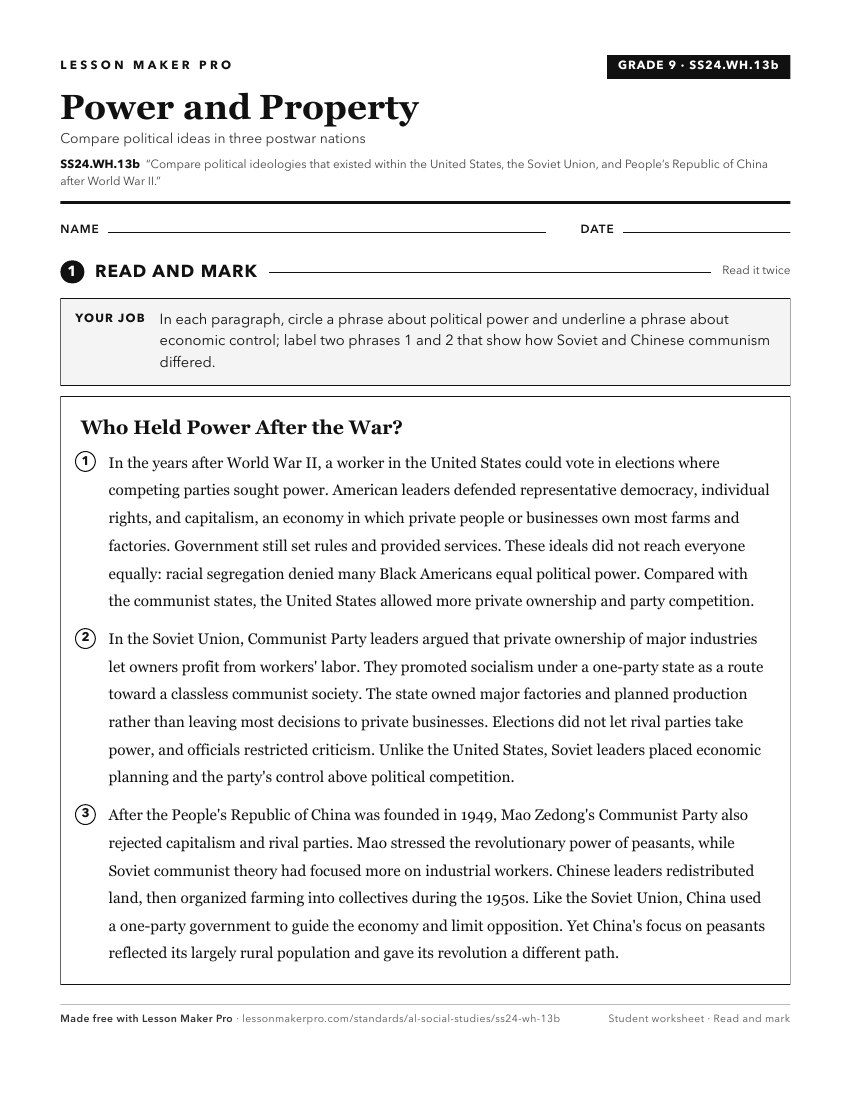
A ready-to-print activity worksheet aligned to SS24.WH.13b, with an answer key for the teacher on its own page. No account needed.
PDF, US Letter, prints cleanly in black and white.
Download the worksheetKeep exploring
Related Standards
- SS24.WH.8a
Compare and contrast political ideologies that emerged in Europe following World War I, including communism, fascism, and social democracy.
- SS24.US2.9a
Develop an argument regarding the effectiveness of the United States policy of containment that resulted from its growing ideological and political tensions wit...
- SS24.5.9a
Compare totalitarianism and democracy as represented in the Axis and Allied powers prior to war in Europe.
- SS24.US2.9b
Compare the application of the United States’ policy of containment to various areas of the world outside the Soviet Union in the late 1940s and 1950s.
Turn this exact standard into a lesson
Grade, subject, topic, and the complete standard are prefilled. Create one free, no account needed.
Also for this standard:Make a WorksheetMake a QuizMake a Sub Lesson