Alabama Social Studies SS24.5.5
Standard Cluster
Summarize the primary causes and consequences of World War I. 5a Identify and explain international events that led to the United States’ entry into World War I. 5b Identify the countries of the Triple Entente and Central Powers during World War I and locate them on a map. 5c Describe the roles and contributions of Alabamians, including the 167th Infantry Regiment (4th Alabama), to the war effort during World War I. 5d Locate Alabama military training camps, ammunition depots, and the Port of Mobile on a map and explain their role in World War I efforts.
2024 Alabama Course of Study: Social Studies
Cluster contents
Standards in This Cluster
SS24.5.5 is a cluster heading. These are the individual standards under it.
- SS24.5.5a
Identify and explain international events that led to the United States’ entry into World War I.
- SS24.5.5b
Identify the countries of the Triple Entente and Central Powers during World War I and locate them on a map.
- SS24.5.5c
Describe the roles and contributions of Alabamians, including the 167th Infantry Regiment (4th Alabama), to the war effort during World War I.
- SS24.5.5d
Locate Alabama military training camps, ammunition depots, and the Port of Mobile on a map and explain their role in World War I efforts.
Teacher's field guide
What This Cluster Means
What Students Need to Do
- Students explain how the assassination and alliances helped start the war, and how the war cost lives and changed borders. They explain why the United States entered and locate the opposing countries on a map. They describe how Alabama soldiers, training camps, ammunition depots, and the Port of Mobile helped the war effort.
What Mastery Looks Like
- A student finds Britain, France, and Russia on one side of a map, and Germany, Austria-Hungary, the Ottoman Empire, and Bulgaria on the other. They connect German submarine attacks and the Zimmermann Telegram to U.S. entry. They explain that Alabama's 167th Infantry Regiment fought in France, while camps trained troops, depots stored ammunition, and Mobile handled supplies.
Common Misconceptions
- Students may treat the assassination as the war's only cause. Some think the United States entered immediately after the Lusitania sank. Others place Italy with the Central Powers because it belonged to a prewar alliance with Germany and Austria-Hungary.
How to Assess It
- Exit ticket: On a blank Europe map, mark the three Triple Entente countries and four Central Powers countries. Then name the war's immediate trigger, one reason the U.S. entered, one result, and one contribution from Alabama.
Lesson moves
Ways to Teach It
Give pairs country labels and a blank Europe map; have them place each alliance group and check their choices against a key.
Ask, 'How did the 167th fight in France while Alabama's camps, depots, and the Port of Mobile helped at home?' Have pairs write two sentences.
Sort assassination, alliances, submarine attacks, Zimmermann Telegram, U.S. entry, and Treaty of Versailles cards into causes, entry triggers, and outcomes.
Compare a wartime Alabama sites map with a current road map; find Camp McClellan, Camp Sheridan, ammunition depots, and the Port of Mobile.
Free download
Printable SS24.5.5 Worksheet
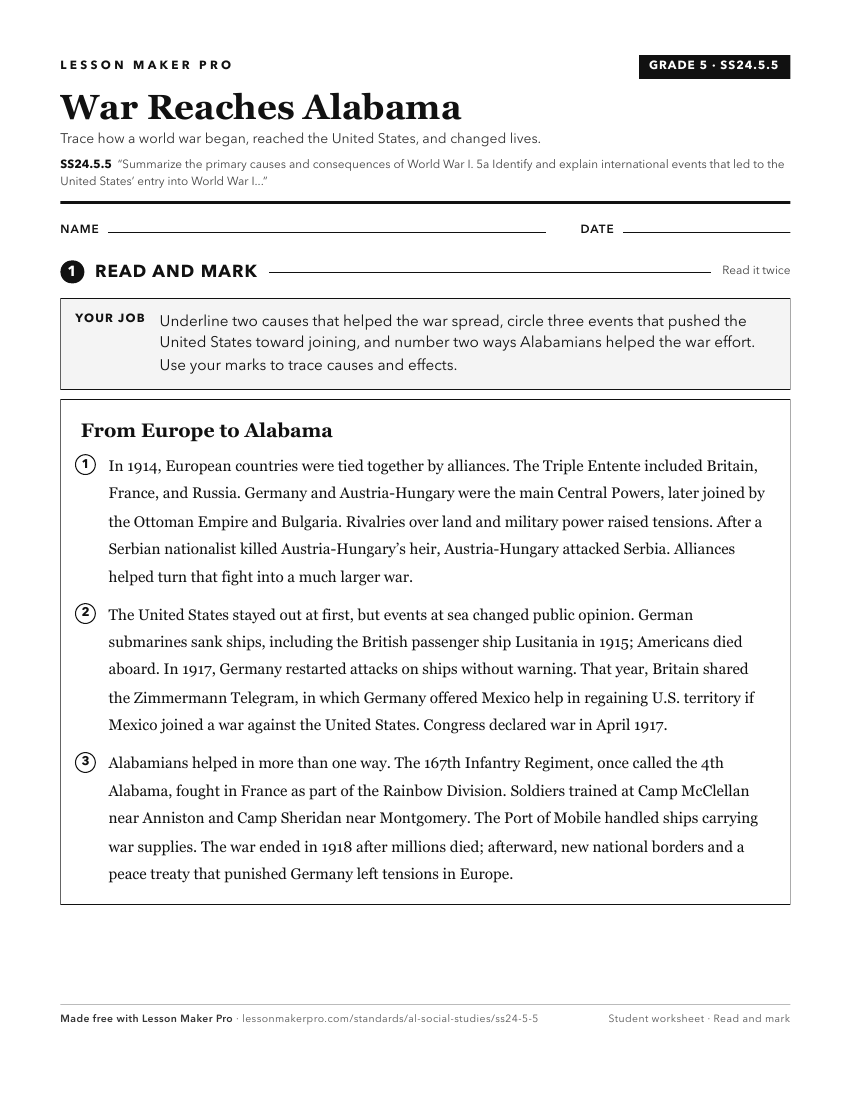
A ready-to-print activity worksheet aligned to SS24.5.5, with an answer key for the teacher on its own page. No account needed.
PDF, US Letter, prints cleanly in black and white.
Download the worksheetKeep exploring
Related Standards
- SS24.US2.1e
Summarize the events and factors that led to the United States entry into World War I.
- SS24.WH.7
Explain causes and consequences of World War I, including imperialism, militarism, nationalism, and the alliance system.
- SS24.WH.8
Analyze the global cultural, economic, and political developments immediately following World War I.
Turn this cluster into a lesson
Grade, subject, topic, and the complete cluster are prefilled. Create one free, no account needed.
Also for this cluster:Make a WorksheetMake a QuizMake a Sub Lesson