Alabama Social Studies SS24.WH.6
Standard Cluster
Explain how imperialism fostered global transformation. 6a Trace the origins of late nineteenth century imperialism, imperialist ideology, and colonialism. 6b Summarize how the actions of imperialist nations affected cultures and peoples of Africa and Asia, and explain how these peoples resisted imperialization. 6c Identify Western nations’ spheres of influence in Africa, Asia, and Latin America that resulted from nineteenth and twentieth century imperialism.
2024 Alabama Course of Study: Social Studies
Cluster contents
Standards in This Cluster
SS24.WH.6 is a cluster heading. These are the individual standards under it.
- SS24.WH.6a
Trace the origins of late nineteenth century imperialism, imperialist ideology, and colonialism.
- SS24.WH.6b
Summarize how the actions of imperialist nations affected cultures and peoples of Africa and Asia, and explain how these peoples resisted imperialization.
- SS24.WH.6c
Identify Western nations’ spheres of influence in Africa, Asia, and Latin America that resulted from nineteenth and twentieth century imperialism.
Teacher's field guide
What This Cluster Means
What Students Need to Do
- Students explain how demand for raw materials, new technology, and racist claims drove imperial expansion. They describe changes to African and Asian communities and give examples of resistance. They locate Western colonies and spheres of influence in Africa, Asia, and Latin America.
What Mastery Looks Like
- A student links European rubber demand and racist claims to forced labor in the Congo. They explain how Indian boycotts challenged British rule. On a map, they distinguish French rule in Indochina from U.S. influence in Cuba.
Common Misconceptions
- Students may call every sphere of influence a colony, even where foreign powers controlled trade without direct rule. They may assume Africans and Asians did not resist, overlooking Ethiopia’s victory at Adwa and Indian boycotts. Some blame expansion only on land hunger and miss markets, raw materials, technology, and racist ideas.
How to Assess It
- Exit ticket: Give one motive for empire, one harm to colonized people, and one specific act of resistance. On a blank map, label British India and Cuba as a U.S. sphere of influence.
Lesson moves
Ways to Teach It
Shade British India and Kenya and French Indochina on a blank map, then outline Cuba as a U.S. sphere of influence.
Have students write a two-sentence reply to a “civilizing mission” claim, using Ethiopia’s victory at Adwa as evidence.
Deal cards labeled rubber demand, racial hierarchy, forced labor, and Adwa; students sort them into motives, justifications, impacts, and resistance.
Compare a modern cocoa supply map with a 1900 West Africa colony map, then write one question about who earns money from cocoa.
Free download
Printable SS24.WH.6 Worksheet
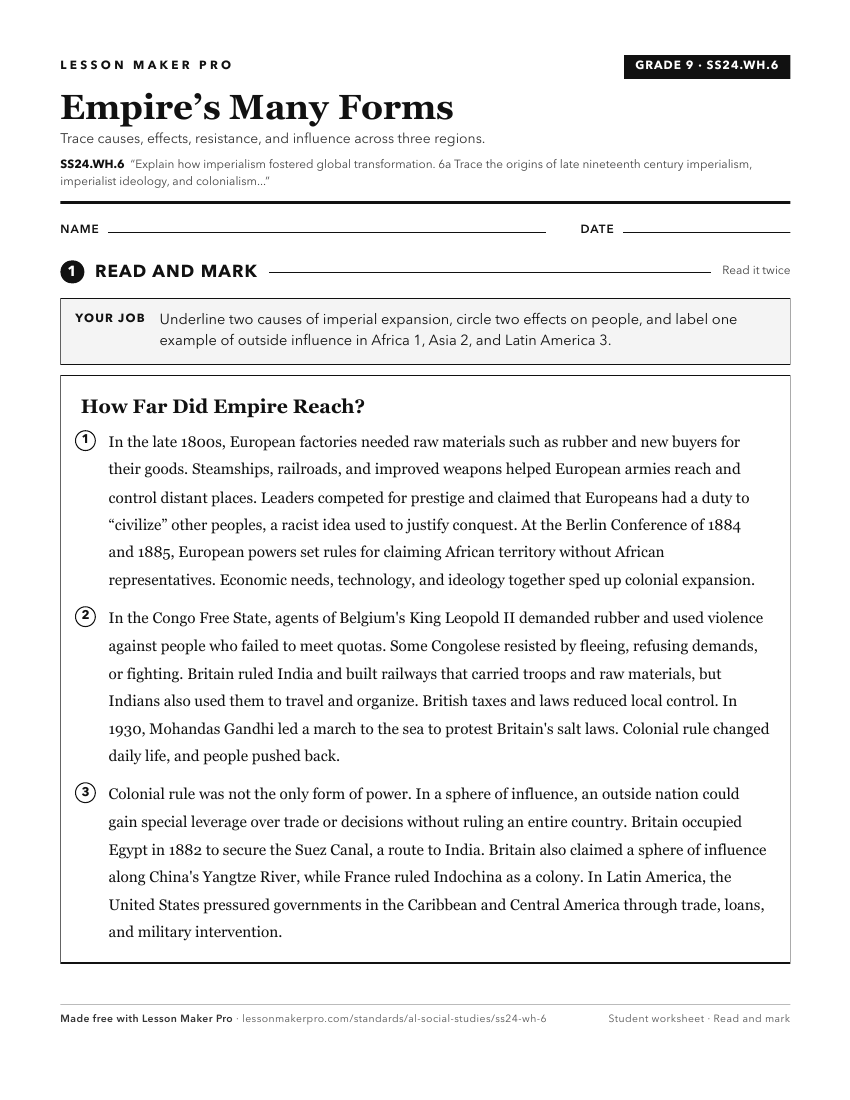
A ready-to-print activity worksheet aligned to SS24.WH.6, with an answer key for the teacher on its own page. No account needed.
PDF, US Letter, prints cleanly in black and white.
Download the worksheetKeep exploring
Related Standards
Turn this cluster into a lesson
Grade, subject, topic, and the complete cluster are prefilled. Create one free, no account needed.
Also for this cluster:Make a WorksheetMake a QuizMake a Sub Lesson