Alabama Social Studies SS24.WH.6b
The Standard
- SS24.WH.6
- Explain how imperialism fostered global transformation.
Summarize how the actions of imperialist nations affected cultures and peoples of Africa and Asia, and explain how these peoples resisted imperialization.
2024 Alabama Course of Study: Social Studies
Teacher's field guide
What This Standard Means
What Students Need to Do
- Students describe how imperial rule changed work, land, trade, and cultural practices in Africa and Asia. They explain how people resisted, using specific places and events.
What Mastery Looks Like
- A student can link forced rubber collection in the Congo to harm in local communities and explain why some villagers fled. They can describe a change under British rule in India and explain why Indians rebelled in 1857.
Common Misconceptions
- Students may think people in Africa and Asia accepted foreign rule without protest. They may also assume resistance always meant fighting, or that new schools and trade benefited everyone.
How to Assess It
- Exit ticket: Name one way imperial rule changed life in the Congo or India. Then describe one act of resistance in that place and what prompted it.
Lesson moves
Ways to Teach It
Give pairs a map and cards for Congo rubber quotas, the 1857 uprising, and the Battle of Adwa; have them place each card.
Read short accounts of Congo villagers fleeing rubber quotas and Indians rebelling in 1857; ask, "What prompted each response?"
Play a card match: pair an imperial action with its effect and a response, such as rubber quotas, forced labor, and village flight.
Show a museum photo of a Benin Bronze and a return-request headline; students explain how the 1897 British seizure affects ownership today.
Free download
Printable SS24.WH.6b Worksheet
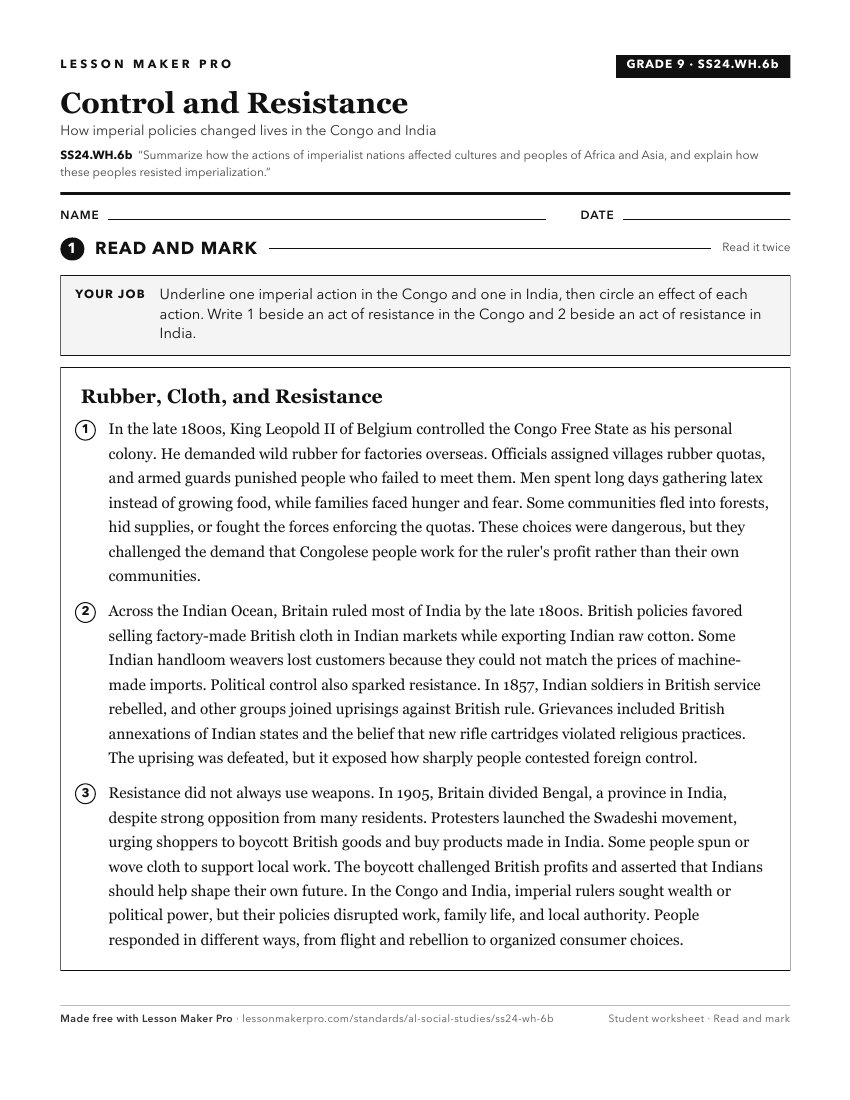
A ready-to-print activity worksheet aligned to SS24.WH.6b, with an answer key for the teacher on its own page. No account needed.
PDF, US Letter, prints cleanly in black and white.
Download the worksheetKeep exploring
Related Standards
- SS24.WH.6c
Identify Western nations’ spheres of influence in Africa, Asia, and Latin America that resulted from nineteenth and twentieth century imperialism.
- SS24.8.12
Trace the cultural, economic, and political effects of European colonization on the populations of Africa, the Americas, and Europe.
- SS24.WH.14
Explain realignment and reconstruction in Europe, Asia, Africa, and Latin America after World War II, including the decline of colonial empires.
- SS24.WH.6
Explain how imperialism fostered global transformation.
Turn this exact standard into a lesson
Grade, subject, topic, and the complete standard are prefilled. Create one free, no account needed.
Also for this standard:Make a WorksheetMake a QuizMake a Sub Lesson