Alabama Social Studies SS24.WH.14
Standard Cluster
Explain realignment and reconstruction in Europe, Asia, Africa, and Latin America after World War II, including the decline of colonial empires. 14a Describe the efforts of people under colonial rule to establish their independence and resistance to these efforts, including the Zionist movement. 14b Analyze how economic aid expanded spheres of influence, including the Marshall Plan and Council for Mutual Economic Assistance (COMECON).
2024 Alabama Course of Study: Social Studies
Cluster contents
Standards in This Cluster
SS24.WH.14 is a cluster heading. These are the individual standards under it.
- SS24.WH.14a
Describe the efforts of people under colonial rule to establish their independence and resistance to these efforts, including the Zionist movement.
- SS24.WH.14b
Analyze how economic aid expanded spheres of influence, including the Marshall Plan and Council for Mutual Economic Assistance (COMECON).
Teacher's field guide
What This Cluster Means
What Students Need to Do
- Students track how countries rebuilt and changed alliances after World War II. They explain independence efforts, resistance to them, and how economic ties helped the United States and Soviet Union gain influence.
What Mastery Looks Like
- Students link independence in India and Ghana to the decline of European empires. They explain the Zionist campaign for a Jewish state in British-ruled Palestine, British restrictions, and Palestinian Arab opposition. They show how Marshall Plan funds and COMECON trade ties strengthened rival blocs.
Common Misconceptions
- Students may assume independence was always a peaceful handoff. They may treat Latin American countries as if they all gained independence after World War II. They may mistake COMECON for a cash grant like the Marshall Plan.
How to Assess It
- Exit ticket: Name one postwar independence movement and who resisted it. Then explain how the Marshall Plan or COMECON helped a superpower gain influence.
Lesson moves
Ways to Teach It
On a blank map, mark India, Ghana, Palestine, Latin America, and both halves of Europe; use two colors for independence and aid.
Post two 1947 claims, 'A Jewish state' and 'Palestinian Arab self-rule'; ask students why these goals conflicted.
Give pairs cards naming Ghanaian independence, British limits on Jewish immigration, the Marshall Plan, and COMECON; sort them by independence, resistance, or influence.
Show a current foreign aid headline; have students name the donor, recipient, promised help, and influence the donor might seek.
Free download
Printable SS24.WH.14 Worksheet
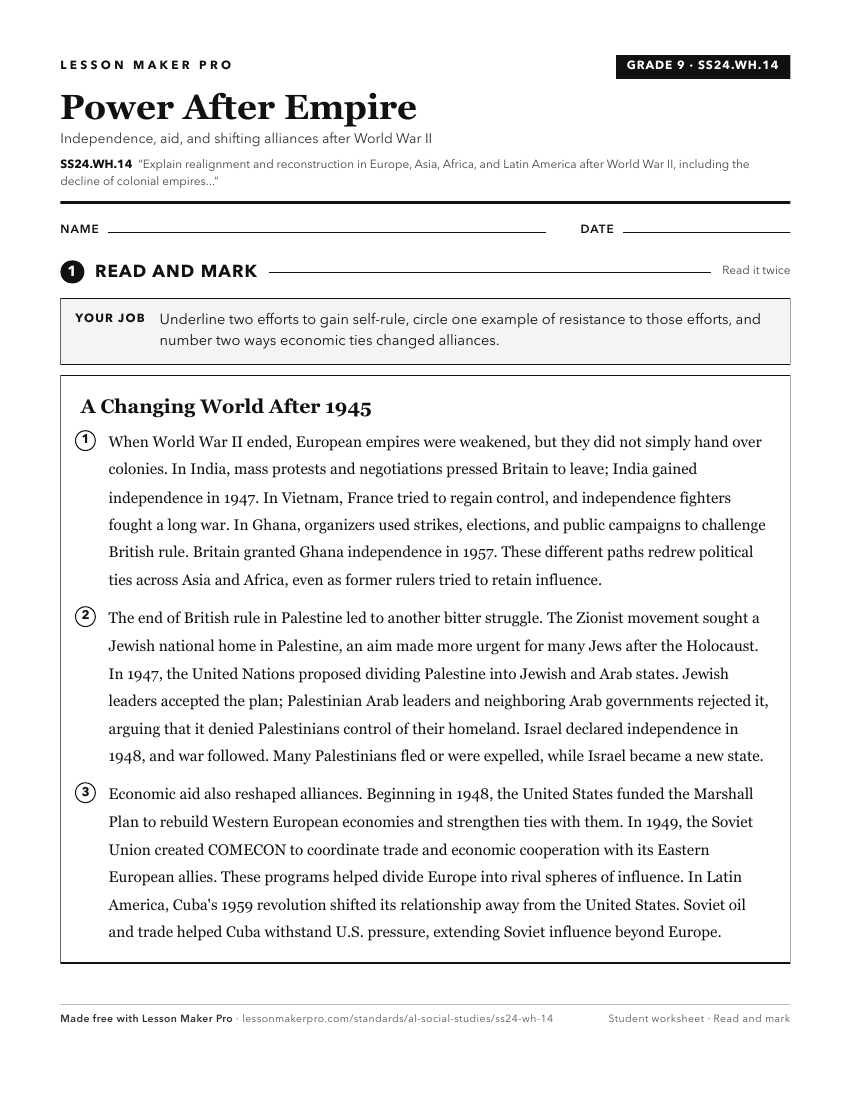
A ready-to-print activity worksheet aligned to SS24.WH.14, with an answer key for the teacher on its own page. No account needed.
PDF, US Letter, prints cleanly in black and white.
Download the worksheetKeep exploring
Related Standards
- SS24.WH.3a
Identify the locations of colonial empires and post-revolutionary countries in Latin America and the Caribbean.
- SS24.WH.6c
Identify Western nations’ spheres of influence in Africa, Asia, and Latin America that resulted from nineteenth and twentieth century imperialism.
- SS24.8.12
Trace the cultural, economic, and political effects of European colonization on the populations of Africa, the Americas, and Europe.
- SS24.WH.6b
Summarize how the actions of imperialist nations affected cultures and peoples of Africa and Asia, and explain how these peoples resisted imperialization.
Turn this cluster into a lesson
Grade, subject, topic, and the complete cluster are prefilled. Create one free, no account needed.
Also for this cluster:Make a WorksheetMake a QuizMake a Sub Lesson