Alabama Social Studies SS24.WH.6c
The Standard
- SS24.WH.6
- Explain how imperialism fostered global transformation.
Identify Western nations’ spheres of influence in Africa, Asia, and Latin America that resulted from nineteenth and twentieth century imperialism.
2024 Alabama Course of Study: Social Studies
Teacher's field guide
What This Standard Means
What Students Need to Do
- Students find places in Africa, Asia, and Latin America where Western powers held colonies or had strong influence around 1900. They name the power involved and tell direct rule from other forms of influence.
What Mastery Looks Like
- A student can locate British India, French West Africa, and Cuba on a map. They can explain that Cuba was not a U.S. colony, though the United States influenced its government.
Common Misconceptions
- Students may treat every place under foreign influence as a colony. They may think the United States had no influence outside North America or mistake Japan for a Western power.
How to Assess It
- Give students a blank map. Ask them to label British India, French West Africa, and Cuba, then circle the place that was not a colony.
Lesson moves
Ways to Teach It
Give pairs a 1910 map and colored pencils to mark British India, French West Africa, and U.S. influence in Cuba.
Ask students to write two sentences explaining how U.S. influence in Cuba differed from British rule in India.
Have students match place cards labeled India, Senegal, and Cuba to Britain, France, and the United States.
Compare a current Panama Canal shipping map with a 1914 Canal Zone map, then mark the area the United States controlled.
Free download
Printable SS24.WH.6c Worksheet
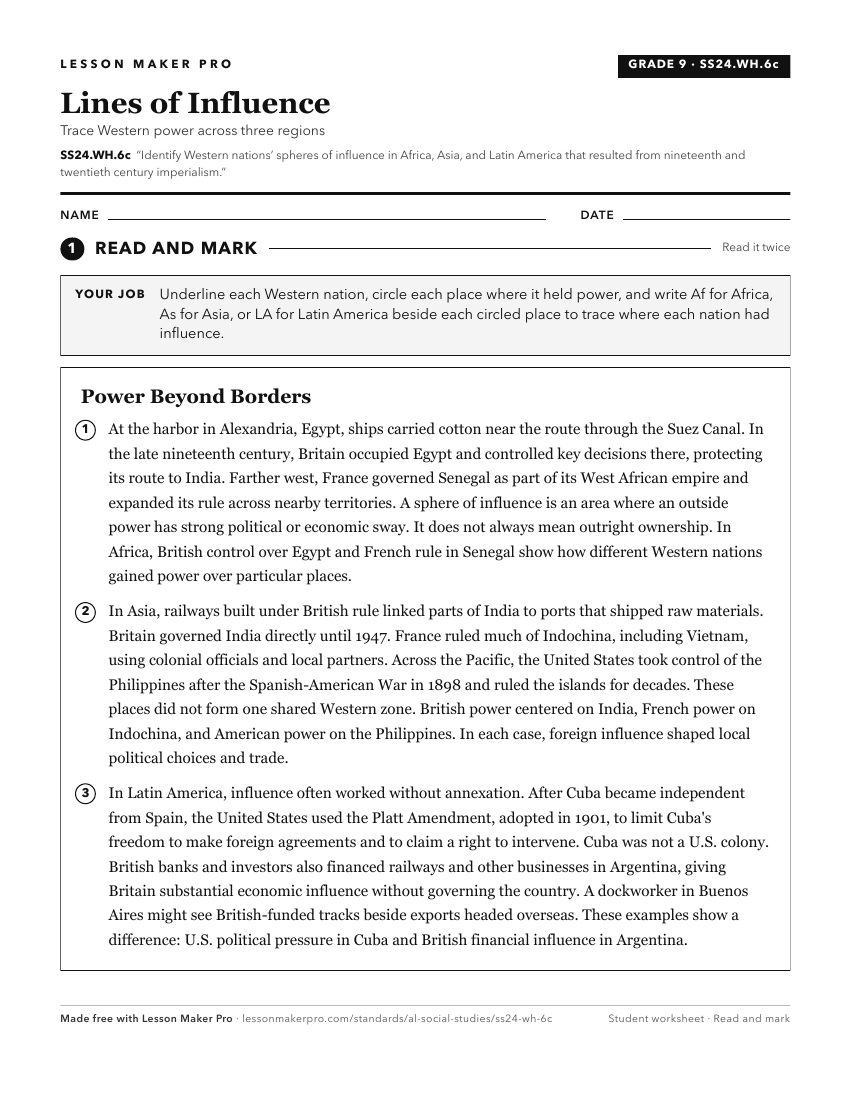
A ready-to-print activity worksheet aligned to SS24.WH.6c, with an answer key for the teacher on its own page. No account needed.
PDF, US Letter, prints cleanly in black and white.
Download the worksheetKeep exploring
Related Standards
- SS24.WH.3a
Identify the locations of colonial empires and post-revolutionary countries in Latin America and the Caribbean.
- SS24.8.12
Trace the cultural, economic, and political effects of European colonization on the populations of Africa, the Americas, and Europe.
- SS24.WH.6b
Summarize how the actions of imperialist nations affected cultures and peoples of Africa and Asia, and explain how these peoples resisted imperialization.
- SS24.WH.6a
Trace the origins of late nineteenth century imperialism, imperialist ideology, and colonialism.
Turn this exact standard into a lesson
Grade, subject, topic, and the complete standard are prefilled. Create one free, no account needed.
Also for this standard:Make a WorksheetMake a QuizMake a Sub Lesson