Alabama Social Studies SS24.WH.6a
The Standard
- SS24.WH.6
- Explain how imperialism fostered global transformation.
Trace the origins of late nineteenth century imperialism, imperialist ideology, and colonialism.
2024 Alabama Course of Study: Social Studies
Teacher's field guide
What This Standard Means
What Students Need to Do
- Students explain why industrial powers sought raw materials, markets, and key trade routes in the late 1800s. They show how rivalry between countries and racist claims were used to justify taking control of land and people.
What Mastery Looks Like
- A student can explain how rubber profits shaped Leopold II's rule in the Congo and why Britain wanted to protect the Suez Canal route. They can identify a racist claim used to justify colonial rule without treating it as fact.
Common Misconceptions
- Students may say European powers took territory only to spread religion, missing profit and strategic goals. Some accept claims about 'civilizing' people as facts. Others confuse trade with direct political control.
How to Assess It
- Exit ticket: Why did Britain occupy Egypt in 1882? Name one reason tied to the Suez Canal and one claim Europeans used to justify colonial rule.
Lesson moves
Ways to Teach It
Give pairs 1880 and 1914 Africa maps; have them locate the Congo and attach a card explaining rubber profits.
Read four lines from Kipling's 1899 poem 'The White Man's Burden'; ask, 'Whose interests does this language hide?'
Hand out cards labeled rubber profits, Suez route, racial superiority, and foreign governors; students sort them into motives, justifications, and colonial rule.
Show a current shipping map of the Suez Canal; ask students why Britain wanted to control that route in 1882.
Free download
Printable SS24.WH.6a Worksheet
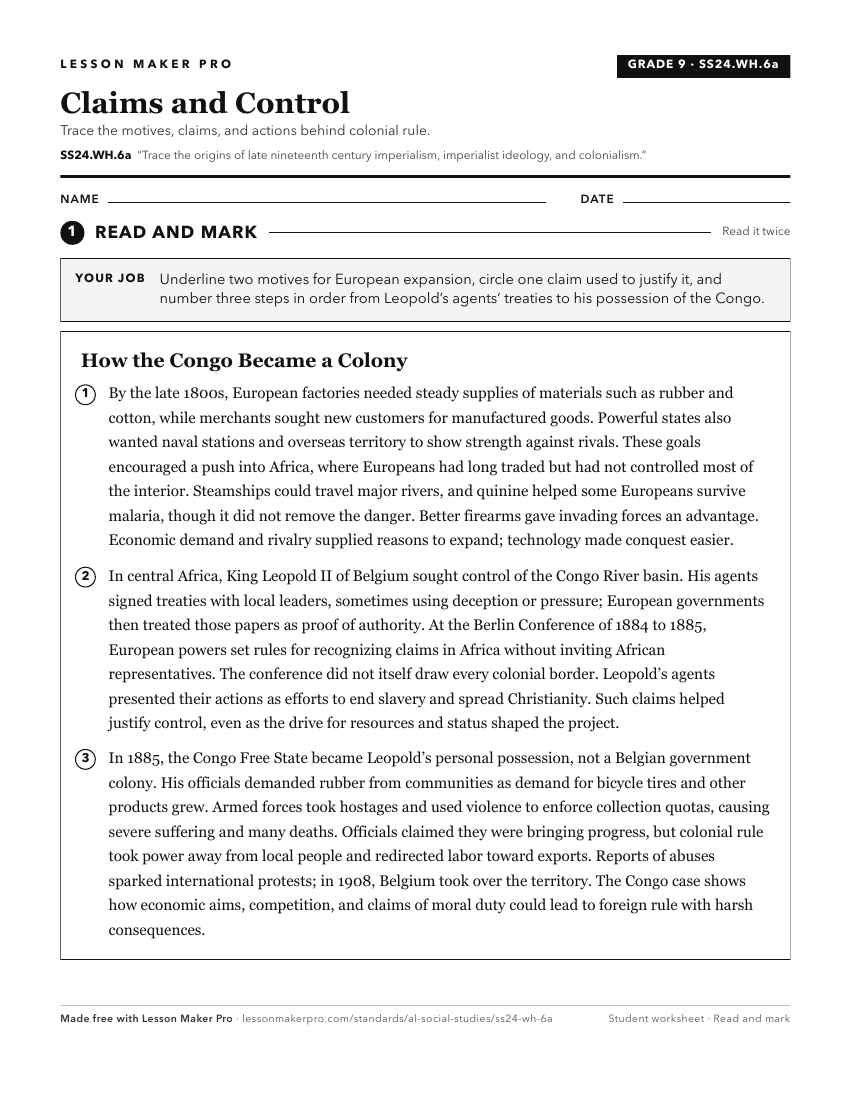
A ready-to-print activity worksheet aligned to SS24.WH.6a, with an answer key for the teacher on its own page. No account needed.
PDF, US Letter, prints cleanly in black and white.
Download the worksheetKeep exploring
Related Standards
- SS24.WH.6c
Identify Western nations’ spheres of influence in Africa, Asia, and Latin America that resulted from nineteenth and twentieth century imperialism.
- SS24.8.12
Trace the cultural, economic, and political effects of European colonization on the populations of Africa, the Americas, and Europe.
- SS24.8.18a
Trace the origins of Enlightenment ideas to earlier eras and movements, including Classical Greece and Rome, Christianity, the Renaissance, the Reformation, and...
- SS24.6.6
Trace the economic and cultural interactions across continents and the colonies resulting from the triangular trade routes, including the forced migration of Af...
Turn this exact standard into a lesson
Grade, subject, topic, and the complete standard are prefilled. Create one free, no account needed.
Also for this standard:Make a WorksheetMake a QuizMake a Sub Lesson