Alabama Social Studies SS24.6.6
Standard Cluster
Trace the economic and cultural interactions across continents and the colonies resulting from the triangular trade routes, including the forced migration of Africans through the transatlantic slave trade and experiences of the Middle Passage. 6a Compare and contrast the institution of slavery in different colonial regions. 6b Summarize the purpose of slave codes in colonial society and explain how they demonstrated that laws can be discriminatory and unfair. 6c Describe how enslaved people and abolitionists sought to oppose slavery in colonial America.
2024 Alabama Course of Study: Social Studies
Cluster contents
Standards in This Cluster
SS24.6.6 is a cluster heading. These are the individual standards under it.
- SS24.6.6a
Compare and contrast the institution of slavery in different colonial regions.
- SS24.6.6b
Summarize the purpose of slave codes in colonial society and explain how they demonstrated that laws can be discriminatory and unfair.
- SS24.6.6c
Describe how enslaved people and abolitionists sought to oppose slavery in colonial America.
Teacher's field guide
What This Cluster Means
What Students Need to Do
- Students map trade, forced migration, and cultural exchange among Africa, Europe, and the colonies. They describe conditions on the Middle Passage and compare slavery in northern and southern colonies. They explain how slave codes denied rights and how enslaved people and abolitionists opposed slavery.
What Mastery Looks Like
- A student traces European cloth to Africa, the forced transport of Africans to the Americas, and colonial sugar to Europe. They describe the crowded, deadly Middle Passage and explain how West African rice knowledge shaped colonial farming. They contrast work in northern homes and shops with labor on southern plantations, then give examples of an unfair slave code, escape, and an antislavery petition.
Common Misconceptions
- Students may think every ship made the same three stops or that Africans chose to migrate. They may place slavery only on southern plantations or think slave codes applied to everyone equally. Some think enslaved people had no ways to resist.
How to Assess It
- On an exit ticket, ask students to label four arrows on an Atlantic map: cloth, forced migration, sugar, and rice knowledge. Have them add one note each on Middle Passage conditions, regional differences, slave codes, and opposition to slavery.
Lesson moves
Ways to Teach It
Have pairs use yarn and labels on an Atlantic map to trace European cloth, forced migration, colonial sugar, and West African rice knowledge.
Read an excerpt from Olaudah Equiano’s account of a slave ship; ask, 'What details show conditions aboard, and whose choices caused them?'
Give groups cards naming northern household work, southern rice plantations, movement bans, escapes, and petitions; have them sort by region, control, or opposition.
Show a bag of rice and a colonial South Carolina map; ask how enslaved West African rice growers' knowledge shaped the crop's production.
Free download
Printable SS24.6.6 Worksheet
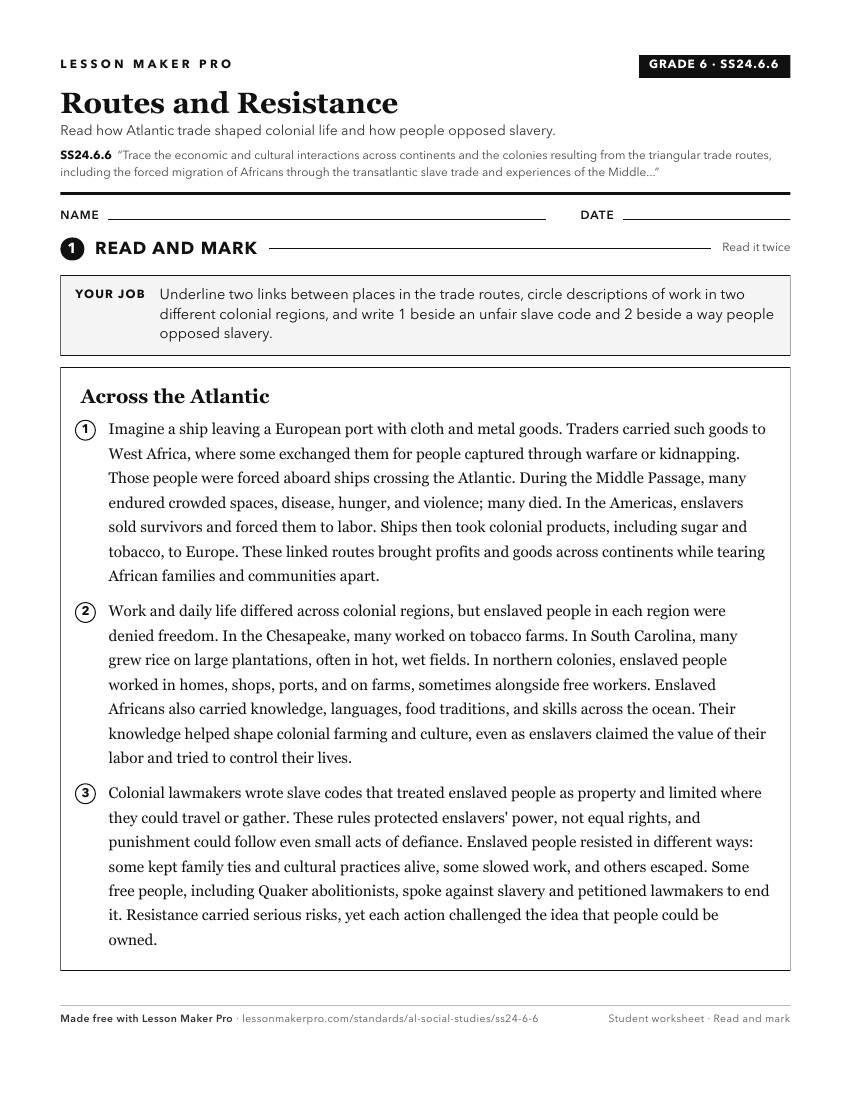
A ready-to-print activity worksheet aligned to SS24.6.6, with an answer key for the teacher on its own page. No account needed.
PDF, US Letter, prints cleanly in black and white.
Download the worksheetKeep exploring
Related Standards
- SS24.8.12
Trace the cultural, economic, and political effects of European colonization on the populations of Africa, the Americas, and Europe.
- SS24.4.3a
Describe the triangular trade system, including the Middle Passage of the transatlantic slave trade, and describe the experiences of West Africans before and af...
- SS24.8.5b
Trace the spread of culture, language, and religion among African civilizations.
- SS24.8.13
Analyze the economic, political, and social effects of the transatlantic slave trade on African societies and American colonies.
Turn this cluster into a lesson
Grade, subject, topic, and the complete cluster are prefilled. Create one free, no account needed.
Also for this cluster:Make a WorksheetMake a QuizMake a Sub Lesson