Alabama Social Studies SS24.6.6b
The Standard
- SS24.6.6
- Trace the economic and cultural interactions across continents and the colonies resulting from the triangular trade routes, including the forced migration of Africans through the transatlantic slave trade and experiences of the Middle Passage.
Summarize the purpose of slave codes in colonial society and explain how they demonstrated that laws can be discriminatory and unfair.
2024 Alabama Course of Study: Social Studies
Teacher's field guide
What This Standard Means
What Students Need to Do
- Students explain how colonial laws let enslavers control enslaved people's families and movement. They identify who gained power under those laws and whose rights were denied.
What Mastery Looks Like
- A student can explain that Virginia's 1662 law made a child's enslaved or free status follow the mother's status. They can show how that rule kept families enslaved across generations and explain why it was unfair.
Common Misconceptions
- Some students think a free father meant an enslaved mother's child was born free. Others assume a law was fair because a government passed it, or that the rules applied to everyone equally.
How to Assess It
- On an exit ticket, give this paraphrase of a 1662 Virginia law: “A child's enslaved or free status follows the mother's status.” Ask: Who benefited from this rule, and why was it unfair?
Lesson moves
Ways to Teach It
Give pairs a family chart with an enslaved mother and a free father; have them mark the child's status under Virginia's 1662 law.
Ask students to write two sentences: How did making a child's status follow the mother help enslavers keep control across generations?
Play Rule and Result: match cards for inherited status, travel restrictions, and bans on gatherings to the freedoms each rule took away.
Read a plain-language version of the Fourteenth Amendment's equal protection clause, then compare it with Virginia's 1662 law.
Free download
Printable SS24.6.6b Worksheet
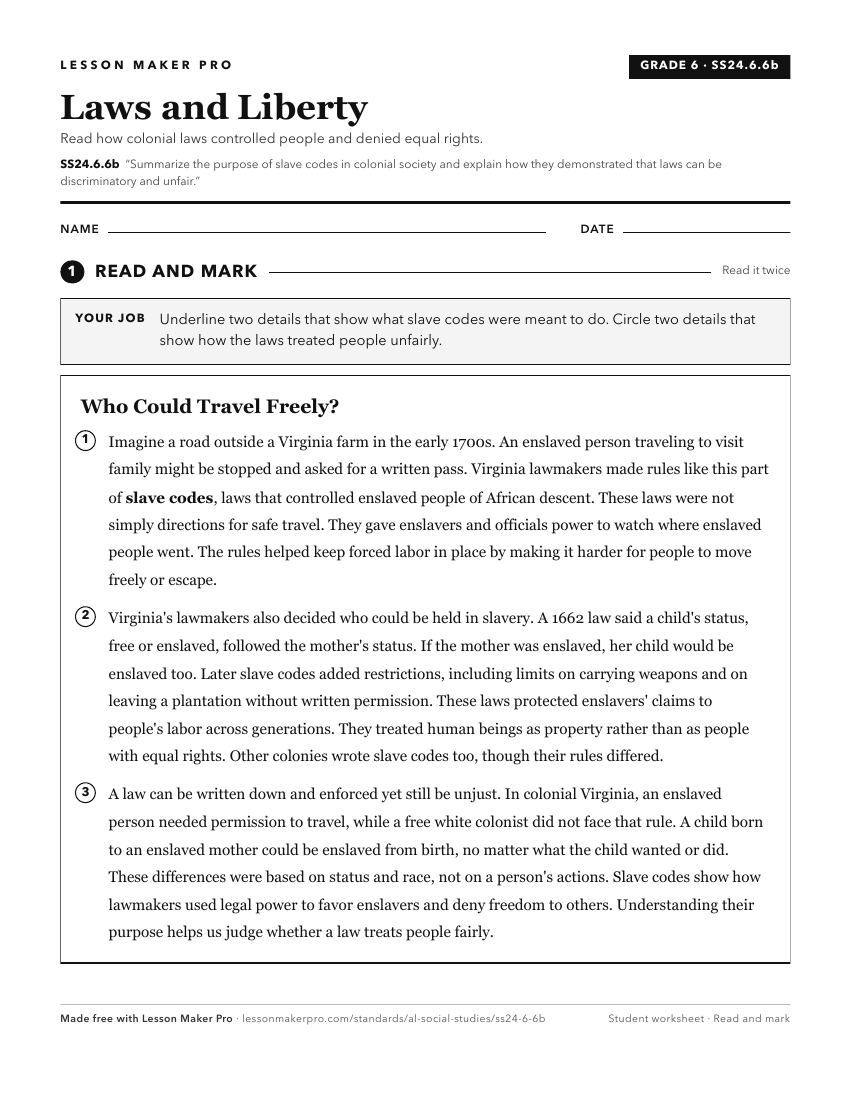
A ready-to-print activity worksheet aligned to SS24.6.6b, with an answer key for the teacher on its own page. No account needed.
PDF, US Letter, prints cleanly in black and white.
Download the worksheetKeep exploring
Related Standards
- SS24.US1.11a
Summarize major legislation and court decisions from 1820 to 1861 that sought to address the issue of slavery, and describe the sectional responses to these gov...
- SS24.4.3
Explain the reasons for the establishment of the labor systems used in colonial America, including apprenticeship, indentured servitude, and slavery, and descri...
- SS24.US1.10a
Describe forms of resistance to slavery demonstrated by enslaved and free Black Americans, and assess the impact of resistance on southern states’ slave codes.
- SS24.6.6a
Compare and contrast the institution of slavery in different colonial regions.
Turn this exact standard into a lesson
Grade, subject, topic, and the complete standard are prefilled. Create one free, no account needed.
Also for this standard:Make a WorksheetMake a QuizMake a Sub Lesson