Alabama Social Studies SS24.4.3
Standard Cluster
Explain the reasons for the establishment of the labor systems used in colonial America, including apprenticeship, indentured servitude, and slavery, and describe the differences among them. 3a Describe the triangular trade system, including the Middle Passage of the transatlantic slave trade, and describe the experiences of West Africans before and after being kidnapped and forced into slavery.
2024 Alabama Course of Study: Social Studies
Cluster contents
Standards in This Cluster
SS24.4.3 is a cluster heading. These are the individual standards under it.
Teacher's field guide
What This Cluster Means
What Students Need to Do
- Students explain why colonists trained apprentices, traded passage for indentured labor, and forced enslaved Africans to work. They compare how long each system lasted and whether workers could leave. They map triangular trade, including the Middle Passage, and describe West Africans' lives before capture and after enslavement.
What Mastery Looks Like
- A student identifies apprenticeship as job training, indenture as service for a set term, and slavery as forced bondage with no set end. They place Europe, West Africa, and the Americas on a trade map. They describe life in West African communities before capture, the brutal ocean crossing, and forced labor afterward.
Common Misconceptions
- Students may think indentured servants and enslaved people had the same legal status, or that apprentices served for life. Some place the Middle Passage between Europe and Africa. Others assume West Africans had no families or communities before capture.
How to Assess It
- Give students a map labeled Europe, West Africa, and the Americas. Ask them to mark the Middle Passage, explain how indenture differed from slavery, and name one change in a captured West African's life.
Lesson moves
Ways to Teach It
Give pairs profile cards for a printer's apprentice, an indentured servant, and an enslaved field worker; sort by training, contract, or forced bondage.
Read short descriptions of a West African market and the Middle Passage; ask, 'What changed after capture?'
Students mark cloth, forced transport of Africans, and sugar on a three-region trade map, then label the Middle Passage.
Show a cafeteria sugar packet; ask where colonial sugar was grown and whose forced labor helped produce it.
Free download
Printable SS24.4.3 Worksheet
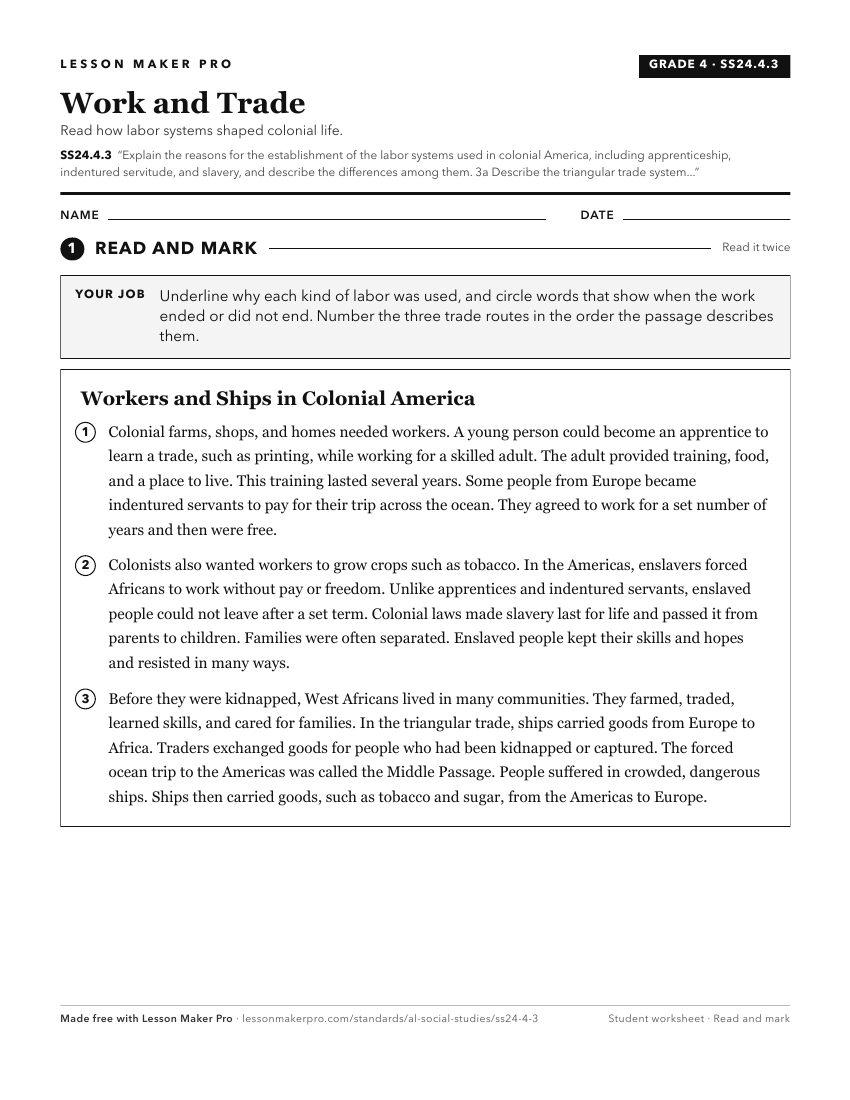
A ready-to-print activity worksheet aligned to SS24.4.3, with an answer key for the teacher on its own page. No account needed.
PDF, US Letter, prints cleanly in black and white.
Download the worksheetKeep exploring
Related Standards
- SS24.US1.8a
Analyze the domestic slave trade/forced migration, labor, and variations in the practice of slavery in different areas of the United States.
- SS24.4.4
Describe how the contributions of various groups living in colonial North America helped colonies develop, including artisans, farmers, large landowners, trades...
- SS24.6.6a
Compare and contrast the institution of slavery in different colonial regions.
- SS24.US1.13c
Explain how ownership of one’s own labor and land were equated with freedom by freedpeople, and describe emerging labor systems that sought to limit this freedo...
Turn this cluster into a lesson
Grade, subject, topic, and the complete cluster are prefilled. Create one free, no account needed.
Also for this cluster:Make a WorksheetMake a QuizMake a Sub Lesson