Alabama Social Studies SS24.WH.5
Standard Cluster
Explain how nationalism fostered global transformation from 1848 to 1914. 5a Evaluate the influence of the Revolutions of 1848 on European politics and society. 5b Analyze how the international balance of power shifted as a result of the unification of Germany, the decline of the Ottoman Empire, and the emergence of international rivalries. 5c Analyze the rise of Japan’s power in East Asia beginning with the Meiji Restoration.
2024 Alabama Course of Study: Social Studies
Cluster contents
Standards in This Cluster
SS24.WH.5 is a cluster heading. These are the individual standards under it.
- SS24.WH.5a
Evaluate the influence of the Revolutions of 1848 on European politics and society.
- SS24.WH.5b
Analyze how the international balance of power shifted as a result of the unification of Germany, the decline of the Ottoman Empire, and the emergence of intern...
- SS24.WH.5c
Analyze the rise of Japan’s power in East Asia beginning with the Meiji Restoration.
Teacher's field guide
What This Cluster Means
What Students Need to Do
- Students explain how the 1848 revolts spread demands for national unity and political rights, even though many revolts failed. They show how German unification and Ottoman decline changed European rivalries. They explain how Meiji reforms helped Japan become a power in East Asia.
What Mastery Looks Like
- A student can name a lasting change from 1848, such as the end of serfdom in the Habsburg Empire. On a map, they can explain why a united Germany worried France and why Ottoman losses increased Russian and Austrian competition in the Balkans. They can connect Japan’s new factories and army to its 1905 victory over Russia.
Common Misconceptions
- Students may think the 1848 revolts immediately created lasting democracies. They may treat Ottoman decline as a sudden collapse rather than a long struggle over territory. They may credit Japan’s victories to military skill alone and overlook Meiji reforms.
How to Assess It
- On an exit ticket, have students label Germany, the Balkans, and Japan on a map. Ask for three cause-and-effect sentences: one about a lasting change from 1848, one about a European rivalry, and one about Japan’s rise.
Lesson moves
Ways to Teach It
Give pairs event cards for 1848, 1868, 1871, and 1905; have them place each on a map and label its impact.
Ask, “Why did nationalism unite Germans but fuel rival claims in the Balkans?” Have students cite one detail from a map.
Play a matching game: pair Meiji schools, factories, and conscription with Japan’s growing power, and Ottoman losses with Balkan rivalries.
Compare 1910 and current maps of the Balkans; have students mark two changed borders and write one question about them.
Free download
Printable SS24.WH.5 Worksheet
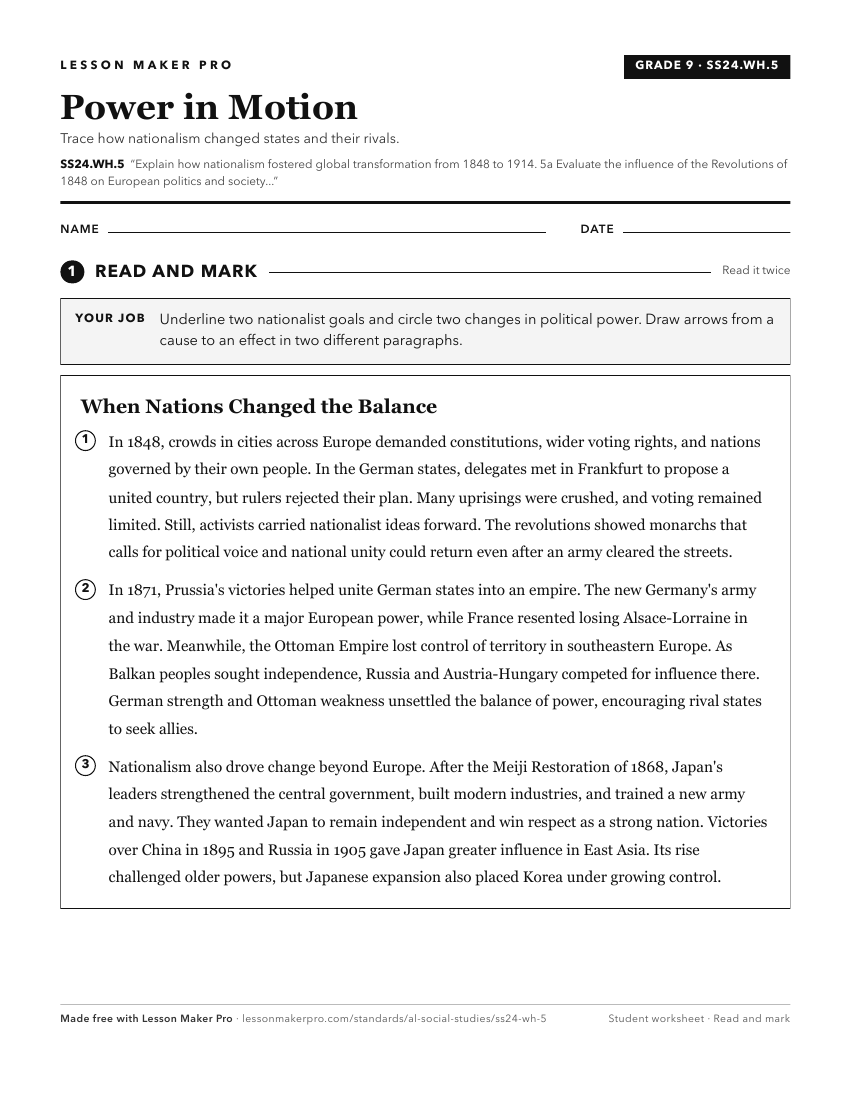
A ready-to-print activity worksheet aligned to SS24.WH.5, with an answer key for the teacher on its own page. No account needed.
PDF, US Letter, prints cleanly in black and white.
Download the worksheetKeep exploring
Related Standards
- SS24.WH.7
Explain causes and consequences of World War I, including imperialism, militarism, nationalism, and the alliance system.
- SS24.US1.6
Evaluate the influence of American social and political reform on the emergence of a national identity from the early to mid-nineteenth century.
- SS24.WH.6
Explain how imperialism fostered global transformation.
- SS24.WH.16e
Describe the influence of internal conflict, nationalism, and factional enmity in various nations and regions.
Turn this cluster into a lesson
Grade, subject, topic, and the complete cluster are prefilled. Create one free, no account needed.
Also for this cluster:Make a WorksheetMake a QuizMake a Sub Lesson