Alabama Social Studies SS24.WH.15c
The Standard
- SS24.WH.15
- Trace the progression of the Cold War from the end of World War II to the collapse of the Soviet Union.
Describe the collapse of the Soviet Empire; Russia’s struggle for democracy, free markets, and economic recovery; and the roles of Mikhail Gorbachev, Ronald Reagan, and Boris Yeltsin in bringing the Cold War to a conclusion.
2024 Alabama Course of Study: Social Studies
Teacher's field guide
What This Standard Means
What Students Need to Do
- Trace how Soviet reforms, protests in Eastern Europe, and the 1991 breakup ended Soviet control. Explain what Gorbachev, Reagan, and Yeltsin did, then describe Russia’s struggles with elections, private ownership, and inflation.
What Mastery Looks Like
- Students place the fall of Eastern European communist governments in 1989 before the Soviet Union’s breakup in 1991. They link Gorbachev to reforms, Reagan to pressure and diplomacy, and Yeltsin to resistance against the 1991 coup. They can explain how rising prices made life hard in Russia afterward.
Common Misconceptions
- Students may think the Berlin Wall fell on the day the Soviet Union ended. Some credit Reagan alone or assume that elections and private businesses made Russia prosperous right away.
How to Assess It
- Exit ticket: Put the Berlin Wall’s fall and the Soviet Union’s breakup in order. Name one action by Gorbachev, Reagan, or Yeltsin, and one problem Russia faced afterward.
Lesson moves
Ways to Teach It
Give pairs cards for perestroika, the Berlin Wall, the 1991 coup, and Soviet dissolution; have them place the cards on a timeline and draw cause arrows.
Ask: Did leaders’ decisions or public protests do more to end the Cold War? Require one example of each.
Play a three-leader match: students pair Gorbachev, Reagan, and Yeltsin with reform, nuclear talks, and resistance to the 1991 coup.
Give students a fictional 1992 Russian family budget with rising bread prices; ask how inflation would change what the family could buy.
Free download
Printable SS24.WH.15c Worksheet
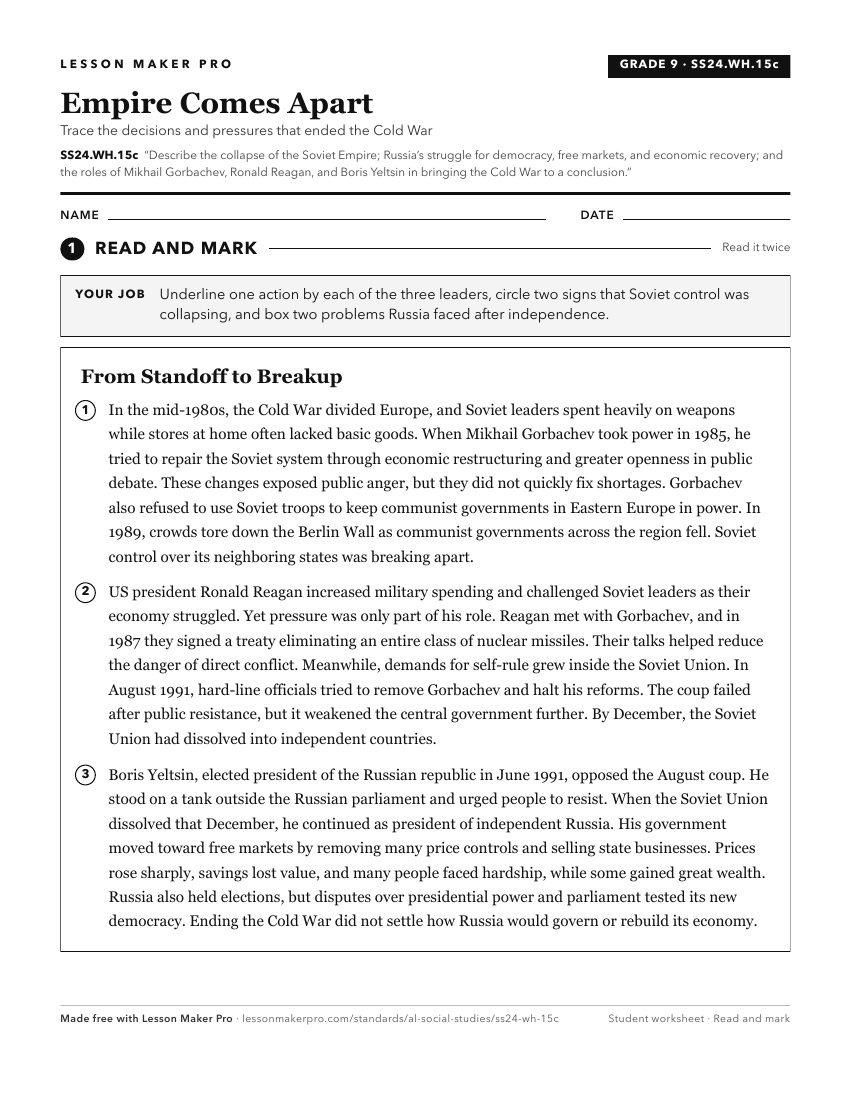
A ready-to-print activity worksheet aligned to SS24.WH.15c, with an answer key for the teacher on its own page. No account needed.
PDF, US Letter, prints cleanly in black and white.
Download the worksheetKeep exploring
Related Standards
- SS24.WH.15
Trace the progression of the Cold War from the end of World War II to the collapse of the Soviet Union.
- SS24.US2.17c
Trace the series of events during Reagan’s presidency leading to the emergence of the United States as the sole superpower, the fall of the Berlin Wall, and the...
- SS24.WH.13b
Compare political ideologies that existed within the United States, the Soviet Union, and People’s Republic of China after World War II.
- SS24.US2.9
Outline the foreign policy changes that led the United States into the Cold War and contributed to its emergence as a superpower.
Turn this exact standard into a lesson
Grade, subject, topic, and the complete standard are prefilled. Create one free, no account needed.
Also for this standard:Make a WorksheetMake a QuizMake a Sub Lesson