Alabama Social Studies SS24.WH.15
Standard Cluster
Trace the progression of the Cold War from the end of World War II to the collapse of the Soviet Union. 15a Explain the development of new technologies and their significance in the nuclear arms race and space race. 15b Evaluate the extent to which efforts to contain or spread communism contributed to global conflict. 15c Describe the collapse of the Soviet Empire; Russia’s struggle for democracy, free markets, and economic recovery; and the roles of Mikhail Gorbachev, Ronald Reagan, and Boris Yeltsin in bringing the Cold War to a conclusion.
2024 Alabama Course of Study: Social Studies
Cluster contents
Standards in This Cluster
SS24.WH.15 is a cluster heading. These are the individual standards under it.
- SS24.WH.15a
Explain the development of new technologies and their significance in the nuclear arms race and space race.
- SS24.WH.15b
Evaluate the extent to which efforts to contain or spread communism contributed to global conflict.
- SS24.WH.15c
Describe the collapse of the Soviet Empire; Russia’s struggle for democracy, free markets, and economic recovery; and the roles of Mikhail Gorbachev, Ronald Rea...
Teacher's field guide
What This Cluster Means
What Students Need to Do
- Students put major Cold War events in order from 1945 to 1991. They explain how nuclear and space technology changed the rivalry, weigh how efforts to contain or spread communism fueled conflicts, and describe Russia's difficult shift toward elections and markets.
What Mastery Looks Like
- A student can connect the Korean War, Cuban missile crisis, and Soviet breakup in the right order, with causes and consequences. They explain why missiles and satellites mattered and distinguish Gorbachev's reforms, Reagan's diplomacy, and Yeltsin's role in the Soviet breakup.
Common Misconceptions
- Students may think the United States and Soviet Union fought each other directly or that every conflict had just one cause. They may treat the fall of the Berlin Wall as the Soviet breakup. Some assume Russia became a stable democracy and market economy overnight.
How to Assess It
- Exit ticket: Put Sputnik, the Cuban missile crisis, and the Soviet breakup in order. Explain how one technology and one effort to contain communism shaped events.
Lesson moves
Ways to Teach It
Give pairs cards for the Berlin blockade, Sputnik, Cuban missile crisis, Gorbachev's reforms, Berlin Wall's fall, and Soviet breakup; have them order the cards.
Ask: How did U.S. containment and Soviet support for North Korea each contribute to the Korean War? Cite two lines from a textbook page.
Match cards labeled ICBM, spy satellite, and Sputnik to nuclear deterrence, surveillance, and space competition; have students defend each match.
Compare a Cold War fallout shelter sign photo with your school's emergency plan; name one shared safety step and one different risk.
Free download
Printable SS24.WH.15 Worksheet
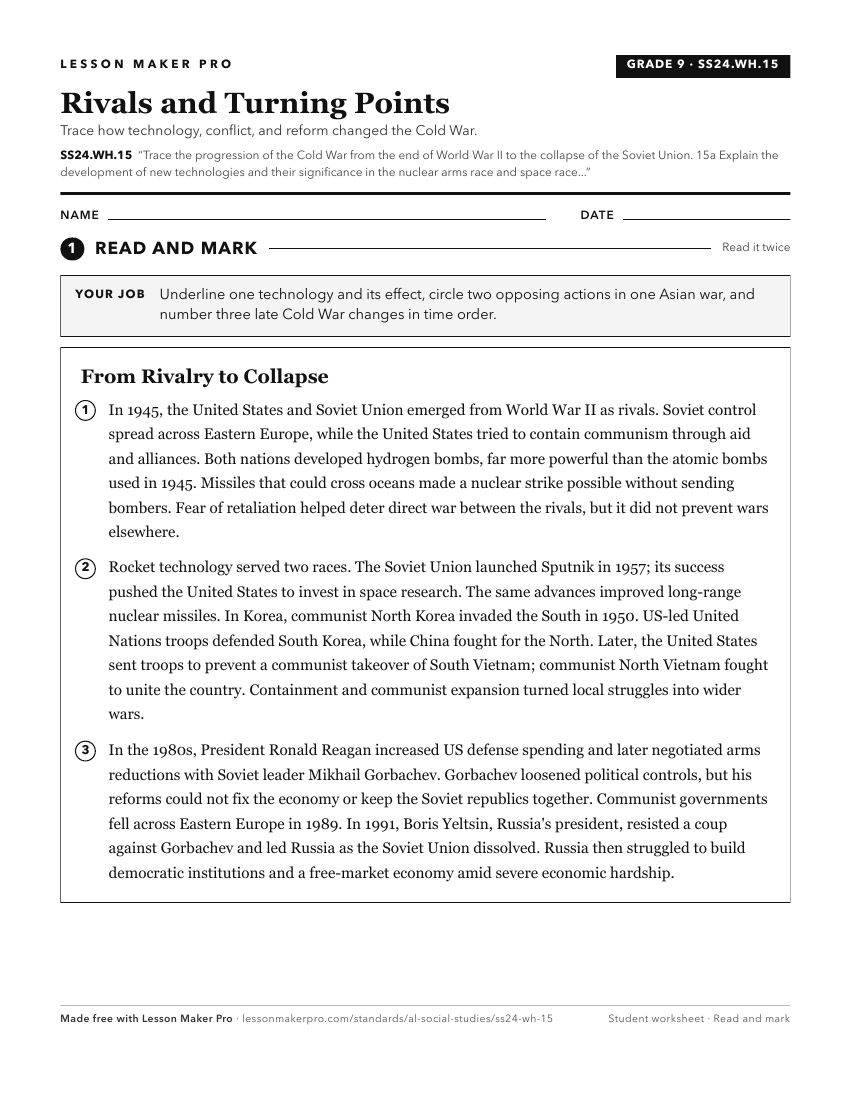
A ready-to-print activity worksheet aligned to SS24.WH.15, with an answer key for the teacher on its own page. No account needed.
PDF, US Letter, prints cleanly in black and white.
Download the worksheetKeep exploring
Related Standards
- SS24.5.13
Summarize why the United States sought to contain communism during the Cold War, and locate major communist countries from the Cold War era on a map.
- SS24.US2.17c
Trace the series of events during Reagan’s presidency leading to the emergence of the United States as the sole superpower, the fall of the Berlin Wall, and the...
- SS24.US2.6
Trace the progression of events and policies leading to World War II and the United States’ entry into the war.
Turn this cluster into a lesson
Grade, subject, topic, and the complete cluster are prefilled. Create one free, no account needed.
Also for this cluster:Make a WorksheetMake a QuizMake a Sub Lesson