Alabama Social Studies SS24.US2.9
Standard Cluster
Outline the foreign policy changes that led the United States into the Cold War and contributed to its emergence as a superpower. 9a Develop an argument regarding the effectiveness of the United States policy of containment that resulted from its growing ideological and political tensions with the Soviet Union. 9b Compare the application of the United States’ policy of containment to various areas of the world outside the Soviet Union in the late 1940s and 1950s. 9c Identify and explain the origins of the United States’ involvement in the Korean War and the consequences of Harry Truman’s limited war plan for Korea. 9d Analyze the domestic responses to the Cold War, including the impact of McCarthyism.
2024 Alabama Course of Study: Social Studies
Cluster contents
Standards in This Cluster
SS24.US2.9 is a cluster heading. These are the individual standards under it.
- SS24.US2.9a
Develop an argument regarding the effectiveness of the United States policy of containment that resulted from its growing ideological and political tensions wit...
- SS24.US2.9b
Compare the application of the United States’ policy of containment to various areas of the world outside the Soviet Union in the late 1940s and 1950s.
- SS24.US2.9c
Identify and explain the origins of the United States’ involvement in the Korean War and the consequences of Harry Truman’s limited war plan for Korea.
- SS24.US2.9d
Analyze the domestic responses to the Cold War, including the impact of McCarthyism.
Teacher's field guide
What This Cluster Means
What Students Need to Do
- Trace how U.S. policy shifted from wartime cooperation with the Soviet Union to aid, alliances, and military action against communist expansion. Compare containment in Europe and Asia, then judge its results using evidence. Explain U.S. entry into Korea, Truman's limited war, and McCarthyism at home.
What Mastery Looks Like
- Students link the Truman Doctrine, Marshall Plan, and NATO to a growing U.S. role abroad. They compare aid in Europe with combat in Korea and defend a judgment about containment. They explain North Korea's invasion, Truman's refusal to widen the war, the divided peninsula, and job losses during McCarthyism.
Common Misconceptions
- Students may think containment meant invading the Soviet Union, rather than stopping communist expansion elsewhere. They may treat the Korean War as a clear U.S. victory, rather than a costly stalemate with no peace treaty. They may assume McCarthy's accusations were proven cases of spying.
How to Assess It
- Exit ticket: Compare Marshall Plan aid with U.S. troops sent after North Korea invaded, then judge which better contained communism. Add one result of Truman's limited war and one cost of McCarthyism.
Lesson moves
Ways to Teach It
Give pairs a blank map and cards labeled Marshall Plan, Berlin Airlift, and Korean War; have them place and annotate each card.
Have students argue whether Truman's decision not to attack China made containment in Korea a success, citing the armistice and division.
Put Truman Doctrine, Marshall Plan, NATO, and Korean War cards on desks; teams race to sort them into aid, alliance, or combat.
Compare a 1950s loyalty oath with a modern job application's background-check notice; ask which information employers need and which could unfairly exclude applicants.
Free download
Printable SS24.US2.9 Worksheet
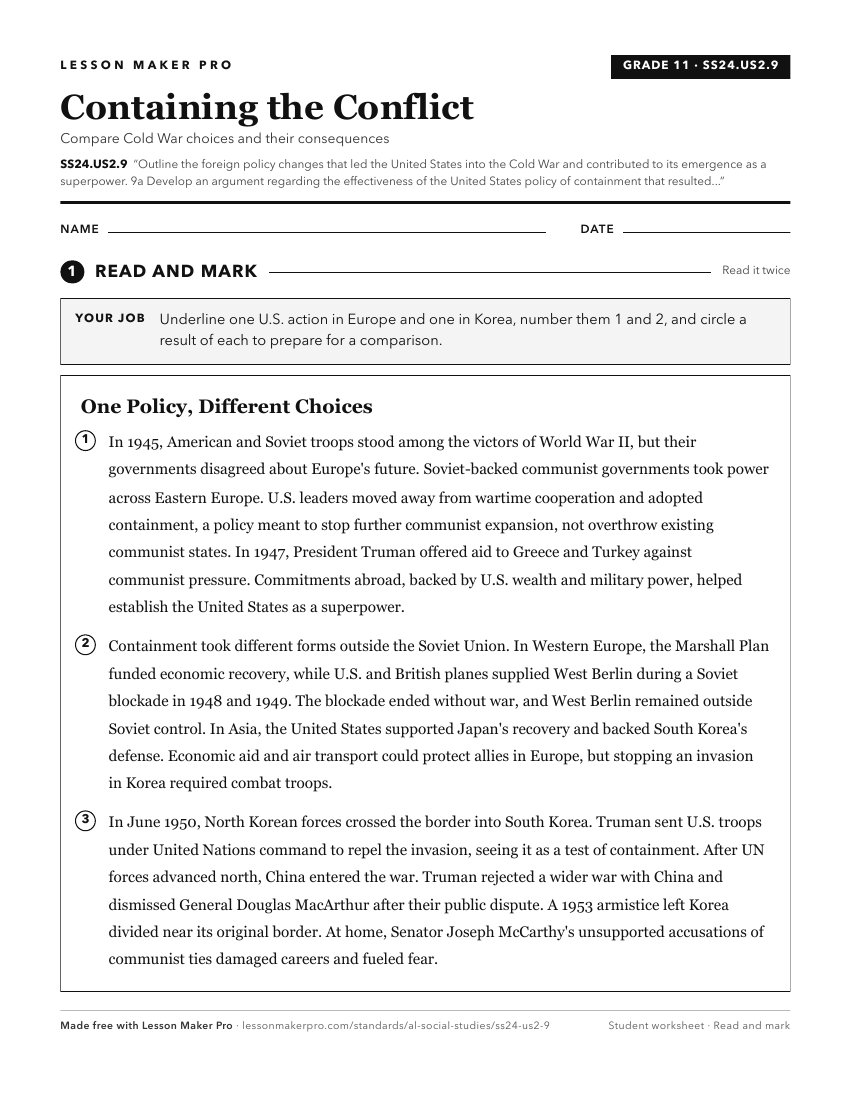
A ready-to-print activity worksheet aligned to SS24.US2.9, with an answer key for the teacher on its own page. No account needed.
PDF, US Letter, prints cleanly in black and white.
Download the worksheetKeep exploring
Related Standards
- SS24.US2.18
Analyze the shifts in United States foreign policy and challenges to it after the Cold War and into the twenty-first century.
- SS24.US2.7e
Explain how key consequences of World War II shaped United States foreign policy after the war.
- SS24.5.14
Describe how the United States’ involvement in the Cold War influenced domestic and international events.
- SS24.US2.13
Explain the evolution of America’s Cold War policy to defend democracy and contain communism around the world and how this led to an escalation in armed conflic...
Turn this cluster into a lesson
Grade, subject, topic, and the complete cluster are prefilled. Create one free, no account needed.
Also for this cluster:Make a WorksheetMake a QuizMake a Sub Lesson