Alabama Social Studies SS24.US2.2
Standard Cluster
Trace United States military involvement in World War I and the contributions of the American Expeditionary Force to the victory of the Allied Powers. 2a Describe the roles of Black Americans as members of the military and on the home front during World War I, including the Harlem Hellfighters and the Great Migration. 2b Describe the changing roles and rights of women in the United States that resulted from their contributions to World War I and ratification of the Nineteenth Amendment. 2c Analyze how government actions in the United States during World War I produced both economic growth and social division. 2d Compare the reasons given by opposing sides in the debate over whether the United States should ratify the Treaty of Versailles (1919).
2024 Alabama Course of Study: Social Studies
Cluster contents
Standards in This Cluster
SS24.US2.2 is a cluster heading. These are the individual standards under it.
- SS24.US2.2a
Describe the roles of Black Americans as members of the military and on the home front during World War I, including the Harlem Hellfighters and the Great Migra...
- SS24.US2.2b
Describe the changing roles and rights of women in the United States that resulted from their contributions to World War I and ratification of the Nineteenth Am...
- SS24.US2.2c
Analyze how government actions in the United States during World War I produced both economic growth and social division.
- SS24.US2.2d
Compare the reasons given by opposing sides in the debate over whether the United States should ratify the Treaty of Versailles (1919).
Teacher's field guide
What This Cluster Means
What Students Need to Do
- Students trace where U.S. troops fought and how they helped the Allies win. They explain Black Americans’ military service and migration north, and how women’s wartime work strengthened calls for voting rights. They examine wartime production and limits on dissent, then compare arguments about the peace treaty.
What Mastery Looks Like
- A student can explain the American Expeditionary Force’s role at Meuse-Argonne and identify the Harlem Hellfighters as a Black regiment that fought under French command. They can link northern factory jobs to the Great Migration and women’s wartime work to the push for voting rights. They can name a policy that increased production, a law that restricted dissent, and a reason each side gave in the treaty debate.
Common Misconceptions
- Students may think the United States fought throughout the war or won it alone. They may think the Great Migration began in 1917 or that the Nineteenth Amendment removed every barrier women faced at the polls. They may assume treaty opponents rejected peace, rather than objecting to League of Nations commitments.
How to Assess It
- Exit ticket: Why did some senators support the peace treaty while others opposed it? Give one reason for each side and mention the League of Nations.
Lesson moves
Ways to Teach It
Give pairs a 1918 France map and cards for Château-Thierry, Saint-Mihiel, and Meuse-Argonne; have them mark where U.S. troops fought.
Show a Harlem Hellfighters photo and a northern factory job ad; ask why military service and migration did not end discrimination.
Run a card sort matching the War Industries Board, Espionage Act, and Nineteenth Amendment to production, dissent, and voting rights.
Compare short excerpts from NATO Article 5 and League Covenant Article 10; ask which commitments a treaty opponent might question.
Free download
Printable SS24.US2.2 Worksheet
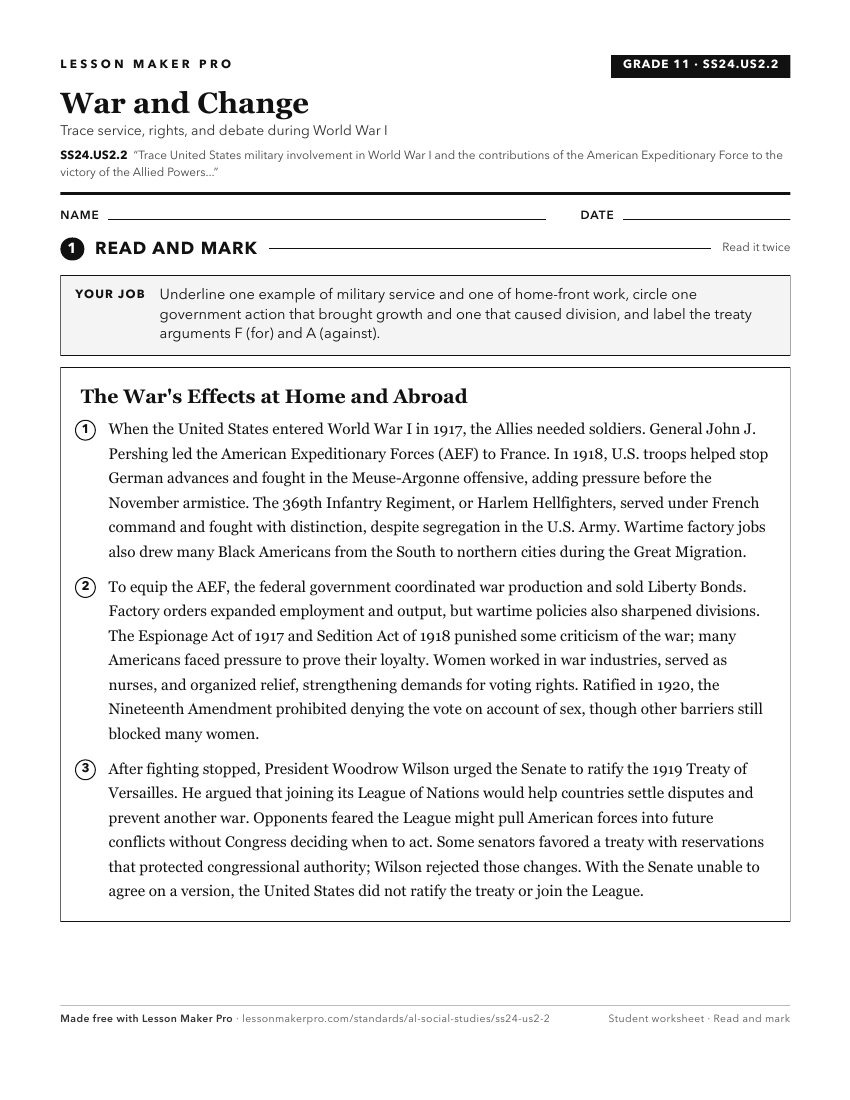
A ready-to-print activity worksheet aligned to SS24.US2.2, with an answer key for the teacher on its own page. No account needed.
PDF, US Letter, prints cleanly in black and white.
Download the worksheetKeep exploring
Related Standards
- SS24.US2.1e
Summarize the events and factors that led to the United States entry into World War I.
- SS24.US2.7
Analyze how United States military involvement shaped major events of World War II.
- SS24.5.5a
Identify and explain international events that led to the United States’ entry into World War I.
- SS24.5.9b
Explain the military contributions of Americans during World War II, including the achievements of the Tuskegee Airmen and Alabama Medal of Honor recipients.
Turn this cluster into a lesson
Grade, subject, topic, and the complete cluster are prefilled. Create one free, no account needed.
Also for this cluster:Make a WorksheetMake a QuizMake a Sub Lesson