Alabama Social Studies SS24.US2.2b
The Standard
- SS24.US2.2
- Trace United States military involvement in World War I and the contributions of the American Expeditionary Force to the victory of the Allied Powers.
Describe the changing roles and rights of women in the United States that resulted from their contributions to World War I and ratification of the Nineteenth Amendment.
2024 Alabama Course of Study: Social Studies
Teacher's field guide
What This Standard Means
What Students Need to Do
- Students describe women's wartime work in factories, hospitals, and relief groups. They explain how that work strengthened a decades-long push for voting rights. They identify voting barriers that remained after 1920.
What Mastery Looks Like
- A student can use a wartime job ad and a 1920 voting notice to explain what changed. They can distinguish voting rights from job opportunities that narrowed after the war. They can explain why many Black women still could not vote freely.
Common Misconceptions
- Students may think women could not vote anywhere before 1920, though some states already allowed it. They may assume the amendment ended racial barriers at the polls. Some mistake temporary wartime jobs for lasting workplace equality.
How to Assess It
- Exit ticket: Name one wartime job women held, explain how wartime service affected the campaign for the vote, and name one voting barrier that remained after 1920.
Lesson moves
Ways to Teach It
Give pairs four cards about factory hiring, wartime nursing, the 1920 vote, and postwar layoffs; have them order the cards and explain each change.
Ask students to write: Did wartime work give women lasting rights? Require one example of a new opportunity and one limit.
Play a card sort: students place six claims under wartime work or voting rights, then correct two false claims.
Compare a 1920 voting eligibility card with today's state registration form; mark a right women gained and a barrier that remained in 1920.
Free download
Printable SS24.US2.2b Worksheet
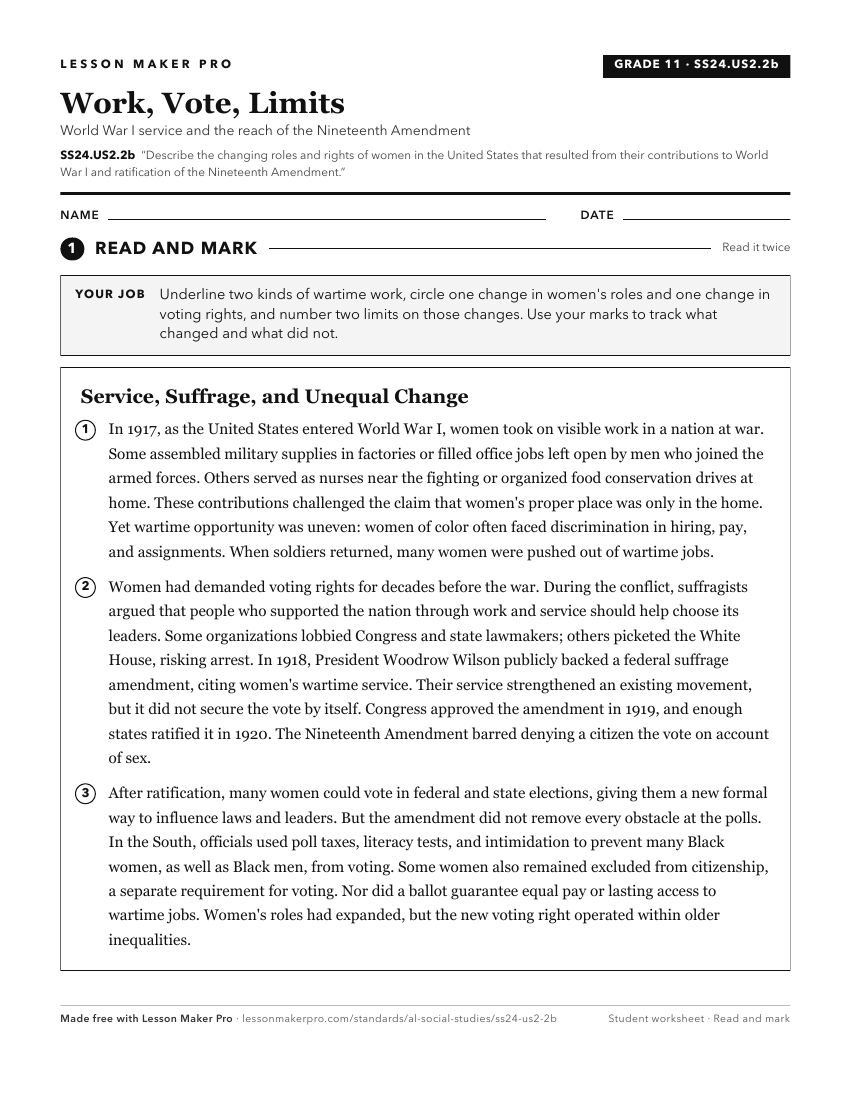
A ready-to-print activity worksheet aligned to SS24.US2.2b, with an answer key for the teacher on its own page. No account needed.
PDF, US Letter, prints cleanly in black and white.
Download the worksheetKeep exploring
Related Standards
- SS24.5.2a
Summarize how women in Alabama participated in the suffrage movement prior to the ratification of the Nineteenth Amendment.
- SS24.US1.7a
Summarize the contributions of women reformers in the early to mid-nineteenth century who sought to expand political and educational opportunities for women.
- SS24.US1.7
Assess how women challenged their societal roles under the Cult of Domesticity through their participation in social movements prior to the Civil War.
- SS24.US1.18d
Analyze the roles and differing viewpoints of female reformers and women’s organizations in guiding the women’s suffrage and temperance movements.
Turn this exact standard into a lesson
Grade, subject, topic, and the complete standard are prefilled. Create one free, no account needed.
Also for this standard:Make a WorksheetMake a QuizMake a Sub Lesson