Alabama Social Studies SS24.US2.2d
The Standard
- SS24.US2.2
- Trace United States military involvement in World War I and the contributions of the American Expeditionary Force to the victory of the Allied Powers.
Compare the reasons given by opposing sides in the debate over whether the United States should ratify the Treaty of Versailles (1919).
2024 Alabama Course of Study: Social Studies
Teacher's field guide
What This Standard Means
What Students Need to Do
- Students compare why some senators supported the treaty and why others opposed it. They explain how the League of Nations raised questions about peace, national independence, and Congress's power to declare war.
What Mastery Looks Like
- A student can explain Wilson's case for joining the League and Lodge's demand for limits on U.S. commitments. They can distinguish senators who wanted changes from those who rejected the treaty outright.
Common Misconceptions
- Students may think every senator who criticized the treaty wanted to reject it. They may also think joining the League would automatically send U.S. troops to every conflict.
How to Assess It
- Exit ticket: Why did Wilson support ratification, and why did Lodge want reservations? Write one sentence explaining how Lodge's position differed from rejecting the treaty outright.
Lesson moves
Ways to Teach It
Give pairs claim cards about peace, Article X, and congressional war powers; have them sort each claim under Wilson, Lodge, or treaty opponents.
Ask students: Would you approve the treaty as written, approve it with reservations, or reject it? Defend your choice against one opposing argument.
Run a three-corner vote for approval, approval with reservations, or rejection; assign students a position to defend using a claim card.
Print NATO's Article 5 and ask students to compare its mutual-defense promise with senators' concerns about U.S. commitments in 1919.
Free download
Printable SS24.US2.2d Worksheet
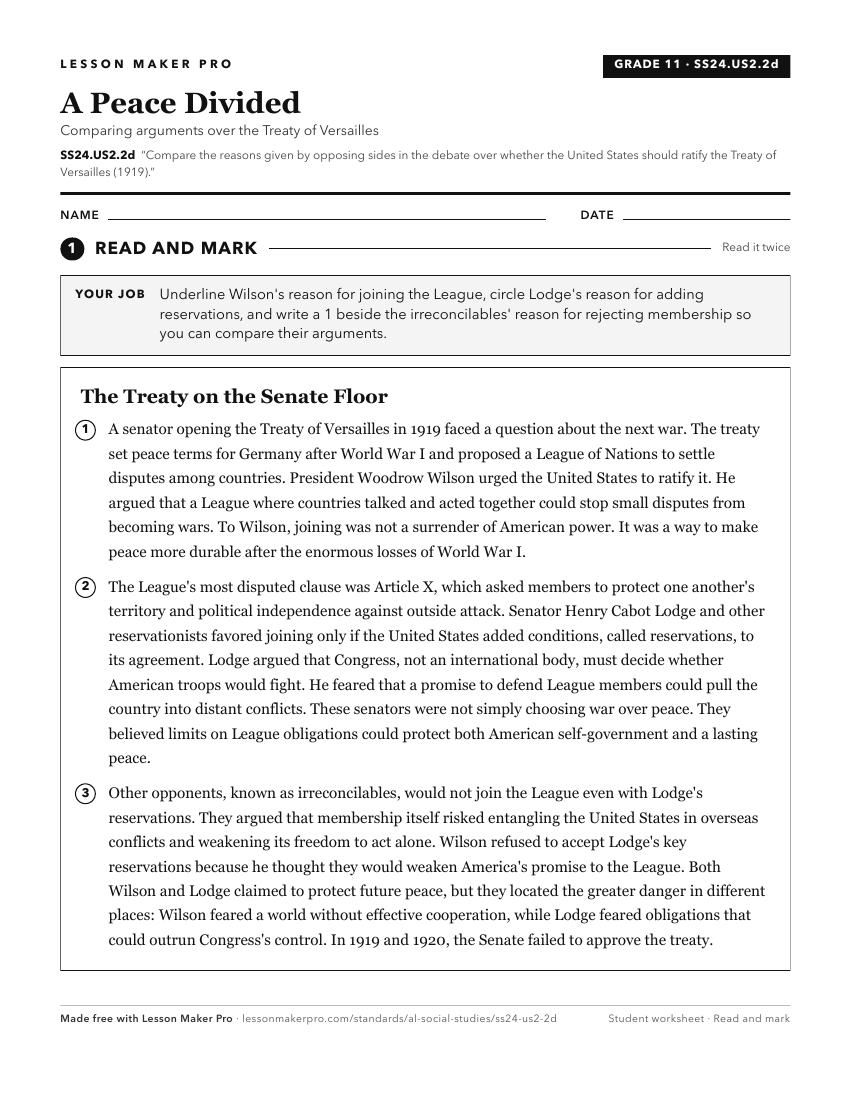
A ready-to-print activity worksheet aligned to SS24.US2.2d, with an answer key for the teacher on its own page. No account needed.
PDF, US Letter, prints cleanly in black and white.
Download the worksheetKeep exploring
Related Standards
- SS24.US2.1
Summarize conflicting viewpoints over the United States’ role in the world from the Spanish-American War to its entry into World War I.
- SS24.US2.1d
Compare and contrast the arguments of those in the United States who advocated for preparedness and those who sought neutrality from 1914 to 1917.
- SS24.WH.7c
Explain the consequences of the Treaty of Versailles of 1919, including political and boundary changes.
- SS24.6.11b
Summarize the arguments favoring and opposing ratification of the Constitution of the United States.
Turn this exact standard into a lesson
Grade, subject, topic, and the complete standard are prefilled. Create one free, no account needed.
Also for this standard:Make a WorksheetMake a QuizMake a Sub Lesson