Alabama Social Studies SS24.US2.1
Standard Cluster
Summarize conflicting viewpoints over the United States’ role in the world from the Spanish-American War to its entry into World War I. 1a Explain how yellow journalism, jingoistic sentiments, and economic interests led to American entry into war with Spain. 1b Describe the consequences of the Spanish-American War, including the United States’ rise to global prominence, debate over territorial expansion, and military intervention in Cuba and the Philippines. 1c Trace United States’ interventions around the world under Theodore Roosevelt’s Big Stick Diplomacy, William Howard Taft’s Dollar Diplomacy, and Woodrow Wilson’s Moral Diplomacy. 1d Compare and contrast the arguments of those in the United States who advocated for preparedness and those who sought neutrality from 1914 to 1917. 1e Summarize the events and factors that led to the United States entry into World War I.
2024 Alabama Course of Study: Social Studies
Cluster contents
Standards in This Cluster
SS24.US2.1 is a cluster heading. These are the individual standards under it.
- SS24.US2.1a
Explain how yellow journalism, jingoistic sentiments, and economic interests led to American entry into war with Spain.
- SS24.US2.1b
Describe the consequences of the Spanish-American War, including the United States’ rise to global prominence, debate over territorial expansion, and military i...
- SS24.US2.1c
Trace United States’ interventions around the world under Theodore Roosevelt’s Big Stick Diplomacy, William Howard Taft’s Dollar Diplomacy, and Woodrow Wilson’s...
- SS24.US2.1d
Compare and contrast the arguments of those in the United States who advocated for preparedness and those who sought neutrality from 1914 to 1917.
- SS24.US2.1e
Summarize the events and factors that led to the United States entry into World War I.
Teacher's field guide
What This Cluster Means
What Students Need to Do
- Students explain why the United States fought Spain and what changed in Cuba, the Philippines, and the debate over empire. They track how Roosevelt, Taft, and Wilson intervened abroad. They compare arguments for neutrality and preparedness, then explain why the United States entered World War I.
What Mastery Looks Like
- A student connects sensational headlines, calls for war, and economic interests to the war with Spain. They identify the war’s effects and link Roosevelt to Panama, Taft to Nicaragua, and Wilson to Mexico. They distinguish preparing for war from entering it and explain how German submarine attacks and the Zimmermann Telegram affected the 1917 decision.
Common Misconceptions
- Students may treat yellow journalism as the only cause of war with Spain or think Cuba and the Philippines became states. They may assume all three presidents used the same approach abroad or that preparedness meant immediate entry into World War I. Some mistake the 1915 sinking of the Lusitania for the event that brought the United States into war in 1917.
How to Assess It
- Exit ticket: Write five sentences covering one cause of war with Spain, one consequence, one difference between two presidents’ policies, one argument for neutrality or preparedness, and one reason for entering World War I.
Lesson moves
Ways to Teach It
Give pairs headline cards, trade figures, and a map of Cuba and the Philippines; have them sort causes and consequences of the 1898 war.
Ask, “Should the United States have kept the Philippines after 1898?” Have students write two sentences for annexation and two against.
Put Panama, Nicaragua, and Mexico on three cards; students match each to Roosevelt, Taft, or Wilson and explain the policy behind it.
Show a headline about U.S. aid to Ukraine; students write one parallel and one difference with the 1917 neutrality debate.
Free download
Printable SS24.US2.1 Worksheet
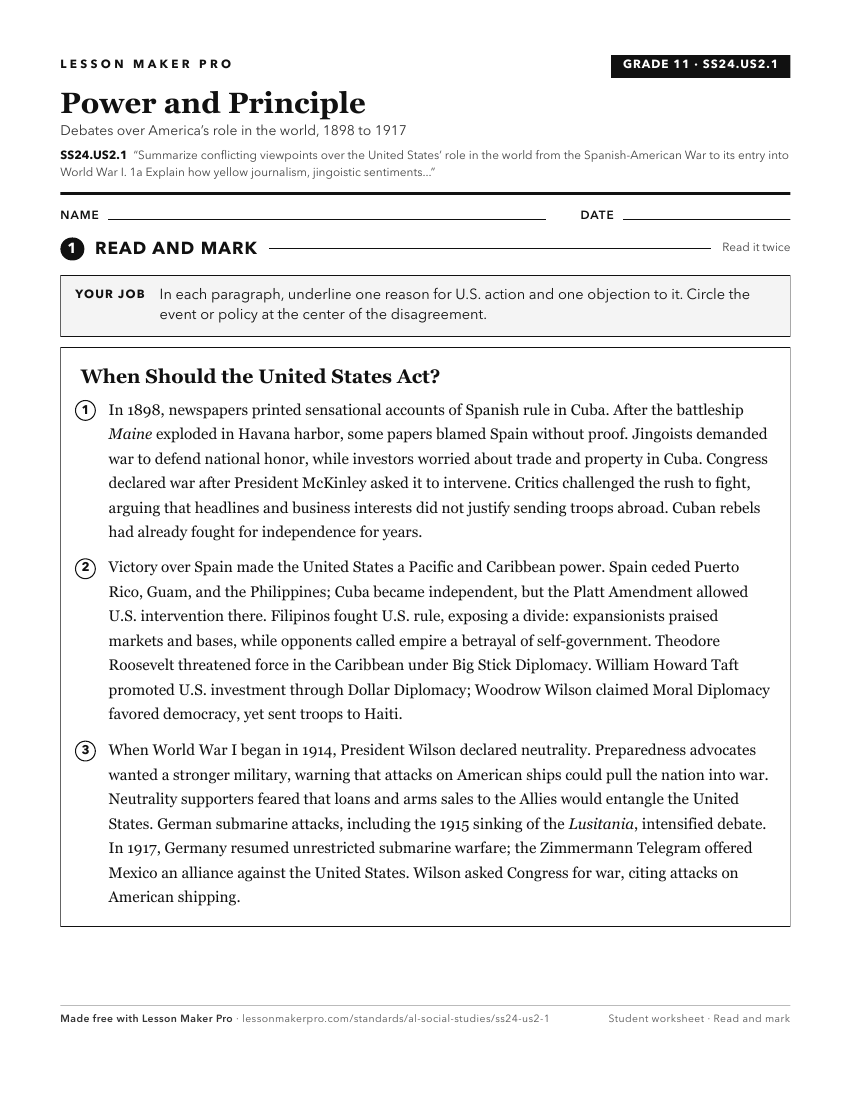
A ready-to-print activity worksheet aligned to SS24.US2.1, with an answer key for the teacher on its own page. No account needed.
PDF, US Letter, prints cleanly in black and white.
Download the worksheetKeep exploring
Related Standards
Turn this cluster into a lesson
Grade, subject, topic, and the complete cluster are prefilled. Create one free, no account needed.
Also for this cluster:Make a WorksheetMake a QuizMake a Sub Lesson