Alabama Social Studies SS24.US2.1c
The Standard
- SS24.US2.1
- Summarize conflicting viewpoints over the United States’ role in the world from the Spanish-American War to its entry into World War I.
Trace United States’ interventions around the world under Theodore Roosevelt’s Big Stick Diplomacy, William Howard Taft’s Dollar Diplomacy, and Woodrow Wilson’s Moral Diplomacy.
2024 Alabama Course of Study: Social Studies
Teacher's field guide
What This Standard Means
What Students Need to Do
- Students place U.S. actions in Panama, Nicaragua, and Mexico on a timeline and map. They explain how each president used force, money, or claims about democracy to extend U.S. influence. They describe what changed for the countries involved.
What Mastery Looks Like
- A student connects Roosevelt to U.S. support for Panama’s separation from Colombia, Taft to loans and troops in Nicaragua, and Wilson to the occupation of Veracruz. They explain that the U.S. gained canal rights in Panama, financial influence in Nicaragua, and faced resistance in Mexico.
Common Misconceptions
- Students may think Dollar Diplomacy relied only on money, with no threat of force. They may assume Moral Diplomacy was peaceful, even though Wilson sent troops. Some mix up which president acted in each country.
How to Assess It
- On a blank map, mark Panama, Nicaragua, and Veracruz. Beside each place, write the president, policy, U.S. action, and one effect.
Lesson moves
Ways to Teach It
Give pairs a blank map and three dated case cards; have them place stickers on Panama, Nicaragua, and Veracruz and label each U.S. action.
Ask: How did Wilson’s occupation of Veracruz fit, or clash, with his claim to support democratic government? Cite one detail.
Play a card match with presidents, policy names, and intervention sites; partners explain each match before keeping the cards.
Show a current Panama Canal shipping map; students draw a route and write how U.S. support for Panama’s independence shaped canal access.
Free download
Printable SS24.US2.1c Worksheet
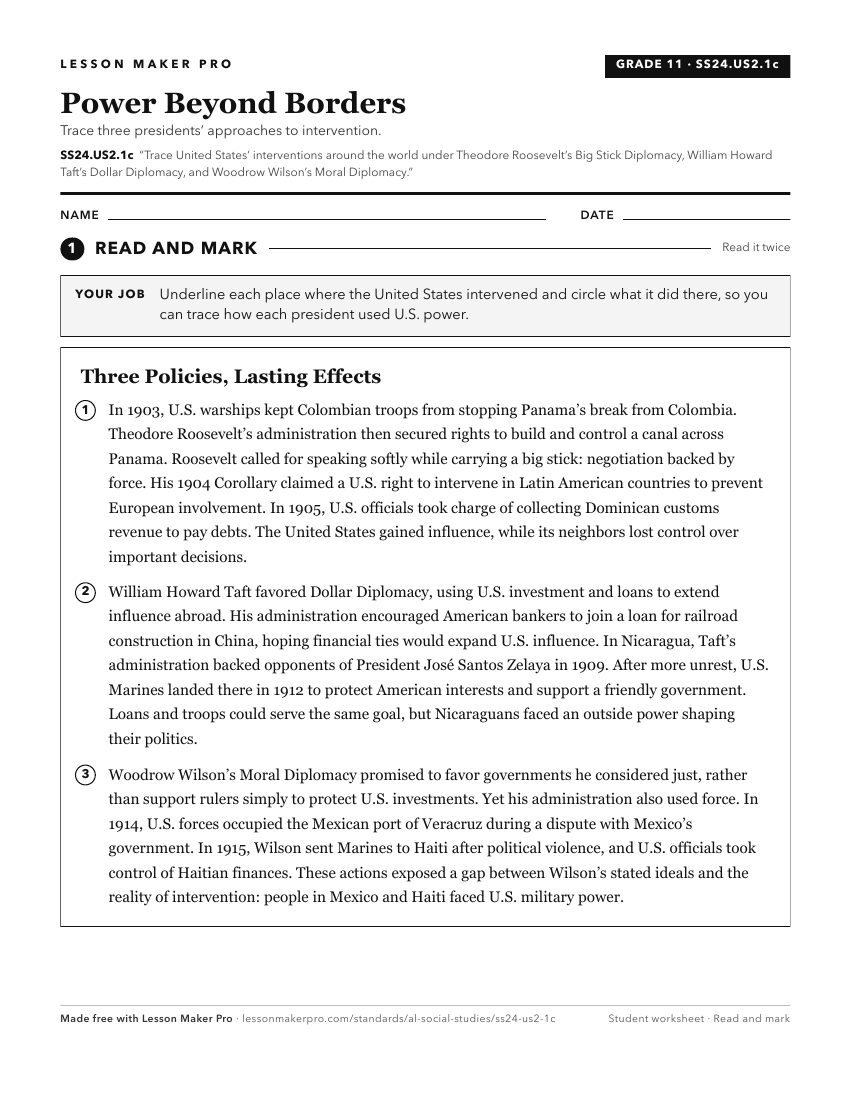
A ready-to-print activity worksheet aligned to SS24.US2.1c, with an answer key for the teacher on its own page. No account needed.
PDF, US Letter, prints cleanly in black and white.
Download the worksheetKeep exploring
Related Standards
- SS24.US2.1
Summarize conflicting viewpoints over the United States’ role in the world from the Spanish-American War to its entry into World War I.
- SS24.US2.7e
Explain how key consequences of World War II shaped United States foreign policy after the war.
- SS24.US2.18a
Investigate the role and influence of the United States in peacekeeping efforts around the world from the 1990s into the early twenty-first century.
- SS24.US1.20
Compare and contrast the domestic agendas and accomplishments of Theodore Roosevelt, William Howard Taft, and Woodrow Wilson.
Turn this exact standard into a lesson
Grade, subject, topic, and the complete standard are prefilled. Create one free, no account needed.
Also for this standard:Make a WorksheetMake a QuizMake a Sub Lesson