Alabama Social Studies SS24.S.11a
The Standard
- SS24.S.11
- Explain why social movements form, and identify the factors that produce large-scale social change as a result of these movements.*
Compare and contrast the major theories of collective behavior, including contagion theory, convergence theory, and emergent norm theory.*
2024 Alabama Course of Study: Social Studies · Social Issues and Social Change
Teacher's field guide
What This Standard Means
What Students Need to Do
- Students explain three ways a crowd can act together: behavior spreads, people with shared views gather, or new rules take shape as people interact. They use details from an event to tell these explanations apart.
What Mastery Looks Like
- Given a crowd scene, a student can identify which explanation fits each detail. They can point to shared views people brought with them, copied behavior, or a new group rule as evidence.
Common Misconceptions
- Students may treat every chant as proof that behavior spread through the crowd, even when people arrived ready to chant. They may mistake a new rule made by the crowd for one set by organizers.
How to Assess It
- Exit ticket: Name the theory that best fits each clue and explain why: 'cheers spread through a crowd,' 'people who already oppose a policy gather,' and 'strangers invent a turn-taking rule during a delay.'
Lesson moves
Ways to Teach It
Give pairs a bus-stop sketch and three sticky notes labeled 'already upset,' 'copies a complaint,' and 'new boarding rule'; sort them under theory headings.
Ask: 'At a planned protest, which theory explains why people came, and which could explain a chant that starts there?'
Call out 'cheer spreads,' 'protesters arrive with shared goals,' and 'riders invent a boarding rule'; students flash theory cards and defend one answer.
At a school game, compare fans arriving to cheer, a chant spreading, and students inventing a concession-line rule; name the theory for each.
Free download
Printable SS24.S.11a Worksheet
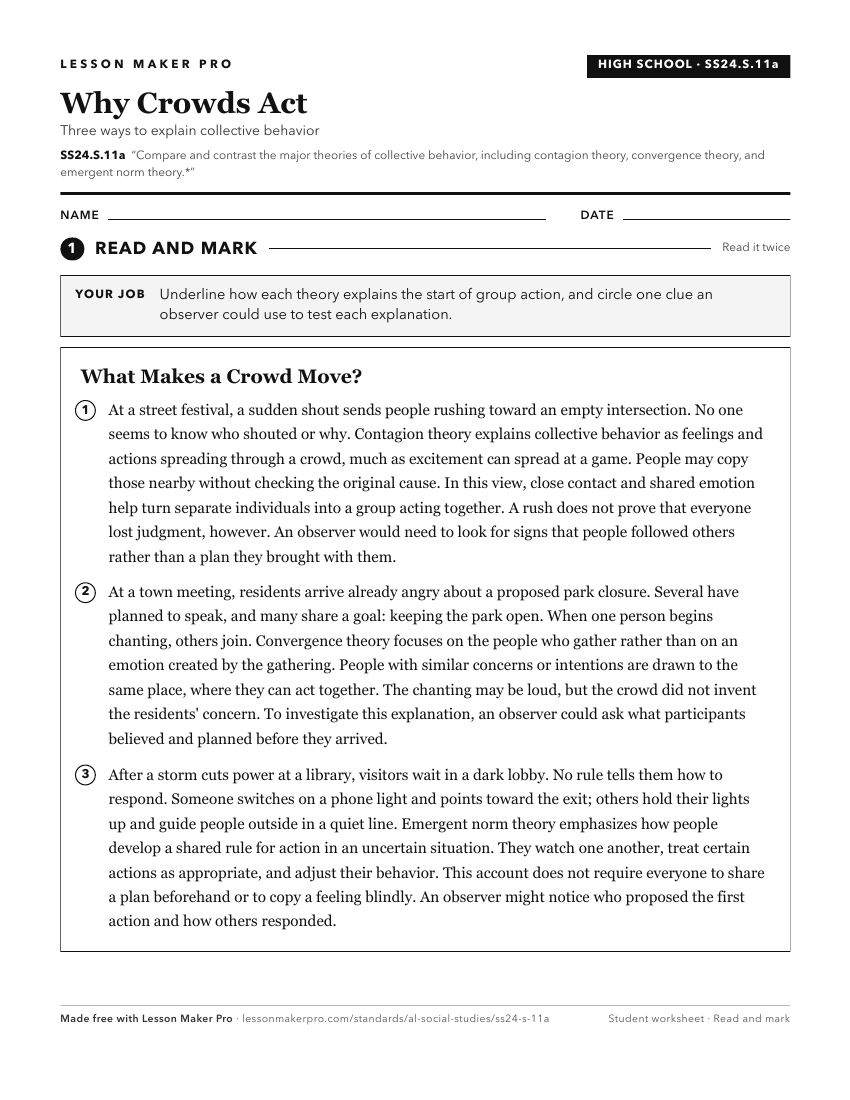
A ready-to-print activity worksheet aligned to SS24.S.11a, with an answer key for the teacher on its own page. No account needed.
PDF, US Letter, prints cleanly in black and white.
Download the worksheetKeep exploring
Related Standards
- SS24.S.7a
Compare and contrast types of groups and the reasons for group formation.*
- SS24.P.17
Describe how attitudes, conditions of obedience and conformity, and other influences affect actions and shape human behavior, including actor-observer, self-ser...
- SS24.S.7
Analyze how different types of social groups can influence individual and group behavior.*
- SS24.S.3
Compare and contrast the three major sociological theories: functionalism, conflict theory, and symbolic interaction.*
Turn this exact standard into a lesson
Grade, subject, topic, and the complete standard are prefilled. Create one free, no account needed.
Also for this standard:Make a WorksheetMake a QuizMake a Sub Lesson