Alabama Social Studies SS24.P.17
Standard Cluster
Describe how attitudes, conditions of obedience and conformity, and other influences affect actions and shape human behavior, including actor-observer, self-server, social facilitation, social loafing, bystander effect, groupthink, and group polarization. 17a Critique the ethical issues found in Stanley Milgram's work with obedience and S. E. Asch's work with conformity.
2024 Alabama Course of Study: Social Studies
Cluster contents
Standards in This Cluster
SS24.P.17 is a cluster heading. These are the individual standards under it.
Teacher's field guide
What This Cluster Means
What Students Need to Do
- Students explain how attitudes, authority, peers, and an audience can change actions. They recognize attribution biases, group decision errors, reduced effort in groups, and hesitation to help in crowds. They critique deception, consent, and possible distress in Milgram's and Asch's studies.
What Mastery Looks Like
- Given a short scenario, students name the influence and point to the detail that shows it. They explain why their own mistake may seem situational while someone else's seems personal. They identify an ethical risk in each study and suggest a safer method.
Common Misconceptions
- Students may treat obedience to an authority and conformity with peers as the same thing. They may confuse groupthink, which favors agreement, with group polarization, which moves opinions toward an extreme. Some assume a study is ethical just because participants agreed to join.
How to Assess It
- Exit ticket: A student privately disagrees but votes with classmates. After talking, the group adopts an even stronger position. Name both group effects, cite a clue for each, and name one ethical concern from Milgram's or Asch's study.
Lesson moves
Ways to Teach It
Pairs sort three cards: a watched familiar task, an unassigned team poster, and a crowded hallway accident; they label each effect.
Ask: Should Milgram and Asch have used deception? Name one possible harm in each study and propose a safer method.
Play concept bingo: read cases of blaming a classmate, excusing your own mistake, silent agreement, or extreme opinions; students justify each marked square.
Show a mock social media thread where replies grow more extreme; students mark evidence of group polarization and rewrite one reply to invite dissent.
Free download
Printable SS24.P.17 Worksheet
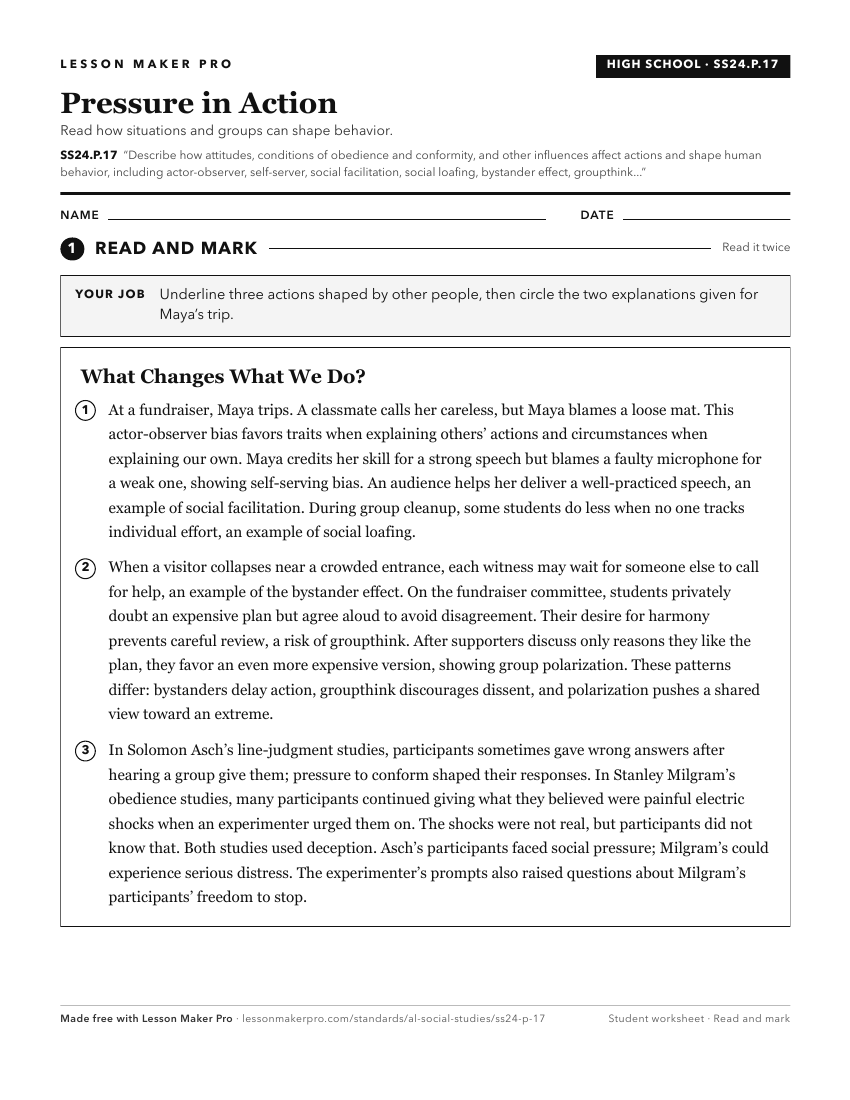
A ready-to-print activity worksheet aligned to SS24.P.17, with an answer key for the teacher on its own page. No account needed.
PDF, US Letter, prints cleanly in black and white.
Download the worksheetKeep exploring
Related Standards
- SS24.S.11a
Compare and contrast the major theories of collective behavior, including contagion theory, convergence theory, and emergent norm theory.*
- SS24.S.4b
Illustrate and explain key concepts and goals of socialization, including self-concept, looking-glass self, significant others, and role-taking.
- SS24.S.5c
Investigate and explain the impact of psychological theories that influence sociology, including Erikson’s Psychosocial Development, Kohlberg’s Stages of Moral ...
- SS24.S.7
Analyze how different types of social groups can influence individual and group behavior.*
Turn this cluster into a lesson
Grade, subject, topic, and the complete cluster are prefilled. Create one free, no account needed.
Also for this cluster:Make a WorksheetMake a QuizMake a Sub Lesson