Alabama Social Studies SS24.S.5c
The Standard
- SS24.S.5
- Compare and contrast the phases of development in the human life cycle, including birth, childhood, adolescence, adulthood, parenthood, middle age, and late adulthood.*
Investigate and explain the impact of psychological theories that influence sociology, including Erikson’s Psychosocial Development, Kohlberg’s Stages of Moral Development, Piaget’s Stages of Cognitive Development, and Vygotsky’s Sociocultural Theory.
2024 Alabama Course of Study: Social Studies · Self and Socialization
Teacher's field guide
What This Standard Means
What Students Need to Do
- Students compare how Erikson, Kohlberg, Piaget, and Vygotsky explain changes in identity, moral reasoning, thinking, and learning. They explain how these ideas shape what sociologists study about family, school, peers, and culture.
What Mastery Looks Like
- Given a student council debate, students distinguish someone's reason for obeying a rule (Kohlberg) from their ability to consider a hypothetical rule (Piaget). They explain how Erikson frames identity in peer groups and Vygotsky frames learning with help from others.
Common Misconceptions
- Students may think Kohlberg's stages measure whether someone behaves well, rather than why they judge an action as right. They may treat Piaget's age ranges as fixed, or confuse Erikson's identity work with Vygotsky's guided learning.
How to Assess It
- Exit ticket: A ninth grader feels more confident after joining a team and learns new plays from an older teammate. Name two theorists, match each to one detail, and explain what each tells sociologists about socialization.
Lesson moves
Ways to Teach It
Sort case cards labeled team identity, rule fairness, abstract debate, and peer tutoring under Erikson, Kohlberg, Piaget, or Vygotsky; explain each match.
Write three sentences comparing how joining a club shapes identity and how a tutor helps learning, using Erikson and Vygotsky.
Play 'Who would ask that?': teams match questions about identity, rule reasons, hypothetical thinking, and peer coaching to the right theorist.
Using a student handbook rule, compare 'avoid detention' and 'keep school orderly' as reasons to comply; label each using Kohlberg's levels.
Free download
Printable SS24.S.5c Worksheet
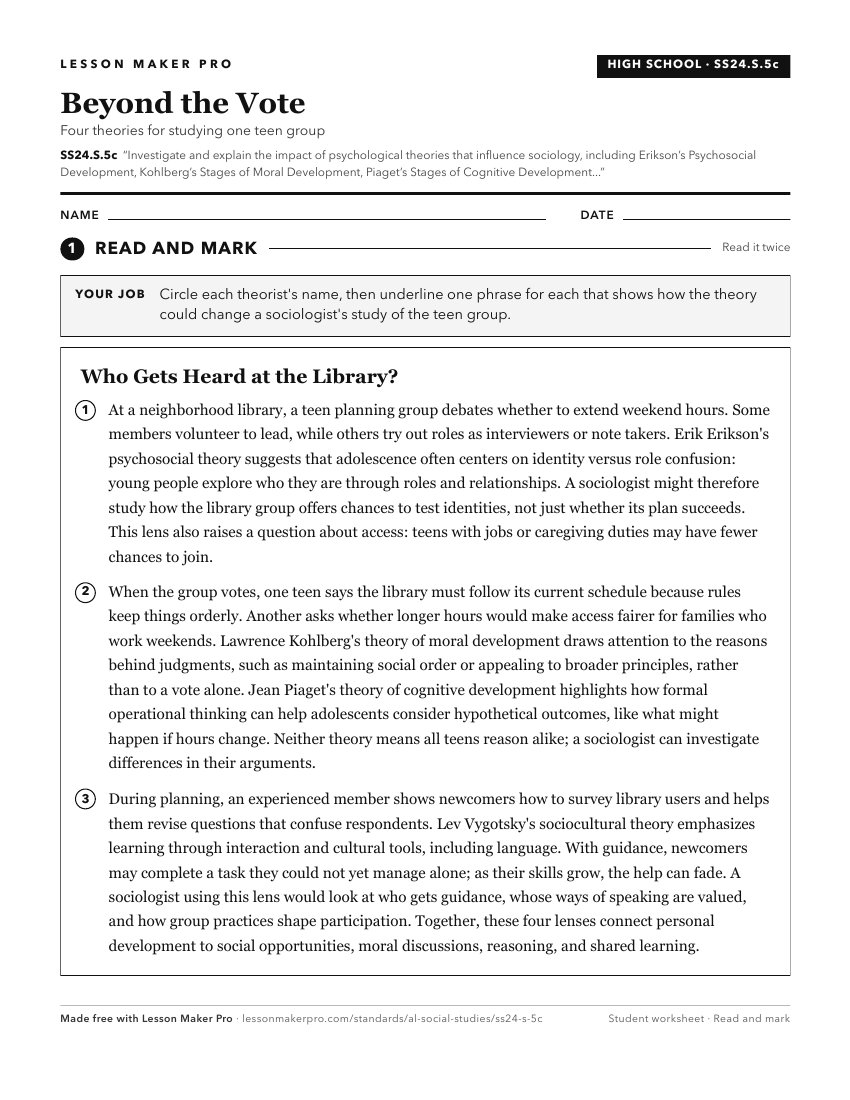
A ready-to-print activity worksheet aligned to SS24.S.5c, with an answer key for the teacher on its own page. No account needed.
PDF, US Letter, prints cleanly in black and white.
Download the worksheetKeep exploring
Related Standards
- SS24.S.1b
Identify and explain tenets of sociology, including functional integration, power, social action, social structure, and culture.
- SS24.P.9
Describe cognitive, physical, and social development across the human lifespan, citing theories of Carol Gilligan, Erik H. Erikson, Jean Piaget, and Lawrence Ko...
- SS24.S.3a
Apply the major sociological theories to a situation and evaluate the differences in interpretations.
- SS24.S.3
Compare and contrast the three major sociological theories: functionalism, conflict theory, and symbolic interaction.*
Turn this exact standard into a lesson
Grade, subject, topic, and the complete standard are prefilled. Create one free, no account needed.
Also for this standard:Make a WorksheetMake a QuizMake a Sub Lesson