Alabama Social Studies SS24.P.9
The Standard
Describe cognitive, physical, and social development across the human lifespan, citing theories of Carol Gilligan, Erik H. Erikson, Jean Piaget, and Lawrence Kohlberg.
2024 Alabama Course of Study: Social Studies
Teacher's field guide
What This Standard Means
What Students Need to Do
- Students trace changes in thinking, the body, and relationships from infancy through old age. They use Piaget, Erikson, Kohlberg, and Gilligan to explain thinking, social challenges, and moral choices.
What Mastery Looks Like
- A student connects a school-age child’s logical sorting to Piaget and a teen’s identity questions to Erikson. They identify puberty as a physical change. They contrast Kohlberg’s focus on justice with Gilligan’s focus on care and relationships.
Common Misconceptions
- Students may mistake Piaget’s stages for physical growth or assume everyone develops at the same age. They may think Gilligan claimed only women use care when making moral choices.
How to Assess It
- Exit ticket: Draw a timeline for a child, a teen, and an older adult. Add one physical change, then label examples that fit Piaget, Erikson, Kohlberg, and Gilligan.
Lesson moves
Ways to Teach It
Give groups age and behavior cards to sort into physical, thinking, and social changes, then have them add a matching theorist where one fits.
Ask students to write how Kohlberg and Gilligan might explain a teen’s choice to report a friend who cheated.
Play a card match with four theorist names and brief examples, such as logical sorting, identity questions, justice reasoning, and care reasoning.
Compare a playground safety sign and a senior center exercise flyer; list the physical, thinking, and social needs each addresses.
Free download
Printable SS24.P.9 Worksheet
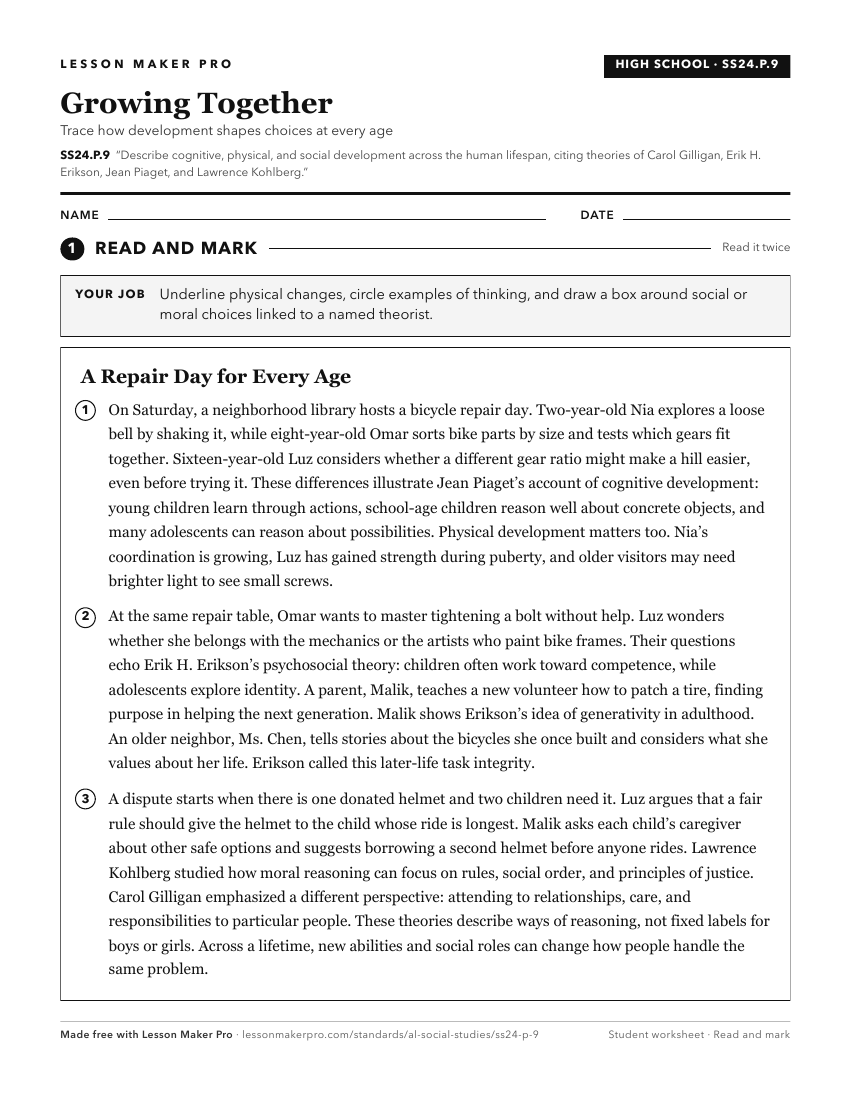
A ready-to-print activity worksheet aligned to SS24.P.9, with an answer key for the teacher on its own page. No account needed.
PDF, US Letter, prints cleanly in black and white.
Download the worksheetKeep exploring
Related Standards
- SS24.S.4b
Illustrate and explain key concepts and goals of socialization, including self-concept, looking-glass self, significant others, and role-taking.
- SS24.S.5c
Investigate and explain the impact of psychological theories that influence sociology, including Erikson’s Psychosocial Development, Kohlberg’s Stages of Moral ...
- SS24.P.14
Explain the role of personality development in human behavior and differentiate among theories that seek to explain this development.
- SS24.S.5
Compare and contrast the phases of development in the human life cycle, including birth, childhood, adolescence, adulthood, parenthood, middle age, and late adu...
Turn this exact standard into a lesson
Grade, subject, topic, and the complete standard are prefilled. Create one free, no account needed.
Also for this standard:Make a WorksheetMake a QuizMake a Sub Lesson