Alabama Social Studies SS24.S.5
Standard Cluster
Compare and contrast the phases of development in the human life cycle, including birth, childhood, adolescence, adulthood, parenthood, middle age, and late adulthood.* 5a Explain the value of utilizing birth cohorts as a research device. 5b Differentiate among primary, secondary, and adult socialization and identify the key influences of socialization for each stage. 5c Investigate and explain the impact of psychological theories that influence sociology, including Erikson’s Psychosocial Development, Kohlberg’s Stages of Moral Development, Piaget’s Stages of Cognitive Development, and Vygotsky’s Sociocultural Theory.
2024 Alabama Course of Study: Social Studies
Cluster contents
Standards in This Cluster
SS24.S.5 is a cluster heading. These are the individual standards under it.
- SS24.S.5a
Explain the value of utilizing birth cohorts as a research device.
- SS24.S.5b
Differentiate among primary, secondary, and adult socialization and identify the key influences of socialization for each stage.
- SS24.S.5c
Investigate and explain the impact of psychological theories that influence sociology, including Erikson’s Psychosocial Development, Kohlberg’s Stages of Moral ...
Teacher's field guide
What This Cluster Means
What Students Need to Do
- Students compare how roles and expectations change from birth through childhood, adolescence, adulthood, parenthood, middle age, and late adulthood. They identify who teaches people new roles at each phase and use birth cohorts and development theories to explain patterns.
What Mastery Looks Like
- Students compare life phases and sort learning at home, at school, and in new adult roles as primary, secondary, and adult socialization. They use birth cohorts to spot shared historical influences without assuming everyone has the same experience. They apply Erikson to identity, Kohlberg to moral choices, Piaget to thinking, and Vygotsky to learning with others.
Common Misconceptions
- Students may treat parenthood as a required phase or assume everyone reaches milestones at the same age. They may confuse a birth cohort with people who are the same age today. They may also treat moral reasoning, thinking, and learning with others as one process rather than distinct ideas.
How to Assess It
- Give students this case: “A 16-year-old learns lab rules from classmates; a 72-year-old learns video calls from a neighbor.” Ask them to name each life phase and type of socialization, identify a theory that explains learning with others, and give one reason to group people by birth year.
Lesson moves
Ways to Teach It
Give groups age cards and role cards; have them build a life timeline and mark which roles, including parenthood, are optional.
Ask students to write how Erikson would explain a teen's search for identity and Kohlberg would explain the teen's choice to report cheating.
Play a sorting relay with scenario cards for primary, secondary, and adult socialization; teams name the parent, peer, teacher, or employer involved.
Use a 1990 and a current school supply ad to predict how students' shared school experiences differ across birth cohorts.
Free download
Printable SS24.S.5 Worksheet
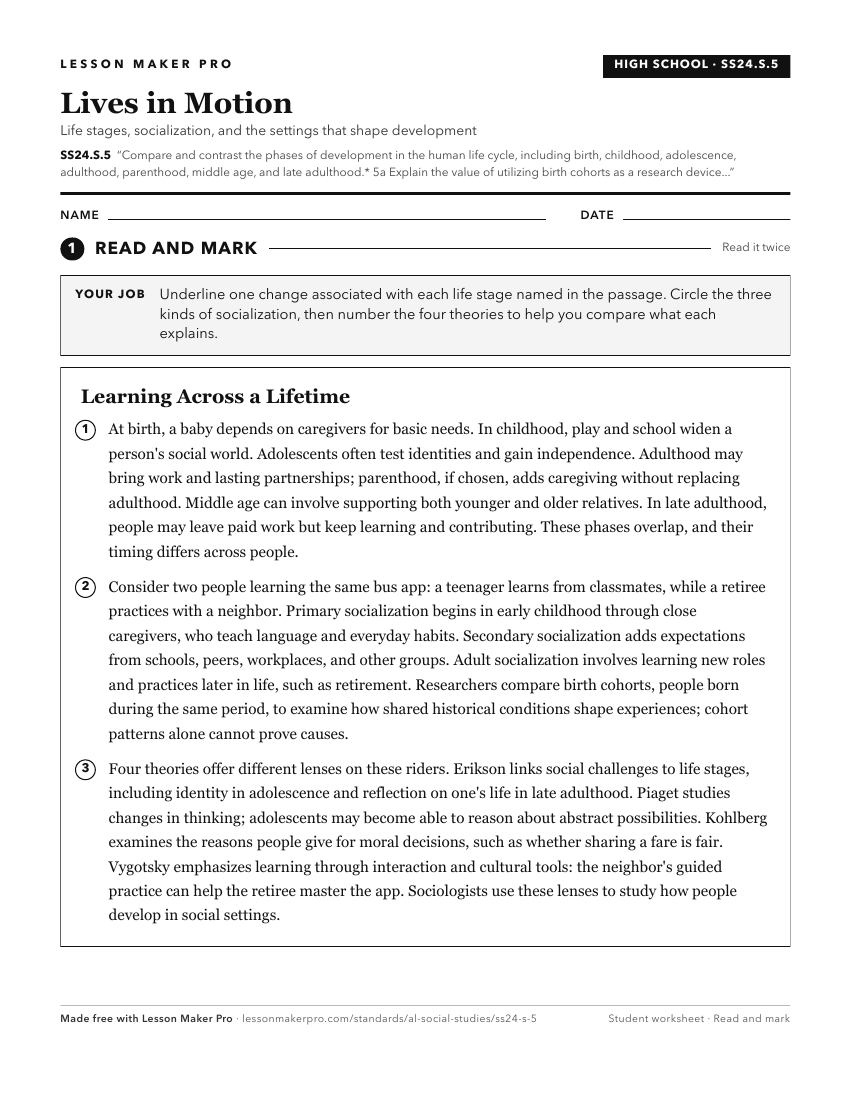
A ready-to-print activity worksheet aligned to SS24.S.5, with an answer key for the teacher on its own page. No account needed.
PDF, US Letter, prints cleanly in black and white.
Download the worksheetKeep exploring
Related Standards
- SS24.HG.8
Compare and contrast the roles of men and women in societies around the world, including matrilineal and patrilineal societies.
- SS24.P.9
Describe cognitive, physical, and social development across the human lifespan, citing theories of Carol Gilligan, Erik H. Erikson, Jean Piaget, and Lawrence Ko...
- SS24.P.4
Compare the effects of heredity and environment on development and behavior.*
Turn this cluster into a lesson
Grade, subject, topic, and the complete cluster are prefilled. Create one free, no account needed.
Also for this cluster:Make a WorksheetMake a QuizMake a Sub Lesson