Alabama Social Studies SS24.S.5b
The Standard
- SS24.S.5
- Compare and contrast the phases of development in the human life cycle, including birth, childhood, adolescence, adulthood, parenthood, middle age, and late adulthood.*
Differentiate among primary, secondary, and adult socialization and identify the key influences of socialization for each stage.
2024 Alabama Course of Study: Social Studies · Self and Socialization
Teacher's field guide
What This Standard Means
What Students Need to Do
- Students sort examples of learning social rules by when and where that learning happens. They identify who teaches those rules, such as caregivers, classmates, friends, or coworkers.
What Mastery Looks Like
- A student can explain why learning table manners from a caregiver is primary socialization, learning classroom norms from classmates is secondary socialization, and learning workplace rules at a new job is adult socialization. They can name an influence in each example.
Common Misconceptions
- Students may think primary means the strongest influence, rather than learning that begins early in life. They may label all learning outside the home as secondary, even when an adult is learning a new job or family role.
How to Assess It
- On an exit ticket, ask students to label three examples: a toddler copies a caregiver's greeting, a ninth grader learns lunchroom norms from friends, and a new employee learns office routines from a supervisor. Have them name the influence in each example.
Lesson moves
Ways to Teach It
Give pairs nine scenario cards and have them sort the cards into early home, school and peer, and adult role groups.
Ask students to write about one rule they learned from family and one they learned from friends, naming how each was taught.
Play a quick matching game with scenario cards and influence cards, such as new employee orientation and supervisor.
Show a sample employee orientation checklist and ask students which workplace rules a new hire must learn from coworkers or a supervisor.
Free download
Printable SS24.S.5b Worksheet
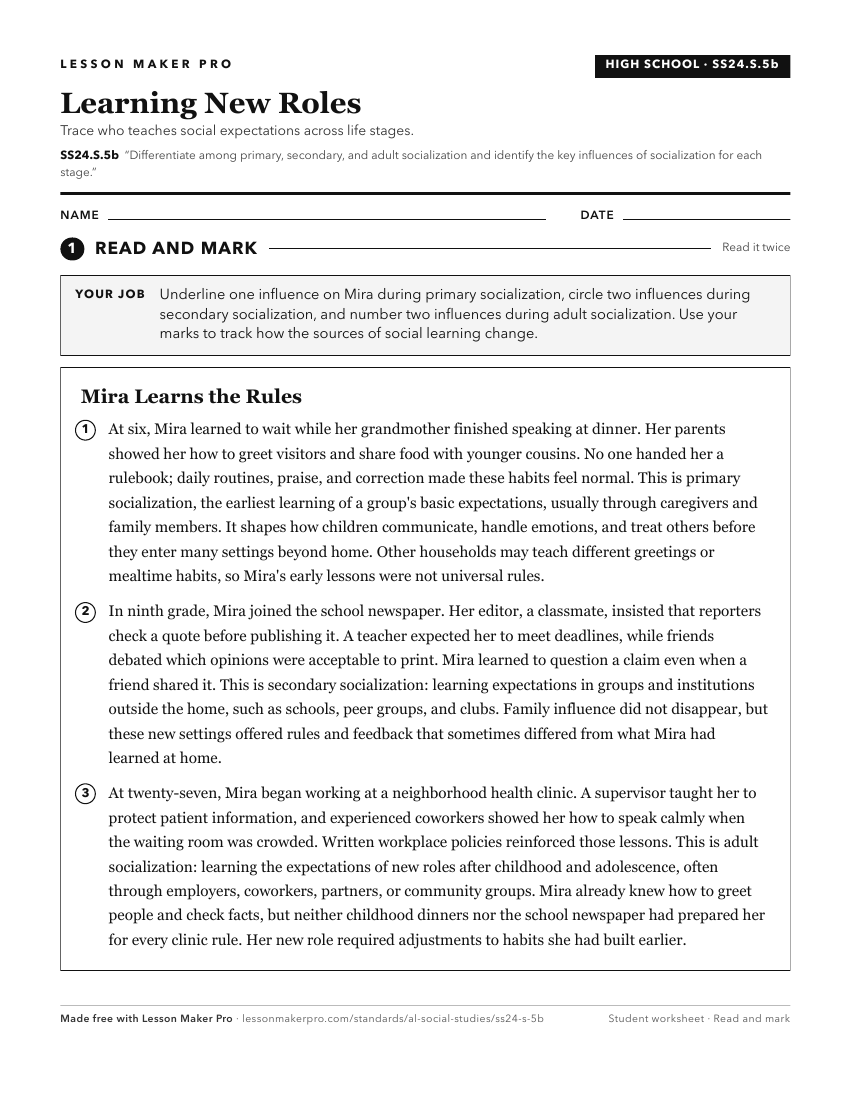
A ready-to-print activity worksheet aligned to SS24.S.5b, with an answer key for the teacher on its own page. No account needed.
PDF, US Letter, prints cleanly in black and white.
Download the worksheetKeep exploring
Related Standards
- SS24.S.4b
Illustrate and explain key concepts and goals of socialization, including self-concept, looking-glass self, significant others, and role-taking.
- SS24.S.4c
Describe the major agents of socialization and evaluate the role that each one plays.*
- SS24.S.5c
Investigate and explain the impact of psychological theories that influence sociology, including Erikson’s Psychosocial Development, Kohlberg’s Stages of Moral ...
- SS24.S.7b
Trace the development of various types of social groups from hunter-gatherer societies to the present day and explain how the importance of primary and secondar...
Turn this exact standard into a lesson
Grade, subject, topic, and the complete standard are prefilled. Create one free, no account needed.
Also for this standard:Make a WorksheetMake a QuizMake a Sub Lesson