Alabama Social Studies SS24.S.7a
The Standard
- SS24.S.7
- Analyze how different types of social groups can influence individual and group behavior.*
Compare and contrast types of groups and the reasons for group formation.*
2024 Alabama Course of Study: Social Studies · Groups and Socialization
Teacher's field guide
What This Standard Means
What Students Need to Do
- Students compare primary groups, like close friends, with secondary groups, like a work crew. They identify in-groups and out-groups from a person's point of view. They explain how shared goals, interests, location, or a need for support bring people together.
What Mastery Looks Like
- Given a friend circle and a school club, students describe the ties in each and explain why each formed. They can explain why a club is an in-group for a member but an out-group for someone who does not belong.
Common Misconceptions
- Students may think primary means first or largest, rather than close-knit. They may treat in-group and out-group as fixed labels, regardless of who is speaking. They may think groups form only around shared hobbies.
How to Assess It
- Exit ticket: Maya joins a neighborhood cleanup crew, while Leo does not. Explain why the crew formed, how it differs from a friend circle, and whose in-group it is.
Lesson moves
Ways to Teach It
Pairs sort cards labeled family, friend circle, cleanup crew, and student council by relationship type, then write why each group formed.
Ask: Why might someone join a school club for its goal but stay for the friendships? Write two sentences comparing those reasons.
Read four group scenarios aloud. Teams name each group type and explain who would see the group as an in-group.
Show a local volunteer flyer. Students name the shared goal, predict who might join, and explain how close friendships could form.
Free download
Printable SS24.S.7a Worksheet
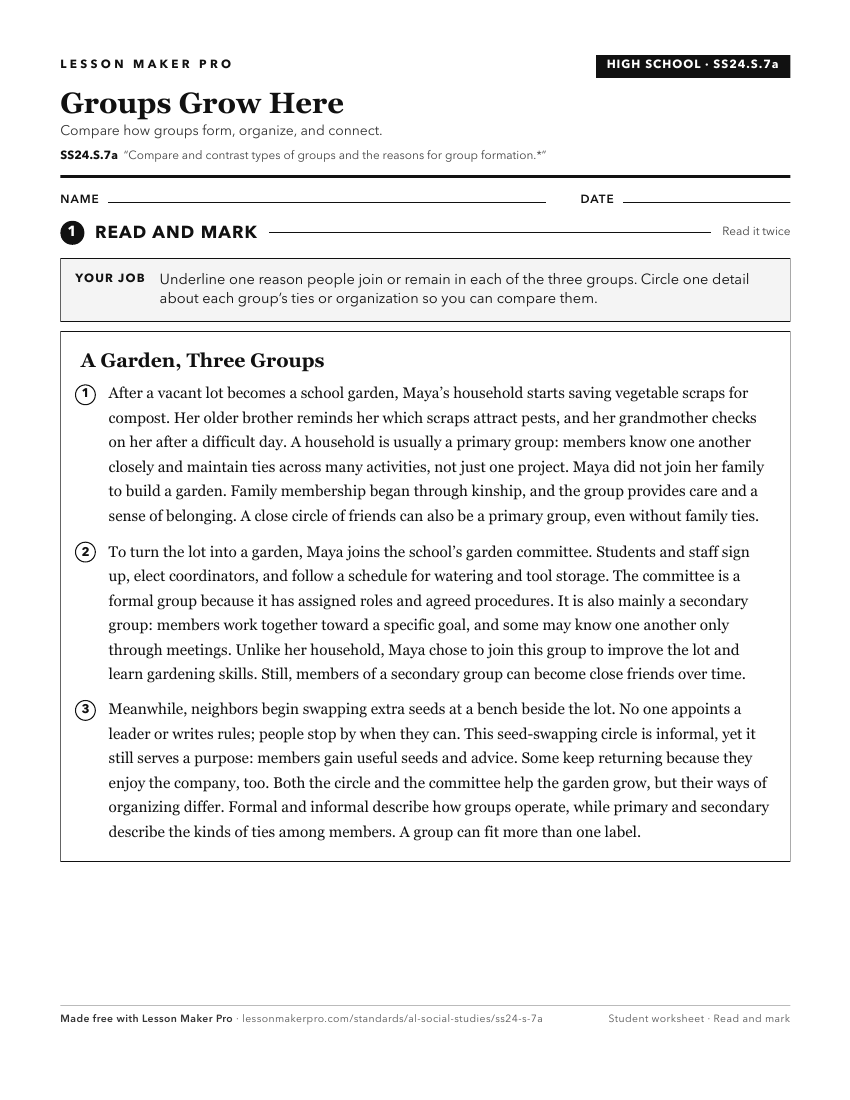
A ready-to-print activity worksheet aligned to SS24.S.7a, with an answer key for the teacher on its own page. No account needed.
PDF, US Letter, prints cleanly in black and white.
Download the worksheetKeep exploring
Related Standards
- SS24.S.11a
Compare and contrast the major theories of collective behavior, including contagion theory, convergence theory, and emergent norm theory.*
- SS24.S.7
Analyze how different types of social groups can influence individual and group behavior.*
- SS24.S.10b
Analyze the impact of social stratification on groups and individuals.*
- SS24.S.7b
Trace the development of various types of social groups from hunter-gatherer societies to the present day and explain how the importance of primary and secondar...
Turn this exact standard into a lesson
Grade, subject, topic, and the complete standard are prefilled. Create one free, no account needed.
Also for this standard:Make a WorksheetMake a QuizMake a Sub Lesson