Alabama Social Studies SS24.S.11
Standard Cluster
Explain why social movements form, and identify the factors that produce large-scale social change as a result of these movements.* 11a Compare and contrast the major theories of collective behavior, including contagion theory, convergence theory, and emergent norm theory.* 11b Describe how social movements, including the Civil Rights Movement, have created change throughout the history of the United States. 11c Explain the role of social institutions in fostering change and reinforcing stratification.*
2024 Alabama Course of Study: Social Studies
Cluster contents
Standards in This Cluster
SS24.S.11 is a cluster heading. These are the individual standards under it.
- SS24.S.11a
Compare and contrast the major theories of collective behavior, including contagion theory, convergence theory, and emergent norm theory.*
- SS24.S.11b
Describe how social movements, including the Civil Rights Movement, have created change throughout the history of the United States.
- SS24.S.11c
Explain the role of social institutions in fostering change and reinforcing stratification.*
Teacher's field guide
What This Cluster Means
What Students Need to Do
- Students explain why people organize around shared problems and what helps a movement grow. They compare three explanations for crowd behavior: spreading emotion, shared beliefs, and new rules formed in the moment. They show how movements and institutions can change laws or preserve inequality.
What Mastery Looks Like
- Students explain why the Montgomery bus boycott began and how church networks and carpools sustained it. They connect the boycott and a federal court ruling to bus desegregation, while noting how city rules had enforced segregation. Given a crowd scene, they can tell which explanation for crowd behavior fits best.
Common Misconceptions
- Students may think all three crowd theories mean people simply copy others. They may credit change to one leader and overlook organizers, institutions, and court action. They may assume schools and laws always reduce inequality, even when their rules preserve it.
How to Assess It
- Exit ticket: Why did the Montgomery bus boycott start, and how did churches and courts affect its outcome? Name the crowd theory that explains people with shared beliefs gathering to protest.
Lesson moves
Ways to Teach It
Give pairs six protest scenario cards to sort by spreading emotion, shared beliefs, or new crowd rules, then defend one choice.
Ask: How did Black churches and federal courts help the Montgomery bus boycott, and where did local government resist change?
Give teams shuffled cards for the Birmingham protests, televised police violence, public pressure, and the 1964 Civil Rights Act; have them explain each link.
Use a school attendance boundary map; students mark neighborhoods farthest from each school and write a question about access for the school board.
Free download
Printable SS24.S.11 Worksheet
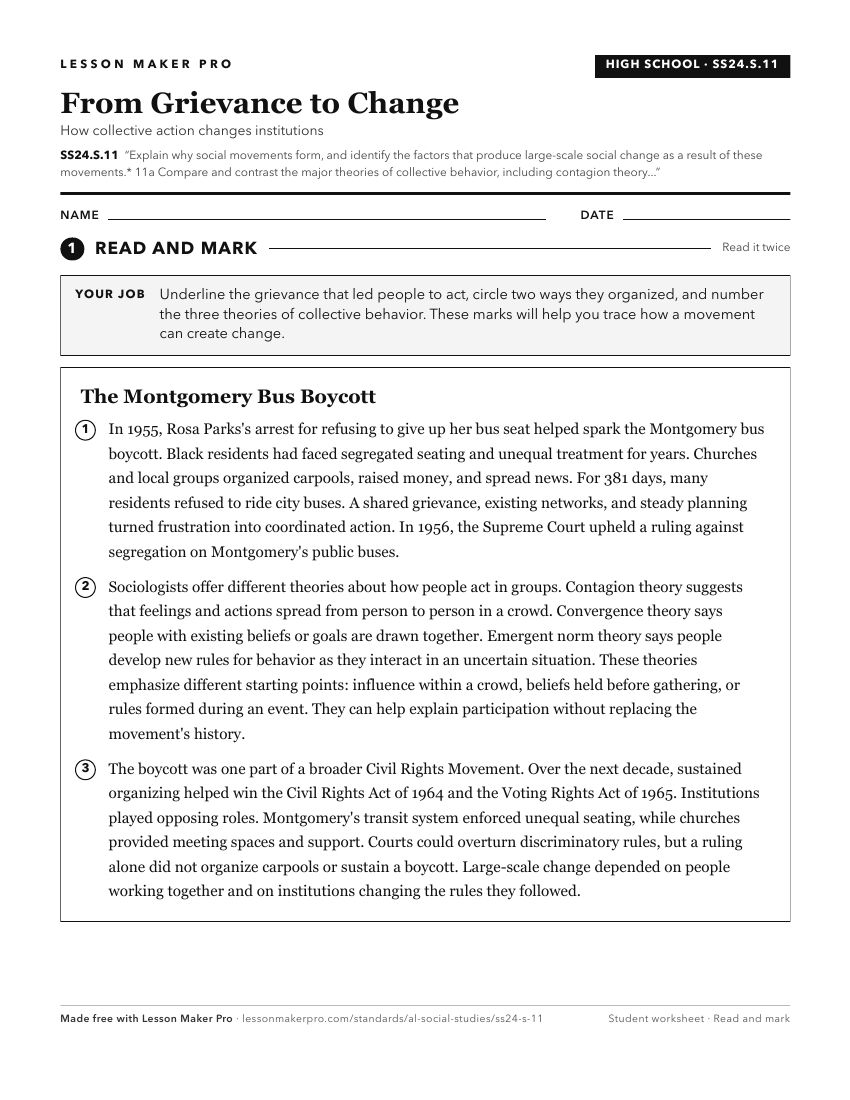
A ready-to-print activity worksheet aligned to SS24.S.11, with an answer key for the teacher on its own page. No account needed.
PDF, US Letter, prints cleanly in black and white.
Download the worksheetKeep exploring
Related Standards
- SS24.S.7a
Compare and contrast types of groups and the reasons for group formation.*
- SS24.US2.10
Evaluate the influence of events, organizations, and individual actions on the expansion of the Civil Rights Movement nationally.
- SS24.S.7
Analyze how different types of social groups can influence individual and group behavior.*
Turn this cluster into a lesson
Grade, subject, topic, and the complete cluster are prefilled. Create one free, no account needed.
Also for this cluster:Make a WorksheetMake a QuizMake a Sub Lesson