Alabama Social Studies SS24.7.14
Standard Cluster
Summarize cultural contributions and legacies of Classical Greece, including architecture, arts, intellectual life, literature, politics, and science. 14a Explain the development of the polis and analyze how geography affected the process, including Athens and Sparta. 14b Trace the development of Greek city-states' political systems, including democracy, that influenced the governments of modern nations. 14c Explain the influence of philosophers on Greek society, culture, and politics as well as their influence on modern thought. 14d Analyze the internal and external conflicts that played a role in Classical Greek society. 14e Describe the influence of Alexander the Great’s empire, including the establishment of Hellenistic kingdoms, the diffusion of Greek culture, and its role in shaping Rome.
2024 Alabama Course of Study: Social Studies
Cluster contents
Standards in This Cluster
SS24.7.14 is a cluster heading. These are the individual standards under it.
- SS24.7.14a
Explain the development of the polis and analyze how geography affected the process, including Athens and Sparta.
- SS24.7.14b
Trace the development of Greek city-states' political systems, including democracy, that influenced the governments of modern nations.
- SS24.7.14c
Explain the influence of philosophers on Greek society, culture, and politics as well as their influence on modern thought.
- SS24.7.14d
Analyze the internal and external conflicts that played a role in Classical Greek society.
- SS24.7.14e
Describe the influence of Alexander the Great’s empire, including the establishment of Hellenistic kingdoms, the diffusion of Greek culture, and its role in sha...
Teacher's field guide
What This Cluster Means
What Students Need to Do
- Students explain how geography shaped Athens and Sparta and how Athenian democracy differed from voting today. They identify Greek ideas in philosophy, architecture, theater, and science that later societies used. They connect wars and Alexander's conquests to Hellenistic kingdoms and Rome.
What Mastery Looks Like
- A student uses a map to explain why Athens relied on sea trade while Sparta built a land army. They explain who could vote in Athens and name a Greek idea, such as geometry or drama, that lasted. They distinguish wars between Greek city-states from wars against Persia and explain how Greek culture spread after Alexander.
Common Misconceptions
- Students may think Greece was one country with one government, rather than separate city-states. They may assume everyone in Athens could vote, including women and enslaved people. They may think Alexander's empire stayed united or that Rome copied Greek culture without changing it.
How to Assess It
- On an exit ticket, ask students to explain how geography shaped Athens and Sparta, who could vote in Athens, and how Greek culture reached Rome after Alexander.
Lesson moves
Ways to Teach It
On a relief map, mark mountains, ports, Athens, and Sparta, then write one reason each city-state developed differently.
Post 'Who should make laws?' Have pairs compare Athenian voting rules with a Socratic question about fairness and today's voting rules.
Give groups five event cards, Persian Wars, Peloponnesian War, Alexander's conquests, Hellenistic kingdoms, and Roman adoption, to order and explain.
Compare photos of a Greek temple and a local courthouse, then label shared columns and trace the design through a Roman temple.
Free download
Printable SS24.7.14 Worksheet
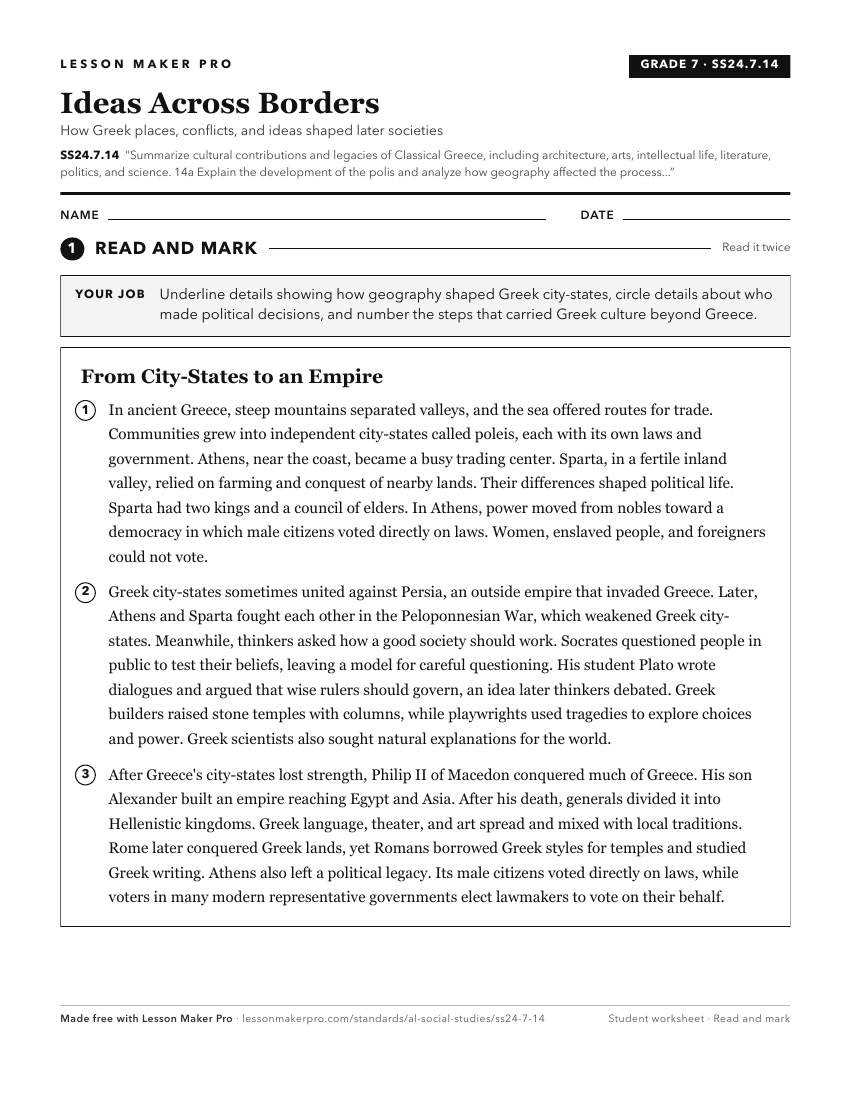
A ready-to-print activity worksheet aligned to SS24.7.14, with an answer key for the teacher on its own page. No account needed.
PDF, US Letter, prints cleanly in black and white.
Download the worksheetKeep exploring
Related Standards
Turn this cluster into a lesson
Grade, subject, topic, and the complete cluster are prefilled. Create one free, no account needed.
Also for this cluster:Make a WorksheetMake a QuizMake a Sub Lesson