Alabama Social Studies SS24.7.14e
The Standard
- SS24.7.14
- Summarize cultural contributions and legacies of Classical Greece, including architecture, arts, intellectual life, literature, politics, and science.
Describe the influence of Alexander the Great’s empire, including the establishment of Hellenistic kingdoms, the diffusion of Greek culture, and its role in shaping Rome.
2024 Alabama Course of Study: Social Studies
Teacher's field guide
What This Standard Means
What Students Need to Do
- Students explain how Alexander's empire split into kingdoms after his death. They trace how Greek language and ideas spread through those kingdoms and how Rome later borrowed from Greek culture.
What Mastery Looks Like
- A student can label Ptolemaic Egypt and Seleucid Asia on a map of Alexander's former empire. They can explain why Greek was used across these kingdoms and identify a Greek design used in Roman buildings.
Common Misconceptions
- Students may think Alexander conquered Rome or ruled the later kingdoms himself. They may also think Greek culture wiped out local customs rather than mixing with them.
How to Assess It
- Exit ticket: Name one kingdom formed after Alexander's death, give one example of Greek culture spreading, and explain one way Rome borrowed from Greek culture.
Lesson moves
Ways to Teach It
Use a blank map and colored pencils to mark Ptolemaic Egypt, Seleucid Asia, and Antigonid Macedonia after Alexander's empire split.
Show a photo and caption of the Rosetta Stone; ask, 'Why would rulers in Egypt publish a decree in Greek and Egyptian scripts?'
Give pairs cards labeled Ptolemaic Egypt, Greek-speaking Alexandria, and Roman copies of Greek statues; have them sort the cards into kingdom, cultural spread, or Roman influence.
Compare photos of the Parthenon and Rome's Pantheon; circle the Greek-style columns on each and note how Rome reused the design.
Free download
Printable SS24.7.14e Worksheet
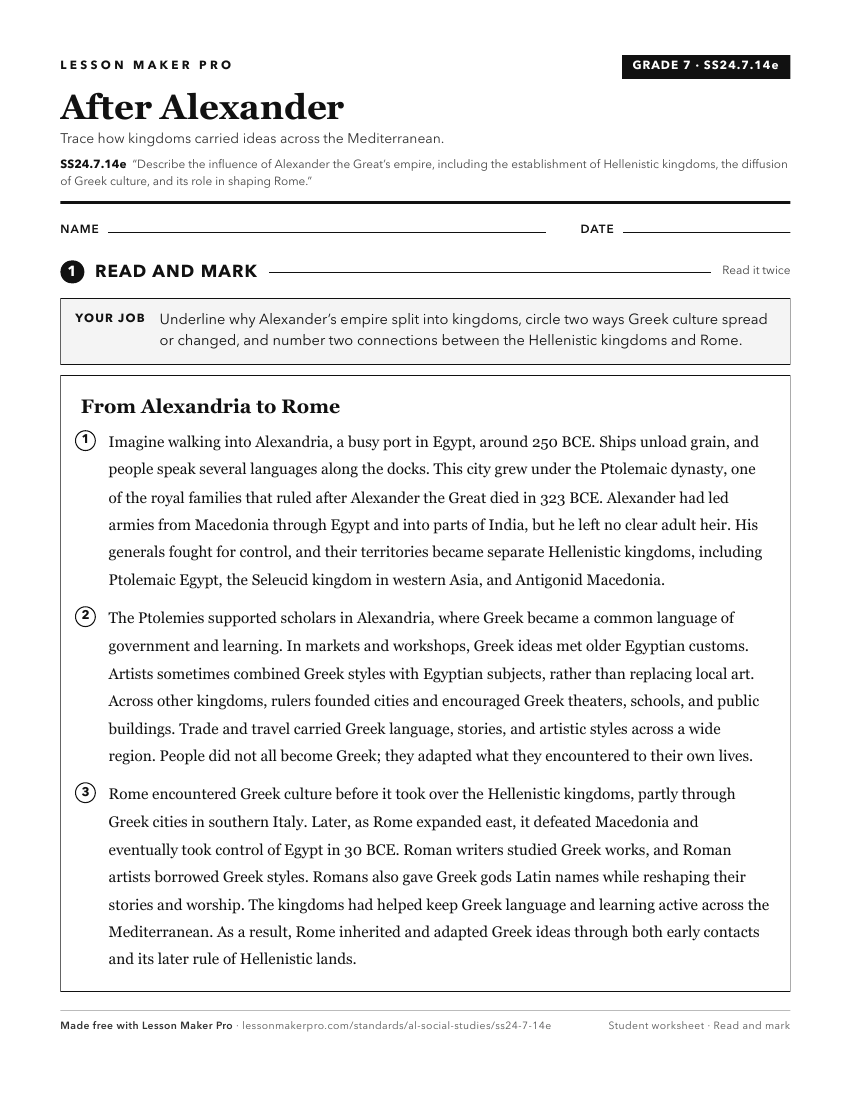
A ready-to-print activity worksheet aligned to SS24.7.14e, with an answer key for the teacher on its own page. No account needed.
PDF, US Letter, prints cleanly in black and white.
Download the worksheetKeep exploring
Related Standards
- SS24.7.16b
Describe the founding and development of Christianity, including the roles of Jesus of Nazareth and Paul of Tarsus, and how its spread was directly and indirect...
- SS24.7.14
Summarize cultural contributions and legacies of Classical Greece, including architecture, arts, intellectual life, literature, politics, and science.
- SS24.7.16a
Explain Rome’s shift from Republic to Empire, including economic, political, and geographic causes.
- SS24.7.14c
Explain the influence of philosophers on Greek society, culture, and politics as well as their influence on modern thought.
Turn this exact standard into a lesson
Grade, subject, topic, and the complete standard are prefilled. Create one free, no account needed.
Also for this standard:Make a WorksheetMake a QuizMake a Sub Lesson