Alabama Science HAP.7
Standard Cluster
Obtain, evaluate, and communicate information describing the structure of lymph nodes and primary cells of the immune system (neutrophils, lymphocytes, monocytes, macrophages, eosinophils, and basophils) and explaining their role in inflammation and the body’s defense. a. Obtain, evaluate, and communicate information explaining how vaccines work to stimulate immunity in the human body. b. Construct an explanation of how the lymphatic system interacts with the immune and circulatory systems.
2023 Alabama Course of Study: Science · From Molecules to Organisms: Structures and Processes
Cluster contents
Standards in This Cluster
HAP.7 is a cluster heading. These are the individual standards under it.
Teacher's field guide
What This Cluster Means
What Students Need to Do
- Students label the main parts of a lymph node and explain what happens as lymph passes through it. They compare six immune cell types, explain inflammation and vaccine protection, and trace lymph back to the blood.
What Mastery Looks Like
- Given a diagram, students label incoming and outgoing lymph vessels, the cortex, and the medulla. They distinguish cells that engulf microbes, cells that release histamine, cells that fight parasites, and lymphocytes that build targeted defenses. They explain how a vaccine produces immune memory and how lymph returns to the bloodstream.
Common Misconceptions
- Students may think lymph nodes pump blood rather than filter lymph, or that all white blood cells do the same job. Some think vaccines supply permanent antibodies instead of prompting the body to make memory cells. Others assume inflammation always means infection.
How to Assess It
- On a blank lymph node sketch, have students draw lymph returning to blood, mark where pathogens are trapped, and name two cells that respond. Ask them to explain why a vaccine can speed a later response.
Lesson moves
Ways to Teach It
Pour pepper mixed with water through a coffee filter to model lymph filtering, then mark where immune cells would inspect trapped particles.
Give students a short note about a swollen lymph node and ask them to explain the swelling using macrophages and lymphocytes.
Play a card match with six immune cell names and jobs, including phagocytosis, histamine release, parasite defense, and immune memory.
Show a sample vaccination record and have students sketch antigen exposure, memory cells, and the response to a later infection.
Free download
Printable HAP.7 Worksheet
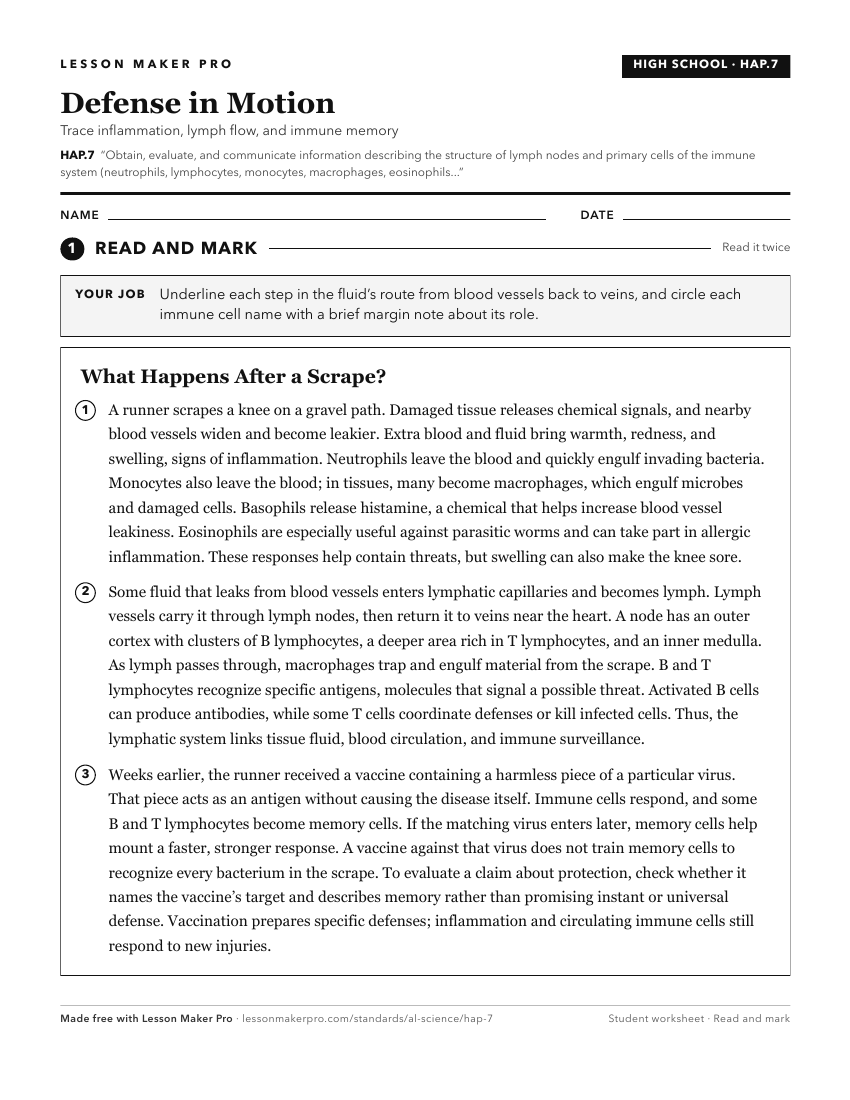
A ready-to-print activity worksheet aligned to HAP.7, with an answer key for the teacher on its own page. No account needed.
PDF, US Letter, prints cleanly in black and white.
Download the worksheetKeep exploring
Related Standards
- HAP.5
Obtain, evaluate, and communicate information explaining the relationship between the structures and functions of the central nervous system and the peripheral ...
- HAP.2
Obtain, evaluate, and communicate information to describe how the structures of the integumentary system and its accessory organs contribute to its function.
- 7.4
Obtain, evaluate, and communicate information explaining how cells, tissues, and organs of various systems of the human body work together for specific function...
- HAP.1
Obtain, evaluate, and communicate information to explain how differences in cellular structure (mitochondria, cytoskeletal structure, endoplasmic reticulum, cel...
Turn this cluster into a lesson
Grade, subject, topic, and the complete cluster are prefilled. Create one free, no account needed.
Also for this cluster:Make a WorksheetMake a QuizMake a Sub Lesson