Alabama Science HAP.5
Standard Cluster
Obtain, evaluate, and communicate information explaining the relationship between the structures and functions of the central nervous system and the peripheral nervous system. a. Use a model to illustrate the role of action potentials in neural transmission. b. Construct an explanation of the role of reflex arcs, the central nervous system, and special senses in the response to stimuli to maintain homeostasis and guide behavior. c. Construct an explanation of the role of neurotransmitters in the functions and behavior of the nervous system. d. Obtain, evaluate, and summarize scientific findings regarding the biological origin of emotions and memories in distinct regions of the brain.
2023 Alabama Course of Study: Science · From Molecules to Organisms: Structures and Processes
Cluster contents
Standards in This Cluster
HAP.5 is a cluster heading. These are the individual standards under it.
- HAP.5.a
Use a model to illustrate the role of action potentials in neural transmission.
- HAP.5.b
Construct an explanation of the role of reflex arcs, the central nervous system, and special senses in the response to stimuli to maintain homeostasis and guide...
- HAP.5.c
Construct an explanation of the role of neurotransmitters in the functions and behavior of the nervous system.
- HAP.5.d
Obtain, evaluate, and summarize scientific findings regarding the biological origin of emotions and memories in distinct regions of the brain.
Teacher's field guide
What This Cluster Means
What Students Need to Do
- Students trace signals from sense organs through nerves and the brain or spinal cord to responses that protect the body or keep it stable. They model action potentials in neurons and chemical signals between neurons. They examine findings about brain areas linked to memory and emotion.
What Mastery Looks Like
- Students identify the brain and spinal cord as the central nervous system and the nerves as the peripheral nervous system. They can trace a reflex, explain how signals cross a synapse, and use evidence to link the hippocampus to memory and the amygdala to fear.
Common Misconceptions
- Students may think every reflex waits for the brain to decide. They may think an electrical pulse jumps between neurons, rather than neurotransmitters crossing a synapse. They may assume one brain area acts alone to produce an emotion or store a whole memory.
How to Assess It
- Exit ticket: Trace a hot-pan withdrawal from skin to muscle, labeling sensory and motor nerves, the spinal cord, action potentials, and a neurotransmitter at a synapse. Then explain what hippocampus damage might reveal about memory.
Lesson moves
Ways to Teach It
Line up two domino chains as neurons with a gap; pass a paper neurotransmitter across the gap to start the second chain.
Give students short cases of hippocampus damage and memory loss and amygdala damage and reduced fear; ask what each case supports.
Give pairs receptor, sensory neuron, spinal cord, motor neuron, and muscle cards to arrange into a reflex arc and explain aloud.
Show a pupil-light-reflex video and have students trace signals from retina through optic nerve, midbrain, and oculomotor nerve to iris muscles.
Free download
Printable HAP.5 Worksheet
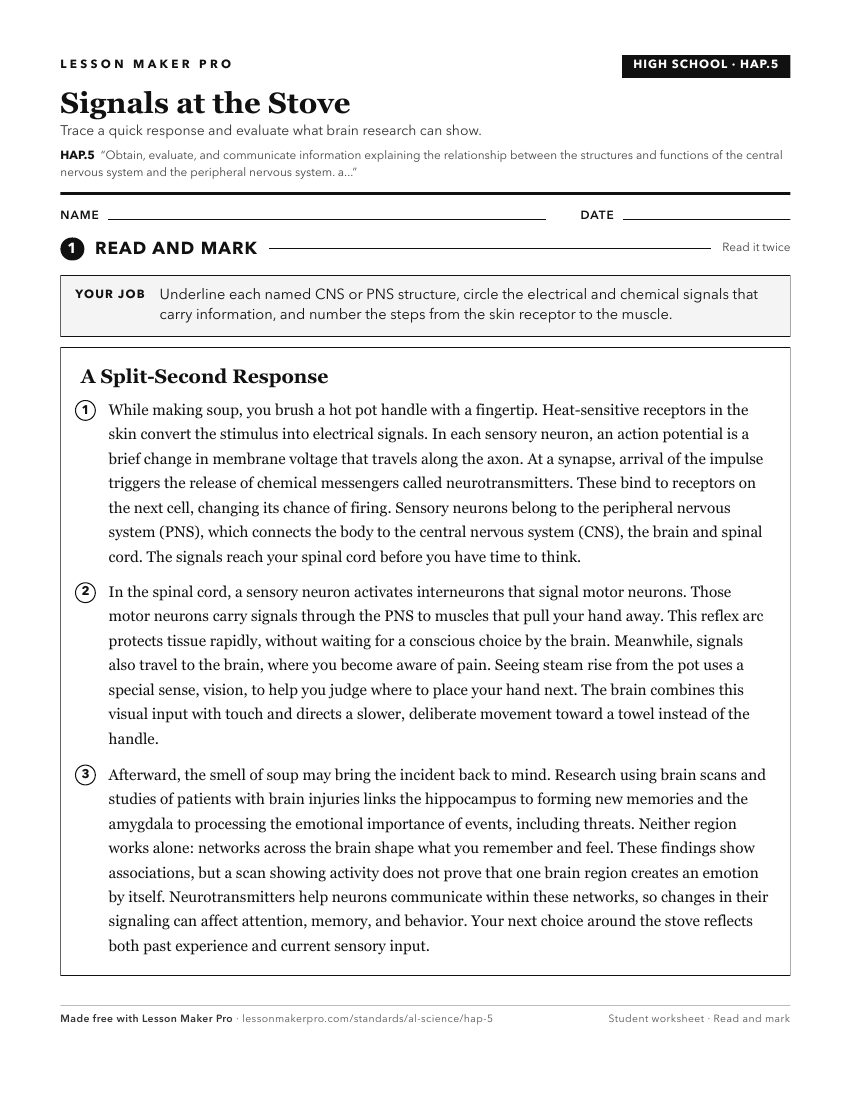
A ready-to-print activity worksheet aligned to HAP.5, with an answer key for the teacher on its own page. No account needed.
PDF, US Letter, prints cleanly in black and white.
Download the worksheetKeep exploring
Related Standards
- HAP.8
Obtain, evaluate, and communicate information explaining how the structures of the cardiovascular system are related to its functions.
- HAP.9
Obtain, evaluate, and communicate information to explain the relationship between the structures and functions of the respiratory system.
- 7.4
Obtain, evaluate, and communicate information explaining how cells, tissues, and organs of various systems of the human body work together for specific function...
- HAP.10
Obtain, evaluate, and communicate information explaining the relationship between the structures and functions of the digestive system, including absorption and...
Turn this cluster into a lesson
Grade, subject, topic, and the complete cluster are prefilled. Create one free, no account needed.
Also for this cluster:Make a WorksheetMake a QuizMake a Sub Lesson