Alabama Science HAP.9
Standard Cluster
Obtain, evaluate, and communicate information to explain the relationship between the structures and functions of the respiratory system. a. Construct an explanation of how the circulatory system works with respiration to transport respiratory gases. b. Use a model to illustrate how pressure gradients move air into and out of the lungs. c. Construct an explanation of the respiratory system’s relationships with other organ systems, including the body’s mechanisms for maintaining homeostasis.
2023 Alabama Course of Study: Science · From Molecules to Organisms: Structures and Processes
Cluster contents
Standards in This Cluster
HAP.9 is a cluster heading. These are the individual standards under it.
- HAP.9.a
Construct an explanation of how the circulatory system works with respiration to transport respiratory gases.
- HAP.9.b
Use a model to illustrate how pressure gradients move air into and out of the lungs.
- HAP.9.c
Construct an explanation of the respiratory system’s relationships with other organ systems, including the body’s mechanisms for maintaining homeostasis.
Teacher's field guide
What This Cluster Means
What Students Need to Do
- Students use diagrams and short readings to explain how alveoli, capillaries, and the diaphragm help the body breathe. They model how pressure moves air and trace oxygen and carbon dioxide between the lungs, blood, and cells. They explain how changes in breathing rate help control carbon dioxide and blood pH.
What Mastery Looks Like
- A student can show that when the diaphragm contracts, chest volume rises, lung pressure falls, and air enters. They can trace oxygen from the alveoli through the heart to body cells, and carbon dioxide back to the lungs. They can explain why rising carbon dioxide prompts faster breathing.
Common Misconceptions
- Students may think the lungs pump air in, rather than pressure differences moving it. Some think blood picks up oxygen in the heart or that inhaled air goes straight to body cells. Others think faster breathing only brings in more oxygen, not that it also removes carbon dioxide.
How to Assess It
- On an exit ticket, have students trace oxygen from an alveolus through the heart to a muscle, then trace carbon dioxide back to the lung. Ask them to explain how diaphragm contraction draws air in and why breathing speeds up during exercise.
Lesson moves
Ways to Teach It
Use a cut-bottom bottle, balloon, straw, and glove to model breathing; pull the glove down and label volume, pressure, and airflow.
Compare two alveolus sketches, one with thick walls and one with thin walls; ask which supports faster gas exchange and why.
Give pairs oxygen and carbon dioxide cards; have them place each card along a lung, heart, and muscle route.
Have students count breaths before and after 30 seconds of step-ups, then explain how the change helps control blood carbon dioxide.
Free download
Printable HAP.9 Worksheet
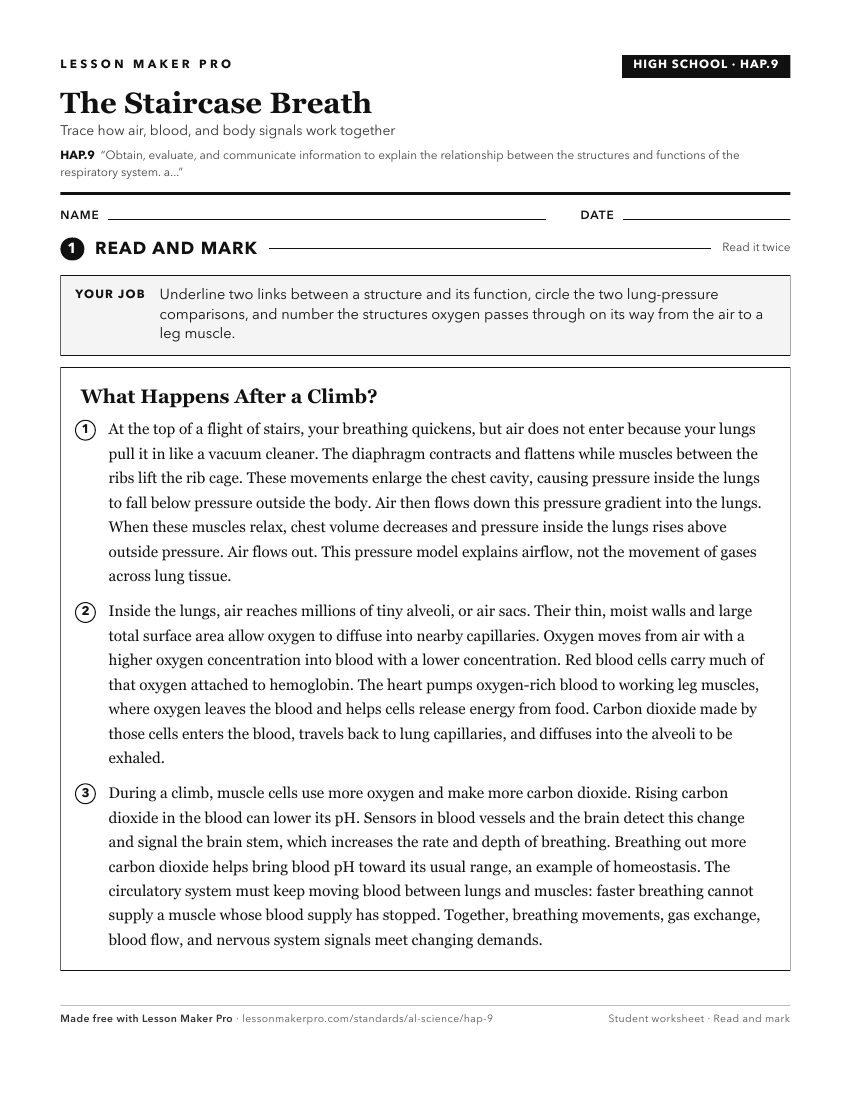
A ready-to-print activity worksheet aligned to HAP.9, with an answer key for the teacher on its own page. No account needed.
PDF, US Letter, prints cleanly in black and white.
Download the worksheetKeep exploring
Related Standards
- HAP.8
Obtain, evaluate, and communicate information explaining how the structures of the cardiovascular system are related to its functions.
- 7.4
Obtain, evaluate, and communicate information explaining how cells, tissues, and organs of various systems of the human body work together for specific function...
- HAP.5
Obtain, evaluate, and communicate information explaining the relationship between the structures and functions of the central nervous system and the peripheral ...
Turn this cluster into a lesson
Grade, subject, topic, and the complete cluster are prefilled. Create one free, no account needed.
Also for this cluster:Make a WorksheetMake a QuizMake a Sub Lesson