Alabama Science 7.4
The Standard
Obtain, evaluate, and communicate information explaining how cells, tissues, and organs of various systems of the human body work together for specific functions, including the circulatory, digestive, muscular, nervous, respiratory, and skeletal systems.
2023 Alabama Course of Study: Science · From Molecules to Organisms: Structures and Processes
Teacher's field guide
What This Standard Means
What Students Need to Do
- Students use diagrams and short texts to find out how cells make up tissues, tissues make up organs, and organs work in systems. They explain how the circulatory, digestive, muscular, nervous, respiratory, and skeletal systems work together to carry out a task.
What Mastery Looks Like
- A student can trace nutrients from the digestive system and oxygen from the lungs through the blood to a leg muscle cell. They can explain how nerve signals make muscles pull on bones to move the leg.
Common Misconceptions
- Students may confuse a cell with a tissue or think an organ works on its own. They may say the heart makes oxygen, bones move by themselves, or nerves carry blood.
How to Assess It
- Exit ticket: “A student eats lunch and later kicks a ball. Explain how each of the six body systems helps, and name one cell, tissue, and organ involved.”
Lesson moves
Ways to Teach It
Give students cards labeled muscle cell, muscle tissue, biceps, and muscular system; have them stack the cards, then add bone and nerve cards to model arm movement.
Ask, “Why does breathing faster help your legs during a run?” Have pairs use a lung, heart, and muscle diagram to explain.
Give teams six system cards and a task card, such as digesting lunch or climbing stairs; award points for accurate connections.
Measure pulse and breathing before and after 30 seconds of marching; explain why the heart and lungs respond when leg muscles work.
Free download
Printable 7.4 Worksheet
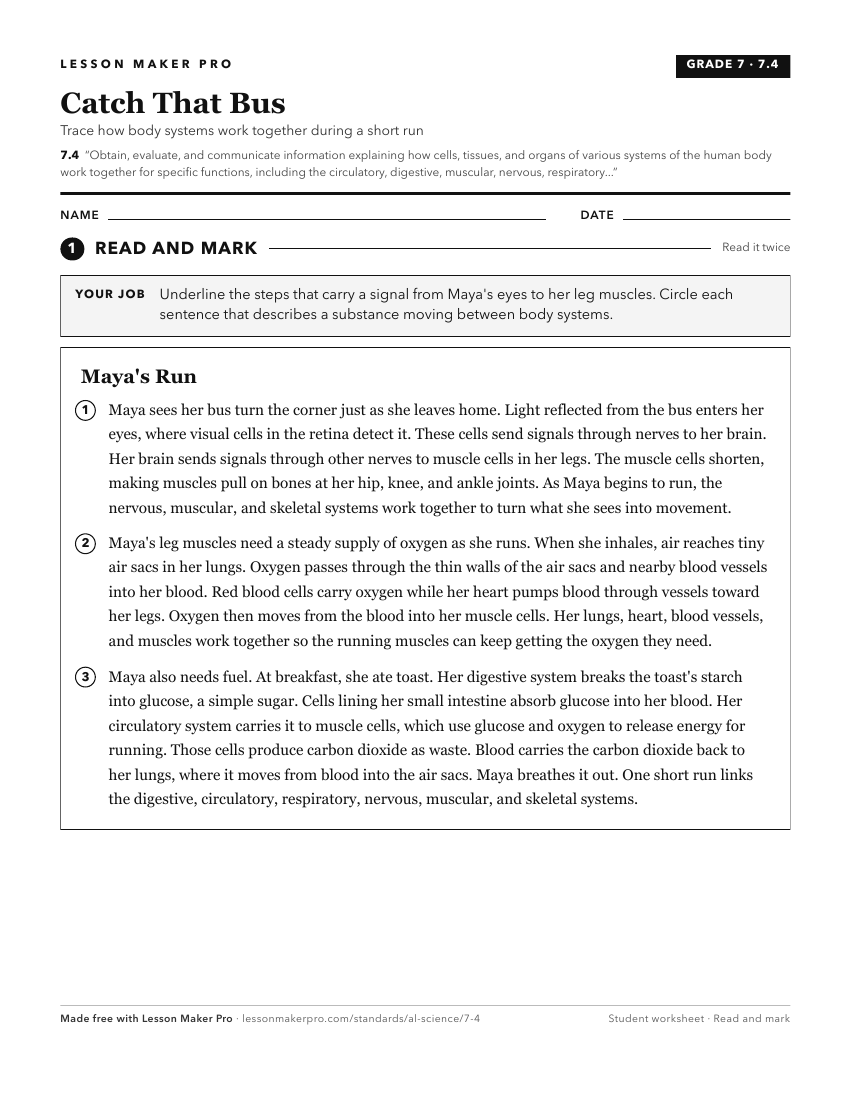
A ready-to-print activity worksheet aligned to 7.4, with an answer key for the teacher on its own page. No account needed.
PDF, US Letter, prints cleanly in black and white.
Download the worksheetKeep exploring
Related Standards
- HAP.8
Obtain, evaluate, and communicate information explaining how the structures of the cardiovascular system are related to its functions.
- HAP.1
Obtain, evaluate, and communicate information to explain how differences in cellular structure (mitochondria, cytoskeletal structure, endoplasmic reticulum, cel...
- HAP.9
Obtain, evaluate, and communicate information to explain the relationship between the structures and functions of the respiratory system.
- HAP.5
Obtain, evaluate, and communicate information explaining the relationship between the structures and functions of the central nervous system and the peripheral ...
Turn this exact standard into a lesson
Grade, subject, topic, and the complete standard are prefilled. Create one free, no account needed.
Also for this standard:Make a WorksheetMake a QuizMake a Sub Lesson