Alabama Science HAP.5.b
The Standard
- HAP.5
- Obtain, evaluate, and communicate information explaining the relationship between the structures and functions of the central nervous system and the peripheral nervous system.
Construct an explanation of the role of reflex arcs, the central nervous system, and special senses in the response to stimuli to maintain homeostasis and guide behavior.
2023 Alabama Course of Study: Science · From Molecules to Organisms: Structures and Processes
Teacher's field guide
What This Standard Means
What Students Need to Do
- Students trace a stimulus from a receptor through the central nervous system to a muscle or gland response. They explain how reflexes protect the body and how senses such as sight and hearing guide behavior.
What Mastery Looks Like
- Given a hot-pan example, a student traces the signal from a skin receptor through the spinal cord to the muscle that pulls the hand away. They explain why the hand moves before the person feels pain, then describe how seeing the burner helps them avoid it.
Common Misconceptions
- Students may think the brain must make a conscious decision before a hand pulls away. They may think the spinal cord only carries messages, or that every response to something seen or heard is a reflex.
How to Assess It
- Exit ticket: A student touches a hot pan, pulls back, then sees the red burner and steps away. Sketch the withdrawal pathway and explain how vision guides the next action.
Lesson moves
Ways to Teach It
Give groups cards labeled bright light, retina, optic nerve, brainstem, motor nerve, and iris; have them arrange and act out pupil constriction.
Ask: Why does your hand leave a hot pan before you feel pain, and how does seeing the burner change your next move?
Play pathway relay: teams sequence skin receptor, sensory neuron, spinal cord, motor neuron, and muscle for a hot-pan scenario.
Give students a mock clinic note, 'pupils shrink in light'; ask what this response tells a doctor about the retina and brainstem.
Free download
Printable HAP.5.b Worksheet
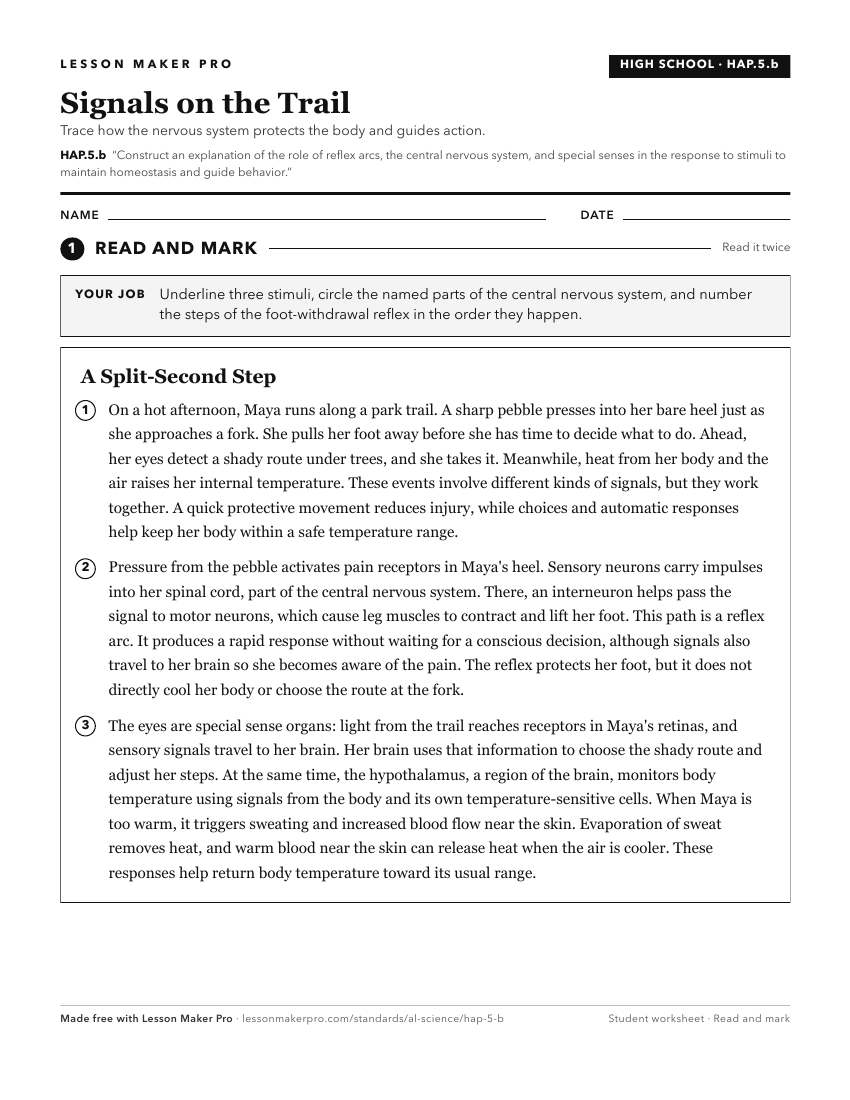
A ready-to-print activity worksheet aligned to HAP.5.b, with an answer key for the teacher on its own page. No account needed.
PDF, US Letter, prints cleanly in black and white.
Download the worksheetKeep exploring
Related Standards
- HAP.6
Construct an explanation of how the interdependence of the nervous and endocrine systems maintains homeostasis.
- HAP.9.c
Construct an explanation of the respiratory system’s relationships with other organ systems, including the body’s mechanisms for maintaining homeostasis.
- HAP.2.a
Construct an explanation of the relationships between the integumentary system and other organ systems, including the body’s mechanisms for maintaining homeosta...
- HAP.10.b
Construct an explanation of the relationships between the digestive system and other organ systems, including the body’s mechanisms for maintaining homeostasis.
Turn this exact standard into a lesson
Grade, subject, topic, and the complete standard are prefilled. Create one free, no account needed.
Also for this standard:Make a WorksheetMake a QuizMake a Sub Lesson