Alabama Science HAP.6
Standard Cluster
Construct an explanation of how the interdependence of the nervous and endocrine systems maintains homeostasis. a. Obtain, evaluate, and communicate information explaining how hormones secreted by endocrine glands help the body maintain homeostasis through negative and positive feedback loops. b. Obtain, evaluate, and communicate information describing the role of endocrine axes involving the thyroid and gonads in controlling growth, development, metabolism, and reproduction.
2023 Alabama Course of Study: Science · From Molecules to Organisms: Structures and Processes
Cluster contents
Standards in This Cluster
HAP.6 is a cluster heading. These are the individual standards under it.
- HAP.6.a
Obtain, evaluate, and communicate information explaining how hormones secreted by endocrine glands help the body maintain homeostasis through negative and posit...
- HAP.6.b
Obtain, evaluate, and communicate information describing the role of endocrine axes involving the thyroid and gonads in controlling growth, development, metabol...
Teacher's field guide
What This Cluster Means
What Students Need to Do
- Students trace signals from the brain through the pituitary to the thyroid and gonads. They explain how negative feedback keeps hormone levels steady and how positive feedback can trigger ovulation. They connect thyroid hormones to growth and metabolism, and gonadal hormones to puberty and reproduction.
What Mastery Looks Like
- Given low thyroid hormone levels, a student predicts that TRH and TSH will rise. They show how rising thyroid hormone then reduces both signals. They can explain how rising estrogen briefly triggers an LH surge before ovulation.
Common Misconceptions
- Students may think the nervous and endocrine systems work separately and miss the hypothalamus as a link. They may think the pituitary makes thyroid hormone, rather than TSH. Some assume all feedback lowers hormone levels and miss the positive feedback before ovulation.
How to Assess It
- On an exit ticket, have students draw arrows from the hypothalamus to the pituitary to the thyroid and predict what happens to TSH when thyroid hormone falls. Ask them to name that feedback type and explain how rising estrogen triggers an LH surge.
Lesson moves
Ways to Teach It
Give groups cards for hypothalamus, pituitary, thyroid, ovaries, TRH, TSH, GnRH, LH, FSH, thyroid hormone, and estrogen to arrange with string arrows.
Ask, “Why does low thyroid hormone raise TSH, while rising estrogen can raise LH just before ovulation?”
Play hormone relay: call out “thyroid hormone drops,” then students raise TRH and TSH cards in order and explain the feedback.
Show a patient’s lab report with high TSH and low T4; ask what the pituitary is responding to and why the patient might feel tired.
Free download
Printable HAP.6 Worksheet
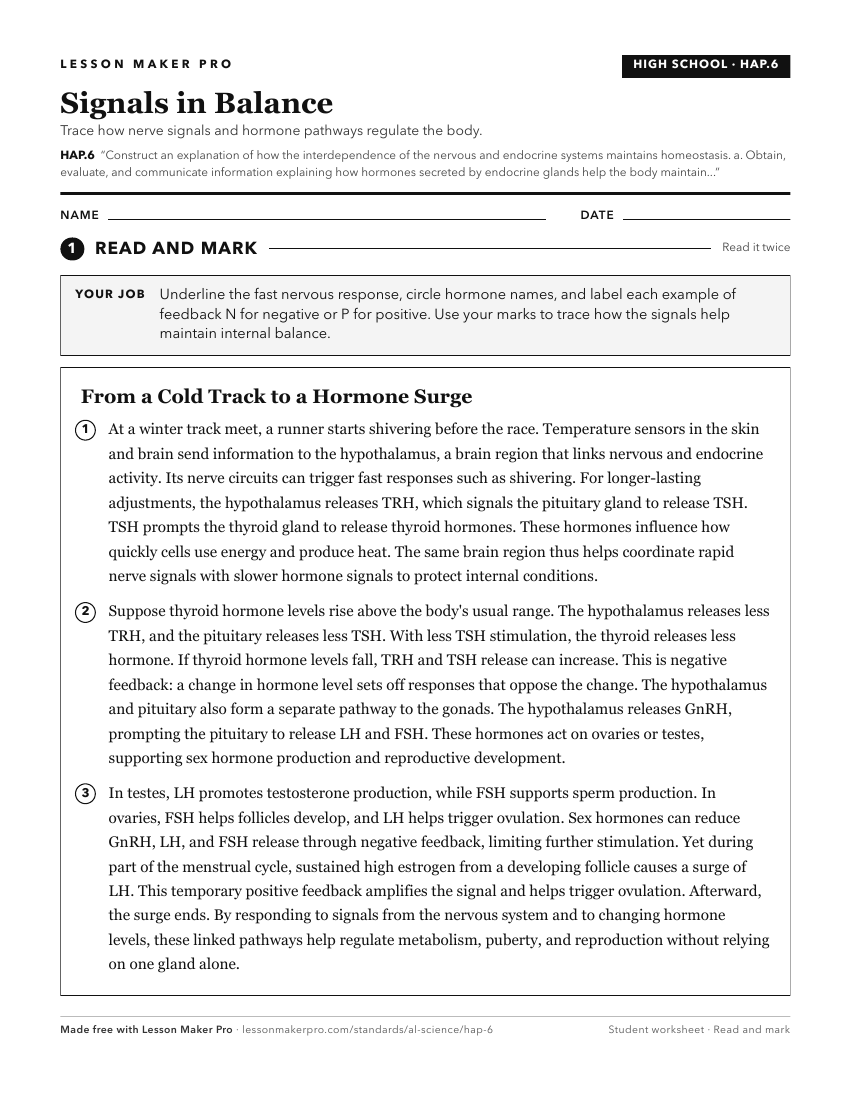
A ready-to-print activity worksheet aligned to HAP.6, with an answer key for the teacher on its own page. No account needed.
PDF, US Letter, prints cleanly in black and white.
Download the worksheetKeep exploring
Related Standards
- HAP.2.a
Construct an explanation of the relationships between the integumentary system and other organ systems, including the body’s mechanisms for maintaining homeosta...
- HAP.10.b
Construct an explanation of the relationships between the digestive system and other organ systems, including the body’s mechanisms for maintaining homeostasis.
- HAP.3.b
Construct an explanation of the relationships between the skeletal system and other organ systems, including the body’s mechanisms for maintaining homeostasis.
- HAP.8.c
Construct an explanation of the cardiovascular system’s relationships with other organ systems, including the body’s mechanisms for maintaining homeostasis.
Turn this cluster into a lesson
Grade, subject, topic, and the complete cluster are prefilled. Create one free, no account needed.
Also for this cluster:Make a WorksheetMake a QuizMake a Sub Lesson