Alabama Science HAP.5.d
The Standard
- HAP.5
- Obtain, evaluate, and communicate information explaining the relationship between the structures and functions of the central nervous system and the peripheral nervous system.
Obtain, evaluate, and summarize scientific findings regarding the biological origin of emotions and memories in distinct regions of the brain.
2023 Alabama Course of Study: Science · From Molecules to Organisms: Structures and Processes
Teacher's field guide
What This Standard Means
What Students Need to Do
- Find trustworthy reports of patient studies and brain scans about emotion and memory. Compare the claims with the evidence, then summarize what brain regions do and where the evidence falls short.
What Mastery Looks Like
- Students explain how the hippocampus supports new memory formation and how the amygdala helps process threats, citing a finding for each. They explain why activity on a scan does not prove that one region creates an emotion alone.
Common Misconceptions
- Students may think all memories are stored in the hippocampus or that the amygdala produces every emotion. They may treat activity on a brain scan as proof of cause, or assume one patient case applies to everyone.
How to Assess It
- Exit ticket: “After hippocampal damage, a patient struggles to form new memories. A scan shows amygdala activity during threat. What does each finding suggest, and what is one limit of the evidence?”
Lesson moves
Ways to Teach It
Print a labeled brain diagram; groups cover region names with stickers, identify each region, then draw arrows linking emotion and memory pathways.
Read a one-page summary of patient H.M.; write what his difficulty forming new memories shows about the hippocampus and what one case cannot prove.
Give pairs cards describing H.M.'s memory loss, amygdala scan activity, and prefrontal injury; match each finding to a claim and a limitation.
Use a public-speaking scenario: students label how the amygdala, prefrontal cortex, and hippocampus might contribute to fear, response, and later recall.
Free download
Printable HAP.5.d Worksheet
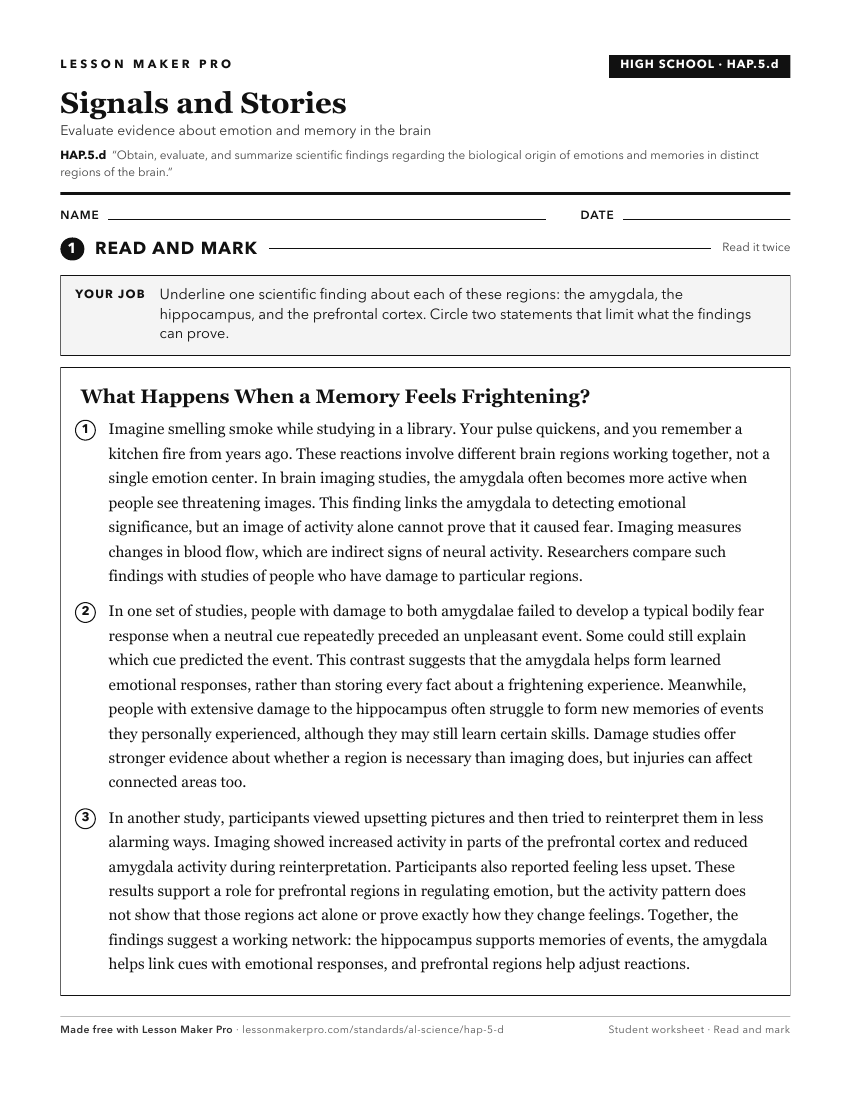
A ready-to-print activity worksheet aligned to HAP.5.d, with an answer key for the teacher on its own page. No account needed.
PDF, US Letter, prints cleanly in black and white.
Download the worksheetKeep exploring
Related Standards
- HAP.5
Obtain, evaluate, and communicate information explaining the relationship between the structures and functions of the central nervous system and the peripheral ...
- BIO.12.b
Obtain, evaluate, and communicate information about how errors during meiosis and environmental factors affect the expression of traits.
- HAP.5.c
Construct an explanation of the role of neurotransmitters in the functions and behavior of the nervous system.
- BIO.2.b
Obtain and evaluate information to explore additional functions and regulatory roles of RNA, DNA, and protein, including their roles in gene expression and cell...
Turn this exact standard into a lesson
Grade, subject, topic, and the complete standard are prefilled. Create one free, no account needed.
Also for this standard:Make a WorksheetMake a QuizMake a Sub Lesson