Alabama Science HAP.7.b
The Standard
- HAP.7
- Obtain, evaluate, and communicate information describing the structure of lymph nodes and primary cells of the immune system (neutrophils, lymphocytes, monocytes, macrophages, eosinophils, and basophils) and explaining their role in inflammation and the body’s defense.
Construct an explanation of how the lymphatic system interacts with the immune and circulatory systems.
2023 Alabama Course of Study: Science · From Molecules to Organisms: Structures and Processes
Teacher's field guide
What This Standard Means
What Students Need to Do
- Students trace fluid from blood capillaries into tissues, through lymph vessels, and back to the bloodstream. They explain how immune cells in lymph nodes respond to germs carried in that fluid.
What Mastery Looks Like
- Given a hand-to-shoulder diagram, a student draws the route from a blood capillary through tissue and lymph vessels to a vein. They explain why immune cells in lymph nodes become active during an infection.
Common Misconceptions
- Students may think lymph vessels carry blood or that lymph nodes pump lymph like a heart. Some think lymph nodes filter blood, rather than lymph, or that fluid in tissues simply disappears.
How to Assess It
- Exit ticket: A cut lets bacteria into a finger. Draw the path of fluid from the finger back to the blood, and explain what happens at a lymph node.
Lesson moves
Ways to Teach It
Move a bead along yarn paths from a capillary through tissue, a lymph vessel, and a lymph node to a vein.
Ask students why a sore throat can cause swollen neck lymph nodes and where fluid passing through those nodes goes next.
Give pairs route cards labeled capillary, tissue, lymph vessel, lymph node, and vein; have them order the cards and explain each stop.
Show a photo of ankle swelling and ask how blocked lymph vessels could cause fluid to collect instead of returning to blood.
Free download
Printable HAP.7.b Worksheet
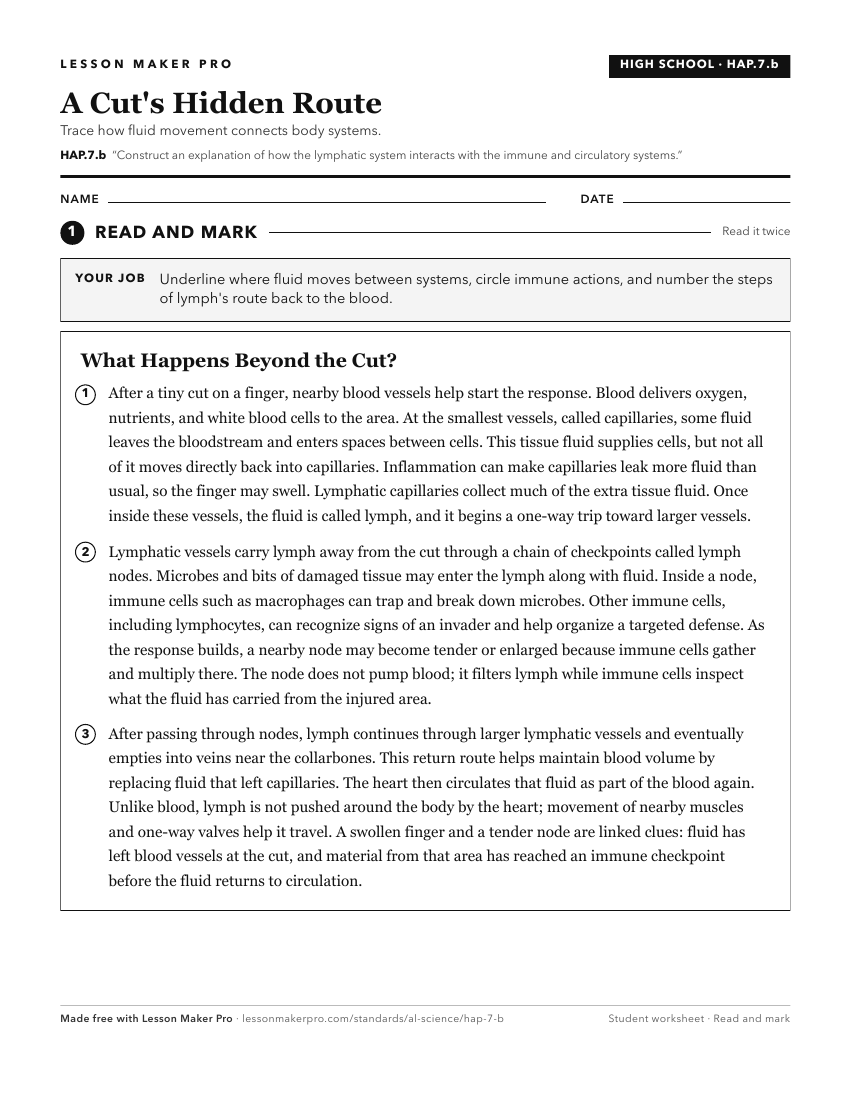
A ready-to-print activity worksheet aligned to HAP.7.b, with an answer key for the teacher on its own page. No account needed.
PDF, US Letter, prints cleanly in black and white.
Download the worksheetKeep exploring
Related Standards
- HAP.8.c
Construct an explanation of the cardiovascular system’s relationships with other organ systems, including the body’s mechanisms for maintaining homeostasis.
- HAP.2.a
Construct an explanation of the relationships between the integumentary system and other organ systems, including the body’s mechanisms for maintaining homeosta...
- HAP.3.b
Construct an explanation of the relationships between the skeletal system and other organ systems, including the body’s mechanisms for maintaining homeostasis.
- HAP.6
Construct an explanation of how the interdependence of the nervous and endocrine systems maintains homeostasis.
Turn this exact standard into a lesson
Grade, subject, topic, and the complete standard are prefilled. Create one free, no account needed.
Also for this standard:Make a WorksheetMake a QuizMake a Sub Lesson