Alabama Science HAP.11
Standard Cluster
Use a model to illustrate the microanatomy of excretory structures and describe their functions. a. Construct an explanation of how the excretory system maintains homeostasis, including blood pressure and pH.
2023 Alabama Course of Study: Science · From Molecules to Organisms: Structures and Processes
Cluster contents
Standards in This Cluster
HAP.11 is a cluster heading. These are the individual standards under it.
Teacher's field guide
What This Cluster Means
What Students Need to Do
- Students label the small structures of a nephron and the capillaries around it. They trace filtration, reabsorption, and secretion between blood and forming urine. They explain how the kidneys help control blood pressure and blood pH.
What Mastery Looks Like
- Given a blank nephron diagram, a student labels the glomerulus, tubules, and collecting duct, then draws arrows showing where water returns to blood. They explain that retaining more sodium and water can raise blood pressure. They show how sending hydrogen ions into urine and returning bicarbonate to blood help control pH.
Common Misconceptions
- Some students think the glomerulus makes finished urine, with nothing returned to the blood. Others think making more urine raises blood pressure. Students may also put bicarbonate into urine when their model should show it returning to blood.
How to Assess It
- Give students a blank nephron diagram. Ask them to mark filtration, water reabsorption, and hydrogen ion secretion, then explain how one of those steps helps control blood pressure or pH.
Lesson moves
Ways to Teach It
Build a nephron with yarn and paper labels, then move colored beads to show filtration, water reabsorption, and hydrogen ion secretion.
Ask students to write: If the kidneys return more sodium and water to blood, what happens to blood volume and pressure?
Give pairs nephron diagrams and process cards; have them place each card and defend its location to another pair.
Give students a mock patient chart showing high blood pressure and excess sodium; ask them to trace how sodium excretion could help.
Free download
Printable HAP.11 Worksheet
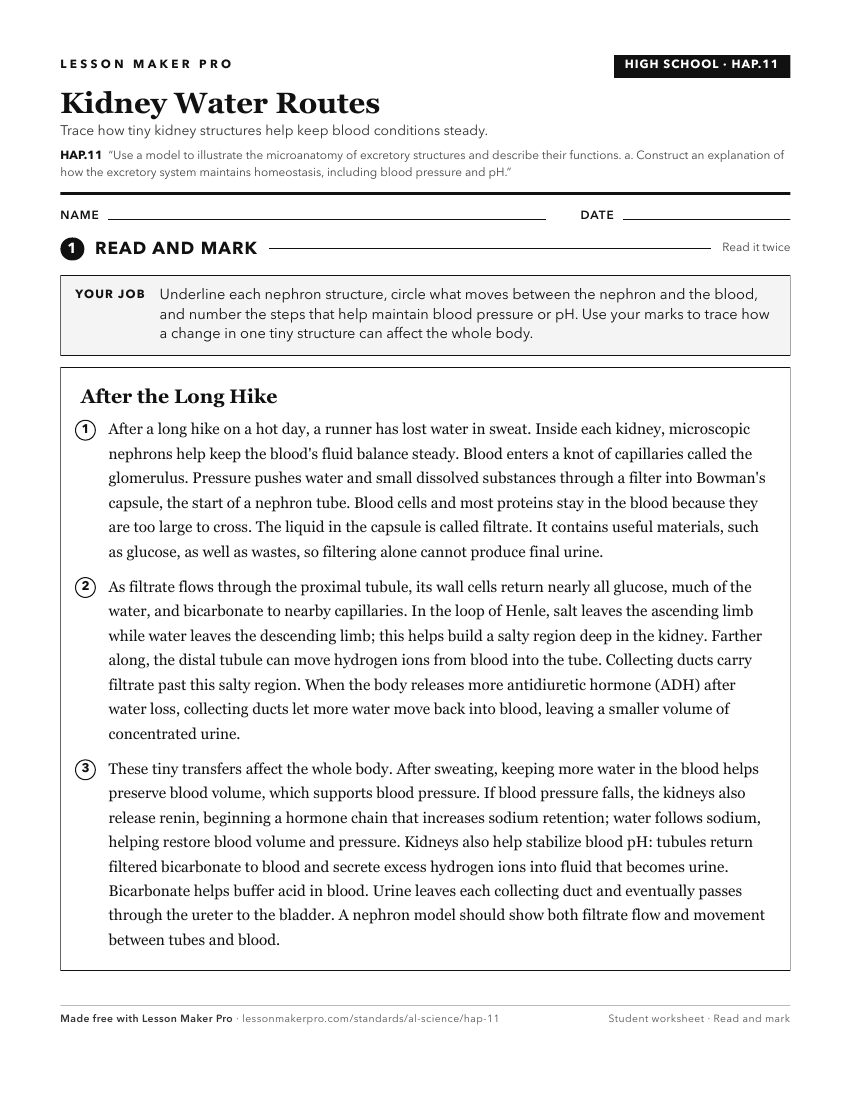
A ready-to-print activity worksheet aligned to HAP.11, with an answer key for the teacher on its own page. No account needed.
PDF, US Letter, prints cleanly in black and white.
Download the worksheetKeep exploring
Related Standards
- HAP.3
Develop and use a model to illustrate how the structures of the skeletal system contribute to its function.
- 7.1
Develop and use a model to explain the functions of specific cell structures necessary for maintaining a stable environment, including the cell membrane, cell w...
- HAP.4
Develop and build a three-dimensional model to illustrate the structures of the muscular system, including muscle locations, origins, and insertions, and explai...
- HAP.12
Use models to compare and contrast the internal and external structures of the female and male reproductive systems and their production of gametes.
Turn this cluster into a lesson
Grade, subject, topic, and the complete cluster are prefilled. Create one free, no account needed.
Also for this cluster:Make a WorksheetMake a QuizMake a Sub Lesson