Alabama Science HAP.11.a
The Standard
- HAP.11
- Use a model to illustrate the microanatomy of excretory structures and describe their functions.
Construct an explanation of how the excretory system maintains homeostasis, including blood pressure and pH.
2023 Alabama Course of Study: Science · From Molecules to Organisms: Structures and Processes
Teacher's field guide
What This Standard Means
What Students Need to Do
- Students explain how kidneys change what leaves in urine and what returns to blood. They connect water and salt balance to blood pressure, and hydrogen ion removal and bicarbonate retention to blood pH.
What Mastery Looks Like
- Given a person who is dehydrated and has acidic blood, a student explains that the kidneys conserve water to support blood pressure. They also explain that the kidneys release hydrogen ions into urine and return bicarbonate to blood to raise blood pH.
Common Misconceptions
- Students may say kidneys only remove waste and miss how water and salt affect blood pressure. They may think acidic urine means acidic blood, rather than seeing acid removal as a way to correct blood pH.
How to Assess It
- Exit ticket: A person is dehydrated and has acidic blood. Explain how the kidneys adjust water, hydrogen ions, and bicarbonate, and what happens to blood pressure and pH.
Lesson moves
Ways to Teach It
Using blood and urine cups, students move water, sodium, hydrogen ion, and bicarbonate cards to model kidney responses to dehydration and acidic blood.
Ask students to explain why acidic urine can be a sign that kidneys are helping raise blood pH.
Hand out cards labeled dehydration, high blood pressure, and acidic blood; pairs match each to a kidney response card and defend their matches.
Compare sodium amounts on two soup labels; students predict how kidneys would adjust salt and water output after each meal.
Free download
Printable HAP.11.a Worksheet
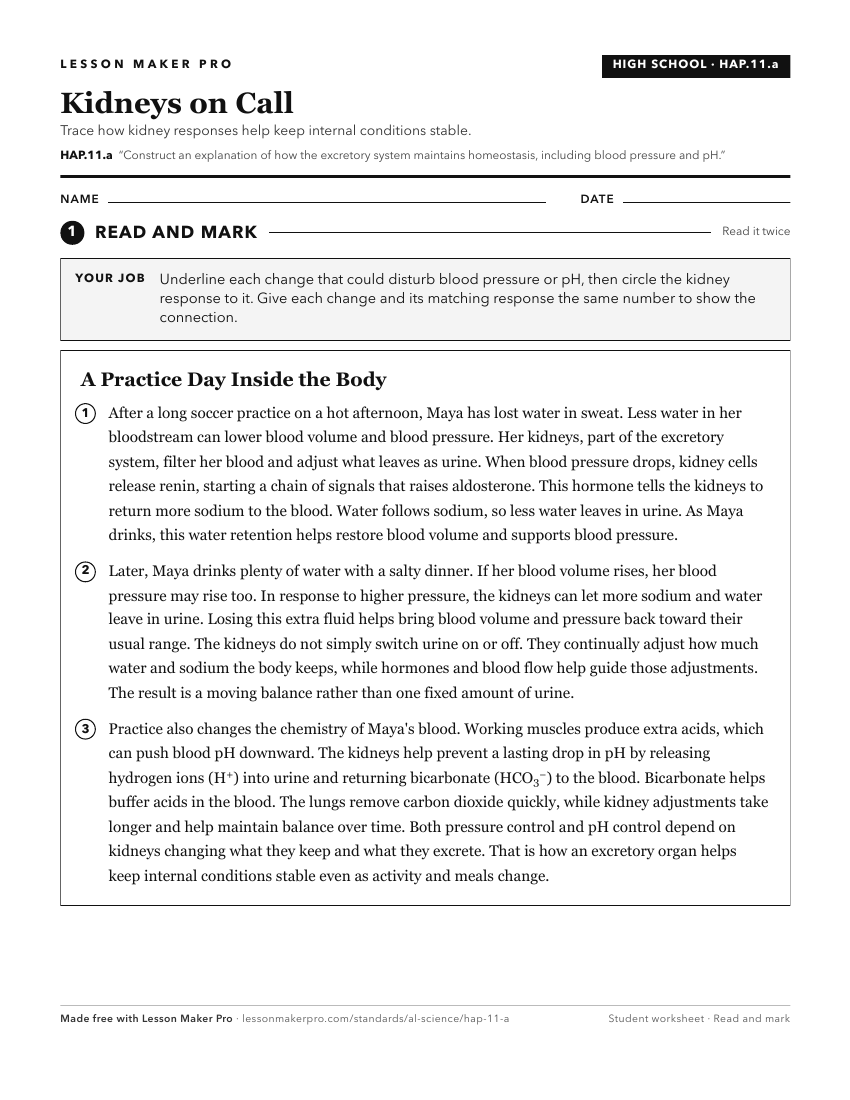
A ready-to-print activity worksheet aligned to HAP.11.a, with an answer key for the teacher on its own page. No account needed.
PDF, US Letter, prints cleanly in black and white.
Download the worksheetKeep exploring
Related Standards
- HAP.8.c
Construct an explanation of the cardiovascular system’s relationships with other organ systems, including the body’s mechanisms for maintaining homeostasis.
- HAP.9.c
Construct an explanation of the respiratory system’s relationships with other organ systems, including the body’s mechanisms for maintaining homeostasis.
- HAP.10.b
Construct an explanation of the relationships between the digestive system and other organ systems, including the body’s mechanisms for maintaining homeostasis.
- HAP.6
Construct an explanation of how the interdependence of the nervous and endocrine systems maintains homeostasis.
Turn this exact standard into a lesson
Grade, subject, topic, and the complete standard are prefilled. Create one free, no account needed.
Also for this standard:Make a WorksheetMake a QuizMake a Sub Lesson