Alabama Science HAP.12
Standard Cluster
Use models to compare and contrast the internal and external structures of the female and male reproductive systems and their production of gametes. a. Construct an explanation of how the endocrine system influences the growth, development, and functions of the reproductive systems in males and females, including the mechanisms of hormonal birth control.
2023 Alabama Course of Study: Science · From Molecules to Organisms: Structures and Processes
Cluster contents
Standards in This Cluster
HAP.12 is a cluster heading. These are the individual standards under it.
Teacher's field guide
What This Cluster Means
What Students Need to Do
- Students label internal and external reproductive organs on two diagrams. They trace where eggs and sperm are made and how each travels. They use a hormone diagram to explain puberty, gamete production, and how hormonal birth control prevents pregnancy.
What Mastery Looks Like
- A student labels organs on both diagrams and traces egg and sperm paths. They explain that egg maturation follows a cycle, while sperm production continues after puberty. They show how FSH and LH regulate ovaries and testes, and how a combined pill usually stops ovulation and thickens cervical mucus.
Common Misconceptions
- Some students think ovaries make a new egg each month or that sperm form in the penis. Some label the vagina as the entire external female anatomy. Others think birth control pills block sperm like a condom.
How to Assess It
- Hand out two unlabeled diagrams and a hormone arrow chart. Ask students to label internal and external organs, mark where gametes form, and explain how FSH, LH, and a combined pill affect ovulation.
Lesson moves
Ways to Teach It
Give pairs organ cards and two blank body outlines; have them place each card, mark internal or external, and trace egg and sperm paths.
Ask students why a combined birth control pill prevents ovulation in its user but does not change sperm production in a partner.
Play a card sort: match GnRH, FSH, LH, estrogen, progesterone, and testosterone to their source and role in puberty or reproduction.
Provide a combined pill fact sheet; students highlight claims about ovulation and cervical mucus, then connect each claim to a hormone diagram.
Free download
Printable HAP.12 Worksheet
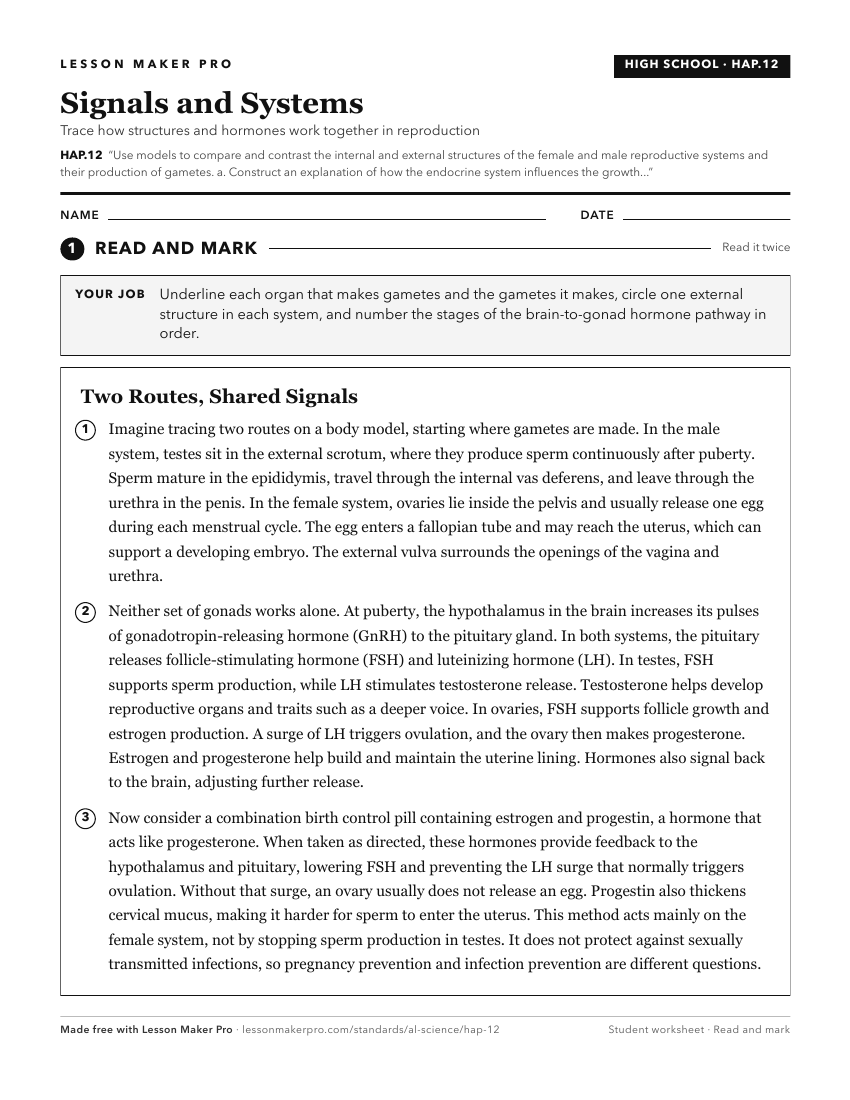
A ready-to-print activity worksheet aligned to HAP.12, with an answer key for the teacher on its own page. No account needed.
PDF, US Letter, prints cleanly in black and white.
Download the worksheetKeep exploring
Related Standards
- 3.5
Develop and use models to compare the diverse life cycles of organisms other than humans, including birth, growth, reproduction, and death.
- BIO.12
Develop and use an evidence-based model to illustrate the formation of reproductive cells through the process of meiosis.
- 7.13
Develop and use models to explain that meiosis results in new genetic combinations with increased variation.
- 1.7
Make observations to identify the similarities and differences between offspring and their parents.
Turn this cluster into a lesson
Grade, subject, topic, and the complete cluster are prefilled. Create one free, no account needed.
Also for this cluster:Make a WorksheetMake a QuizMake a Sub Lesson