Alabama Science HAP.3
Standard Cluster
Develop and use a model to illustrate how the structures of the skeletal system contribute to its function. a. Obtain, evaluate, and communicate information describing the growth and development of the skeletal system. b. Construct an explanation of the relationships between the skeletal system and other organ systems, including the body’s mechanisms for maintaining homeostasis.
2023 Alabama Course of Study: Science · From Molecules to Organisms: Structures and Processes
Cluster contents
Standards in This Cluster
HAP.3 is a cluster heading. These are the individual standards under it.
Teacher's field guide
What This Cluster Means
What Students Need to Do
- Students build and use a labeled bone and joint model to explain support, movement, and blood cell production. They compare child and adult bone images to explain growth plate changes. They show how bones, muscles, hormones, and kidneys work together to keep blood calcium steady.
What Mastery Looks Like
- A student uses a model to explain how compact bone supports weight, spongy bone reduces weight, and marrow makes blood cells. They show a muscle pulling on a bone through a tendon to move a joint. They explain how growth plates lengthen bones and how a drop in blood calcium triggers its release from bone.
Common Misconceptions
- Students may think bones are solid, dead rods rather than living tissue with marrow. They may think an entire bone stretches longer, rather than growing at a growth plate. Some confuse tendons with ligaments or think blood calcium changes without hormone signals.
How to Assess It
- On an exit ticket, ask students to draw and label a long bone and joint, including a growth plate and marrow. Have them add arrows for muscle movement and for calcium release when blood calcium drops.
Lesson moves
Ways to Teach It
Build a long bone with a paper tube, sponge, and red beads; label compact bone, spongy bone, and marrow, then explain each part.
Compare printed child and adult knee X-rays; write which image shows open growth plates and what that means for lengthwise growth.
Give pairs bone, muscle, tendon, ligament, and joint cards; have them place each on an arm diagram, then explain elbow movement.
Give students a low blood calcium case; have them draw arrows showing hormone signals, calcium release from bone, and calcium retention by kidneys.
Free download
Printable HAP.3 Worksheet
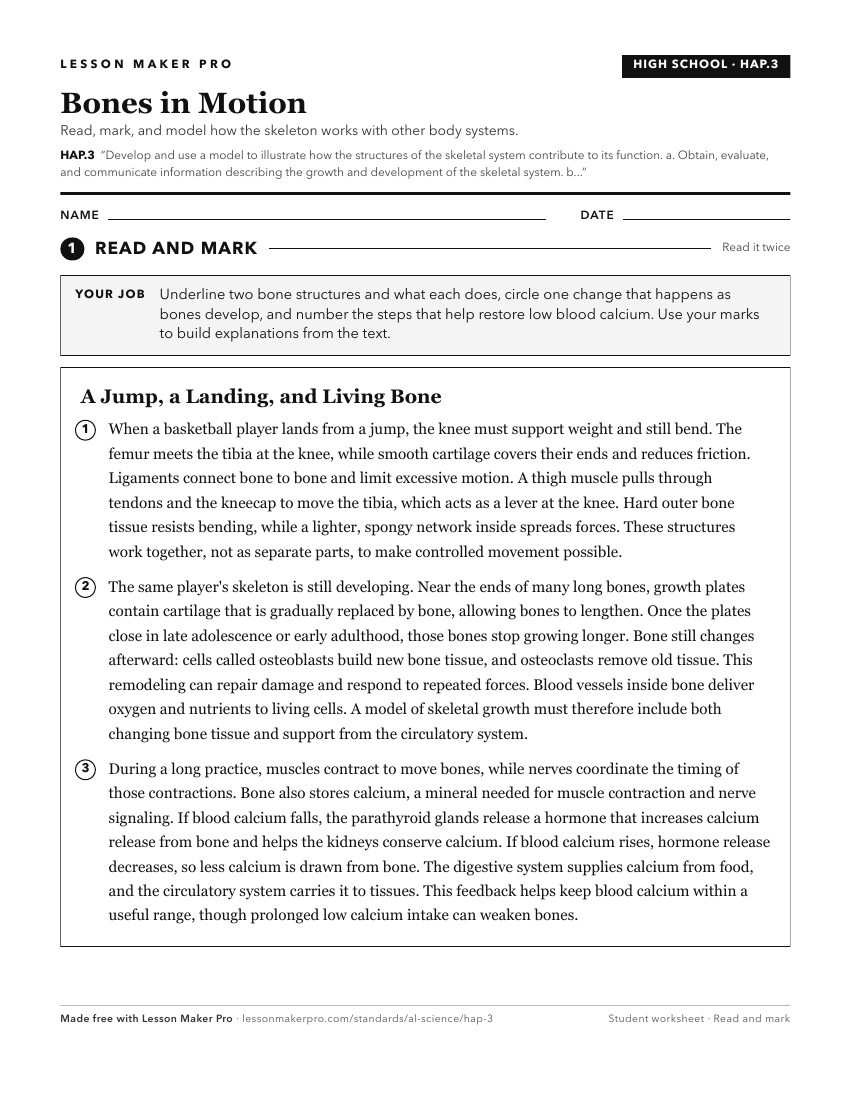
A ready-to-print activity worksheet aligned to HAP.3, with an answer key for the teacher on its own page. No account needed.
PDF, US Letter, prints cleanly in black and white.
Download the worksheetKeep exploring
Related Standards
- HAP.4
Develop and build a three-dimensional model to illustrate the structures of the muscular system, including muscle locations, origins, and insertions, and explai...
- 7.1
Develop and use a model to explain the functions of specific cell structures necessary for maintaining a stable environment, including the cell membrane, cell w...
Turn this cluster into a lesson
Grade, subject, topic, and the complete cluster are prefilled. Create one free, no account needed.
Also for this cluster:Make a WorksheetMake a QuizMake a Sub Lesson