Alabama Science HAP.3.a
The Standard
- HAP.3
- Develop and use a model to illustrate how the structures of the skeletal system contribute to its function.
Obtain, evaluate, and communicate information describing the growth and development of the skeletal system.
2023 Alabama Course of Study: Science
Teacher's field guide
What This Standard Means
What Students Need to Do
- Students use diagrams and health sources to trace how a long bone forms and grows. They explain how growth plates add length and how bone keeps renewing after height growth ends. They check the source of their information and share what they found.
What Mastery Looks Like
- A student can point to a growth plate on a long-bone diagram and explain where new length is added. They can explain that bones stop lengthening when growth plates close, but still rebuild. They can say why a medical source with cited research is more reliable than a supplement ad.
Common Misconceptions
- Students may think bones grow by stretching along the shaft. They may mistake growth plates for empty gaps or joints. They may also think bones stop changing once a person reaches adult height.
How to Assess It
- Show an open and a closed growth-plate image beside a hospital handout and a supplement ad. Ask: “Where does length growth happen, what changes after the plates close, and which source would you trust? Why?”
Lesson moves
Ways to Teach It
Build a long-bone model with index-card ends and a paper-strip growth plate; add strips to show where length increases.
Put a hospital growth-plate handout beside a supplement ad; ask partners which better explains bone growth and what evidence supports it.
Give pairs picture cards showing a cartilage model, an open growth plate, a closed growth plate, and adult bone remodeling; have them order and explain them.
Compare printed hand X-rays with open and closed growth plates, then explain how doctors judge whether more height growth is likely.
Free download
Printable HAP.3.a Worksheet
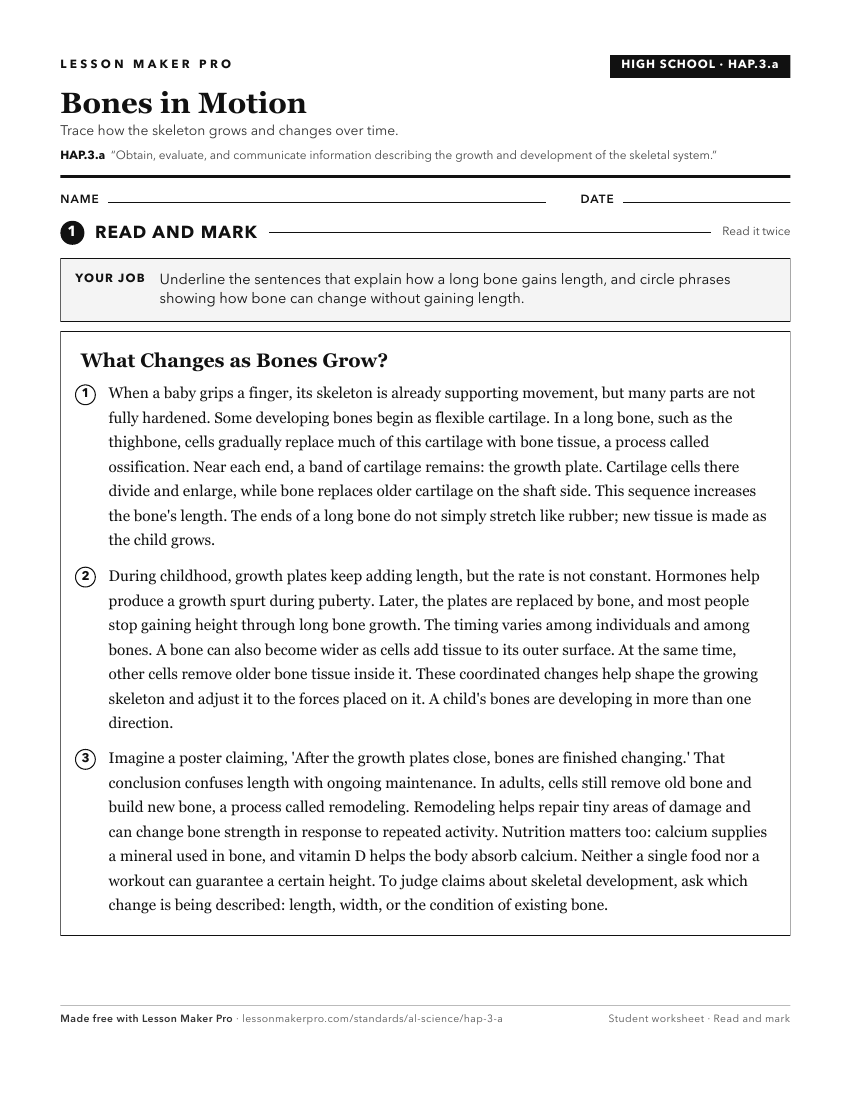
A ready-to-print activity worksheet aligned to HAP.3.a, with an answer key for the teacher on its own page. No account needed.
PDF, US Letter, prints cleanly in black and white.
Download the worksheetKeep exploring
Related Standards
- HAP.6.b
Obtain, evaluate, and communicate information describing the role of endocrine axes involving the thyroid and gonads in controlling growth, development, metabol...
- HAP.3
Develop and use a model to illustrate how the structures of the skeletal system contribute to its function.
- 7.4
Obtain, evaluate, and communicate information explaining how cells, tissues, and organs of various systems of the human body work together for specific function...
- HAP.2
Obtain, evaluate, and communicate information to describe how the structures of the integumentary system and its accessory organs contribute to its function.
Turn this exact standard into a lesson
Grade, subject, topic, and the complete standard are prefilled. Create one free, no account needed.
Also for this standard:Make a WorksheetMake a QuizMake a Sub Lesson