Alabama Science HAP.4
Standard Cluster
Develop and build a three-dimensional model to illustrate the structures of the muscular system, including muscle locations, origins, and insertions, and explain their roles in movement and support. a. Model the cellular physiology of skeletal muscle, including how the cell functions in muscle contraction and relaxation. b. Obtain, evaluate, and communicate information to explain muscle fatigue and tone in terms of muscle cell physiology.
2023 Alabama Course of Study: Science · From Molecules to Organisms: Structures and Processes
Cluster contents
Standards in This Cluster
HAP.4 is a cluster heading. These are the individual standards under it.
Teacher's field guide
What This Cluster Means
What Students Need to Do
- Students build a three-dimensional model that shows where arm muscles attach and how they move and support a joint. They model what happens inside a muscle cell during contraction and relaxation. They compare explanations of fatigue and muscle tone, then explain both using cell processes.
What Mastery Looks Like
- A student can place the biceps and triceps on an arm model, mark their bone attachments, and show which muscle bends or straightens the elbow. They can show calcium starting the pull between actin and myosin, and ATP helping the muscle pull and relax. They can explain fatigue as a drop in force during repeated work and tone as low-level muscle activity at rest.
Common Misconceptions
- Students may swap the origin and insertion or think muscles push bones instead of pulling them. Some think a muscle relaxes when ATP runs out, though ATP is needed for relaxation too. Others mistake tone for a full contraction or blame all fatigue on a lack of oxygen.
How to Assess It
- Give students an arm sketch. Ask them to mark the biceps origin and insertion, then write one phrase each explaining elbow flexion, relaxation, fatigue, and tone.
Lesson moves
Ways to Teach It
Build a three-dimensional arm from cardboard tubes and yarn; anchor biceps at the scapula and radius, then pull the yarn to bend the elbow.
Ask: Why does an arm stay slightly firm at rest but weaken after repeated curls? Explain tone and fatigue using muscle cells.
Give pairs calcium, ATP, actin, and myosin cards; have them sequence contraction and relaxation, then explain each card's job.
Lift a light tote of books, then trace how biceps pull on the radius; discuss why repeated lifts eventually weaken.
Free download
Printable HAP.4 Worksheet
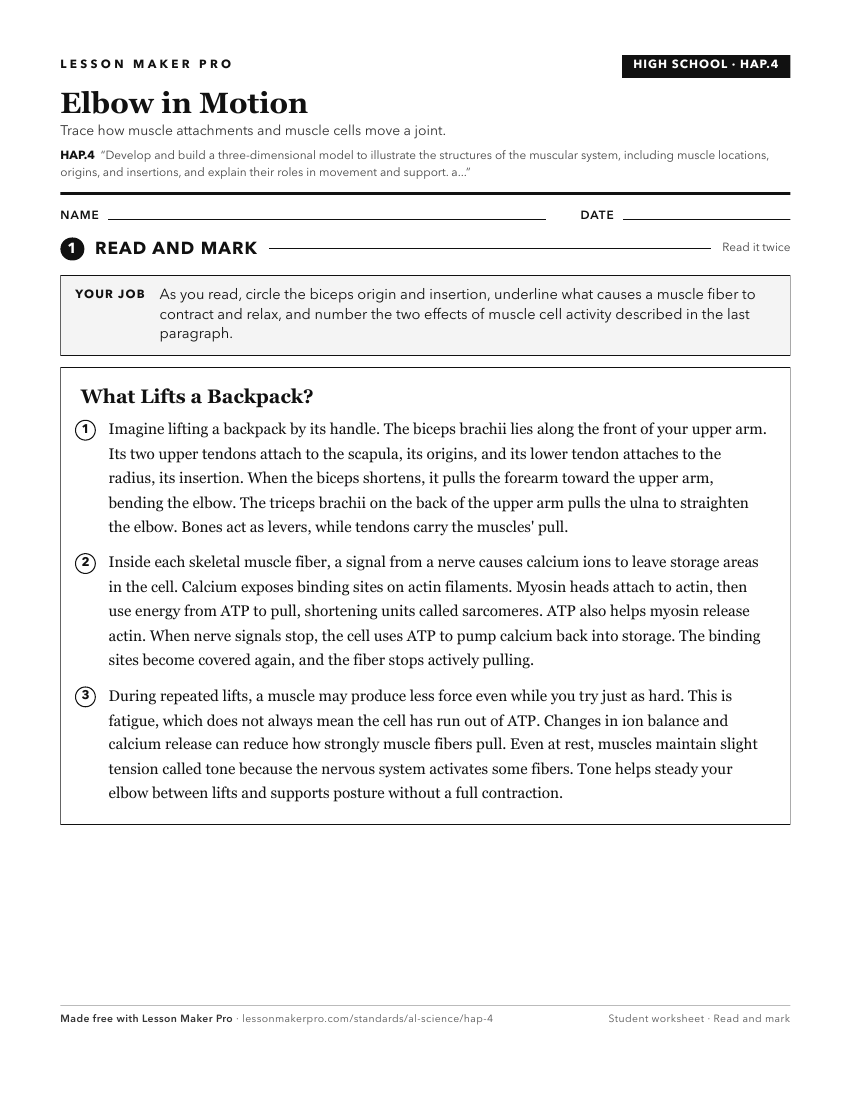
A ready-to-print activity worksheet aligned to HAP.4, with an answer key for the teacher on its own page. No account needed.
PDF, US Letter, prints cleanly in black and white.
Download the worksheetKeep exploring
Related Standards
- HAP.3
Develop and use a model to illustrate how the structures of the skeletal system contribute to its function.
- 7.1
Develop and use a model to explain the functions of specific cell structures necessary for maintaining a stable environment, including the cell membrane, cell w...
- HAP.3.b
Construct an explanation of the relationships between the skeletal system and other organ systems, including the body’s mechanisms for maintaining homeostasis.
Turn this cluster into a lesson
Grade, subject, topic, and the complete cluster are prefilled. Create one free, no account needed.
Also for this cluster:Make a WorksheetMake a QuizMake a Sub Lesson