Alabama Science HAP.4.b
The Standard
- HAP.4
- Develop and build a three-dimensional model to illustrate the structures of the muscular system, including muscle locations, origins, and insertions, and explain their roles in movement and support.
Obtain, evaluate, and communicate information to explain muscle fatigue and tone in terms of muscle cell physiology.
2023 Alabama Course of Study: Science · From Molecules to Organisms: Structures and Processes
Teacher's field guide
What This Standard Means
What Students Need to Do
- Students use a muscle cell diagram and check sources to explain why repeated contractions can produce less force. They also explain why muscles keep slight tension at rest.
What Mastery Looks Like
- A student explains how nerve signals and calcium trigger contraction, and how changes in calcium handling or energy supply can lower force during repeated work. They describe tone as low-level, nerve-driven contraction.
Common Misconceptions
- Students may blame fatigue entirely on lactic acid or think a tired muscle has used up all its ATP. They may confuse muscle tone with muscle size or assume resting muscles receive no nerve signals.
How to Assess It
- Exit ticket: Compare these claims: 'A tired muscle has no ATP left' and 'Repeated contractions can change how muscle cells handle calcium.' Which better explains a weakening grip? Explain what maintains muscle tone at rest.
Lesson moves
Ways to Teach It
Have students squeeze a clothespin for three 30-second rounds, count full squeezes, and mark where calcium and ATP act on a muscle cell diagram.
Ask, 'Why does your arm keep some tension after you set down a book?' Have students answer using motor neurons and calcium.
Run a claim sort with cards labeled 'ATP disappears,' 'calcium handling changes,' and 'tone needs nerve input'; students justify placements using a textbook diagram.
Show a sports drink ad claiming it prevents muscle fatigue; students check the claim against a physiology text and name what the ad leaves out.
Free download
Printable HAP.4.b Worksheet
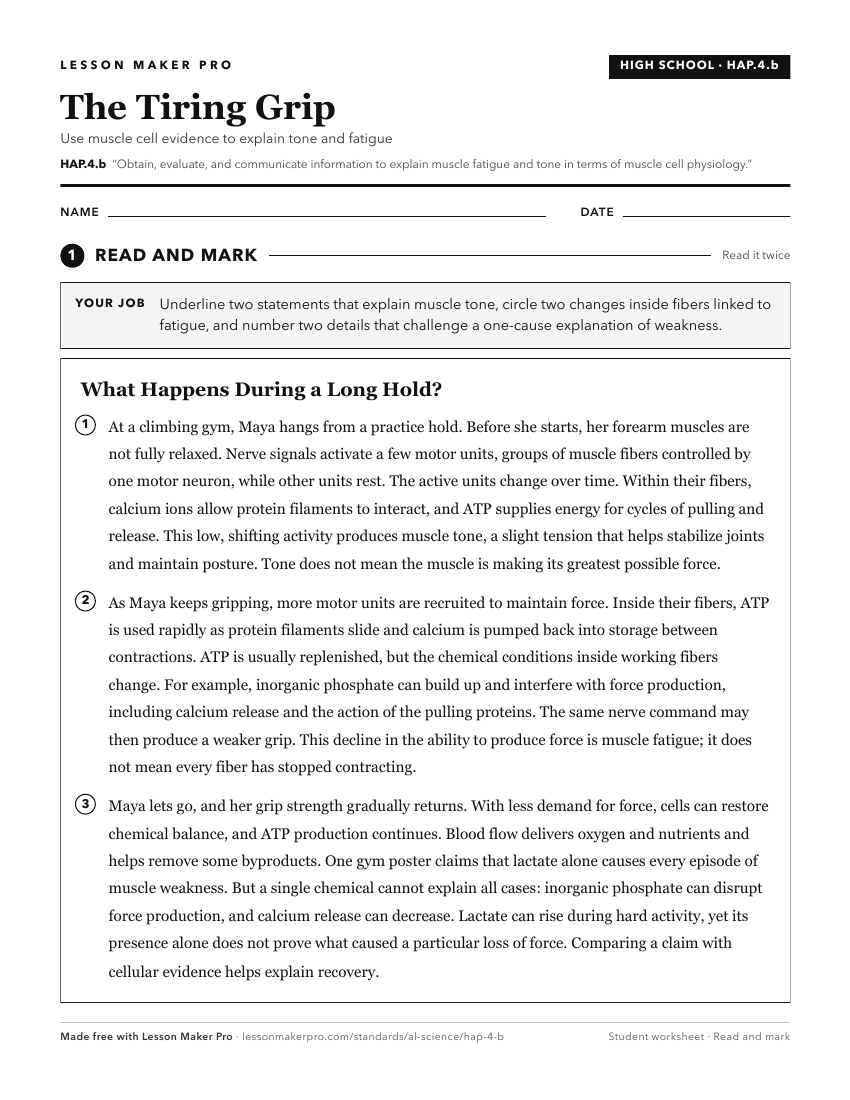
A ready-to-print activity worksheet aligned to HAP.4.b, with an answer key for the teacher on its own page. No account needed.
PDF, US Letter, prints cleanly in black and white.
Download the worksheetKeep exploring
Related Standards
- HAP.4.a
Model the cellular physiology of skeletal muscle, including how the cell functions in muscle contraction and relaxation.
- HAP.1
Obtain, evaluate, and communicate information to explain how differences in cellular structure (mitochondria, cytoskeletal structure, endoplasmic reticulum, cel...
- 7.4
Obtain, evaluate, and communicate information explaining how cells, tissues, and organs of various systems of the human body work together for specific function...
- HAP.5
Obtain, evaluate, and communicate information explaining the relationship between the structures and functions of the central nervous system and the peripheral ...
Turn this exact standard into a lesson
Grade, subject, topic, and the complete standard are prefilled. Create one free, no account needed.
Also for this standard:Make a WorksheetMake a QuizMake a Sub Lesson